Argonauta argo
Rare but unforgettable: spot the Common Paper Nautilus across the Pacific Coast US, South Africa, and the Philippines in waters from 14-29 °C.
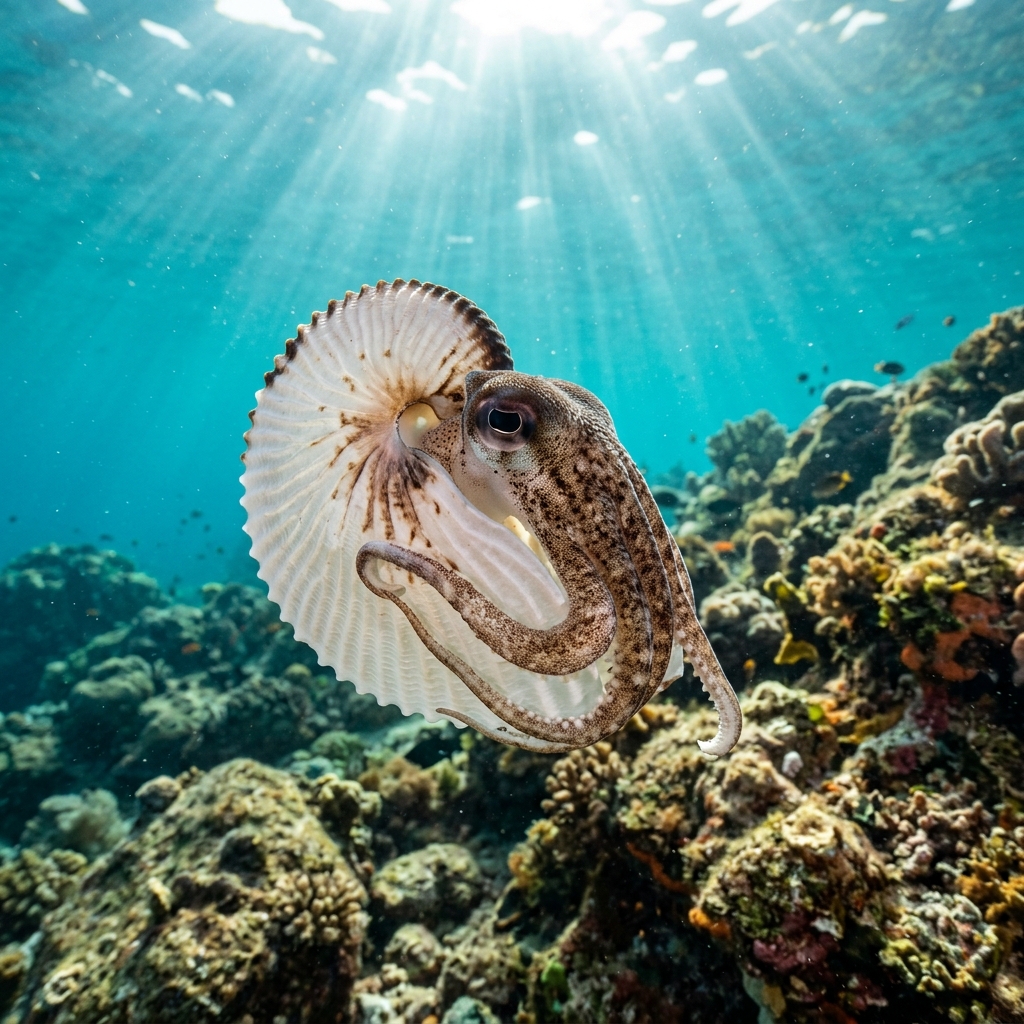
Look for a thin, white, ribbed shell, almost like crumpled paper, roughly the size of a large grapefruit, drifting near the surface or in open water rather than on the reef. The female produces and occupies this shell (technically an egg case, not a true shell), curling her two broad, flattened arms around it. The rest of the animal peeks out from the opening as a small, soft-bodied octopus with typical eight arms. Males are dramatically smaller, shell-less, and rarely encountered by divers.
Encounters typically happen in open water or at the surface rather than on the reef, the female drifts with currents, cradling her papery egg case. She tends to be slow-moving and largely unbothered by divers, though she may retract her arms into the shell if approached too quickly. Night dives and drift dives in blue water give the best odds of an accidental, magical crossing.
The 'shell' is not a true molluscan shell at all, the female secretes it herself using two specialised arms, purely to brood her eggs. Once the eggs hatch, she may abandon it. Males, which are about one-tenth her size, use a detached, modified arm called a hectocotylus to deliver sperm, and early naturalists mistook that arm for a parasitic worm.
There is not enough monthly sighting data to point to a clear season, so treat it as year-round wherever the species occurs. It tolerates a wide temperature band from around 14 °C to over 29 °C, which spans both temperate and tropical dive destinations.
Most sightings are logged along the Pacific Coast of the United States and in the Western Cape of South Africa, with a strong cluster of records also coming from Luzon and northern Philippines. The Azores and the Lisbon Coast of Portugal round out the confirmed range for divers.
Mapping where Common Paper Nautilus is logged…
Confirmed diver sightings come from the Pacific Coast of the United States, the Western Cape of South Africa, Luzon and northern Philippines, the Azores, and the Lisbon Coast of Portugal. Encounters tend to be opportunistic, open-water drifts and surface snorkels rather than planned reef dives.
No clear seasonal peak has emerged from logged sightings, so it can turn up year-round. The species tolerates water temperatures from roughly 14 °C to 29 °C, meaning it appears in both cold temperate and warm tropical waters whenever currents carry it through.
The white, ribbed, papery egg case is the giveaway, it looks like a delicate, lopsided spiral that has been moulded from thin paper. A small octopus-like animal peeks from the opening, often wrapping two broad flattened arms around the outside. Nothing else a diver is likely to encounter looks quite like it.
Females, which carry the egg case, can reach around 30 cm shell diameter in large specimens, though most encountered by divers are smaller. Males are dramatically smaller, often under 2 cm body length, and carry no shell at all.
No, despite the name, it is an octopus, not a true nautilus. It belongs to the family Argonautidae and is more closely related to common octopuses than to the shelled nautiluses of deep Indo-Pacific reefs. The 'shell' it carries is a self-secreted egg case, not a home grown from birth.
Site and sighting data is aggregated from diver logs, iNaturalist and GBIF. For taxonomy and conservation status:
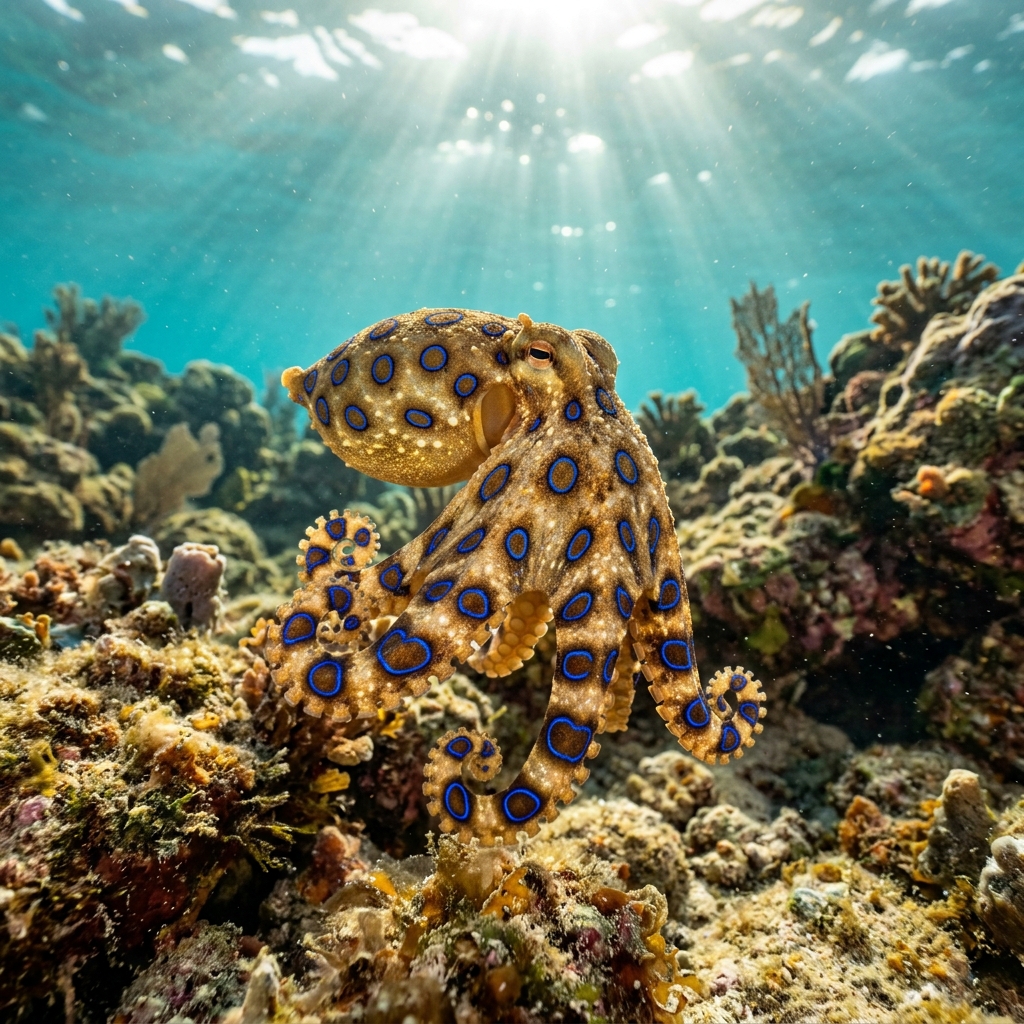
Blue-ringed Octopus
923 sites