Apolemia uvaria
String jelly drifts through cool Atlantic and Mediterranean waters. See where divers log it in Bohuslän, Corsica, and the Dodecanese.
Safety warning
This species can sting on contact with its tentacles, which may trail well beyond the body and can still sting after the animal is dead or washed up. Look but do not touch, and give it a wide berth.
If you're stung
Stinging tentaclesGeneral first-aid guidance, not a substitute for professional medical care. In an emergency, call your local emergency number.
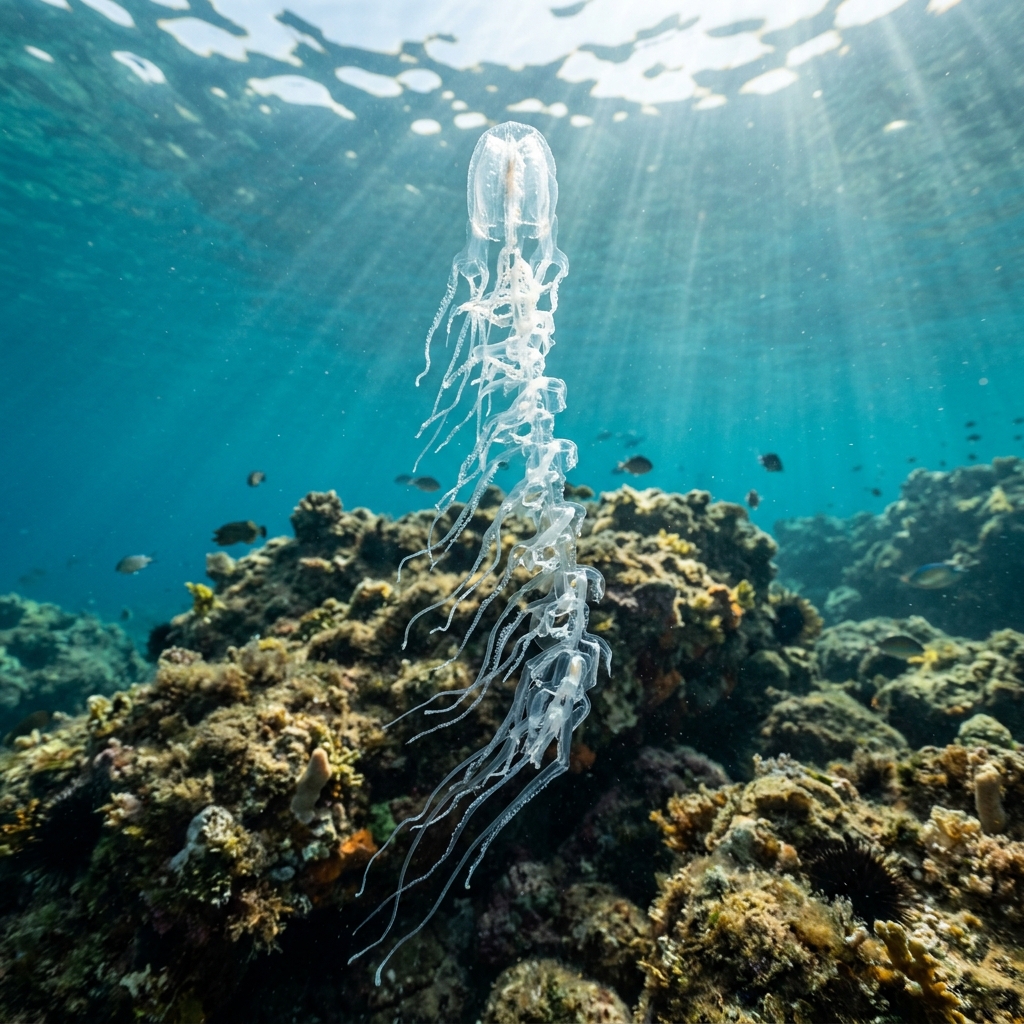
Long, rope-like chains of linked zooids (individual body units) give this siphonophore a distinctive appearance quite unlike a typical jellyfish, it looks more like a translucent, pinkish-white ribbon or string drifting through the water column. The colony can stretch to several metres, with dense clusters of feeding and defensive tentacles hanging below. That extreme elongated form is the key field mark; nothing else in European waters quite resembles it.
String jelly drifts passively in open water or close to the surface, carried by current rather than swimming under its own power. Divers typically encounter it mid-water, the colony hanging vertically or gently undulating as it moves. It shows no reaction to diver presence, simply continue your approach slowly to avoid breaking apart the fragile chain.
Despite looking like a single organism, a string jelly is actually a siphonophore: a colonial animal made up of thousands of genetically identical but functionally specialised individuals called zooids, each performing a different role such as swimming, feeding, or reproduction. The whole colony acts as one coordinated unit.
There is not yet enough monthly sighting data to pin down a peak season, so treat encounters as possible year-round wherever conditions suit. The observed temperature range of roughly 10 to 22 °C points to cool temperate and cool Mediterranean waters as its comfort zone.
Most sightings come from Sweden's Bohuslän coast, which accounts for the majority of logged encounters, making it the standout destination. France's Corsica and the Dodecanese islands of Greece are the next best options in warmer southern waters. A single record from Ireland's southwest coast suggests occasional Atlantic appearances worth watching for.
Mapping where String Jelly is logged…
Bohuslän on Sweden's west coast is where divers log it most often. Corsica in France and the Dodecanese islands in Greece are the next most reliable spots, with at least one sighting recorded off Ireland's southwest coast as well.
There is not enough seasonal data to name a peak month. Encounters have been logged across multiple regions without a clear pattern, so any dive in suitable cool temperate or Mediterranean waters could produce one. The species appears comfortable between roughly 10 and 22 °C.
Look for an extremely long, translucent ribbon or rope of linked units drifting in open water, often pinkish-white, with trailing tentacles. No true jellyfish has this continuous chain-like form, so if it looks like a living string or rope several metres long, it is almost certainly this species.
No. It is a siphonophore, a colonial organism made up of thousands of specialised individuals called zooids, all working together as one animal. It is more closely related to Portuguese man o' war than to a true jellyfish.
String jelly is not considered dangerous to divers. Avoid handling it as with any marine invertebrate, but there are no recorded risks to divers from this species.
The colony can reach several metres in total length, making it one of the longest organisms you might encounter in European waters. Because it is a colonial animal rather than a single body, its overall size depends on how many zooids have formed in that particular colony.
Site and sighting data is aggregated from diver logs, iNaturalist and GBIF. For taxonomy and conservation status:
Moon Jellyfish
1,766 sites