Anarrhichthys ocellatus
Spot wolf-eels along the Pacific Coast and British Columbia in cold 8-15 °C water. Here's where divers see them and how to recognise them underwater.
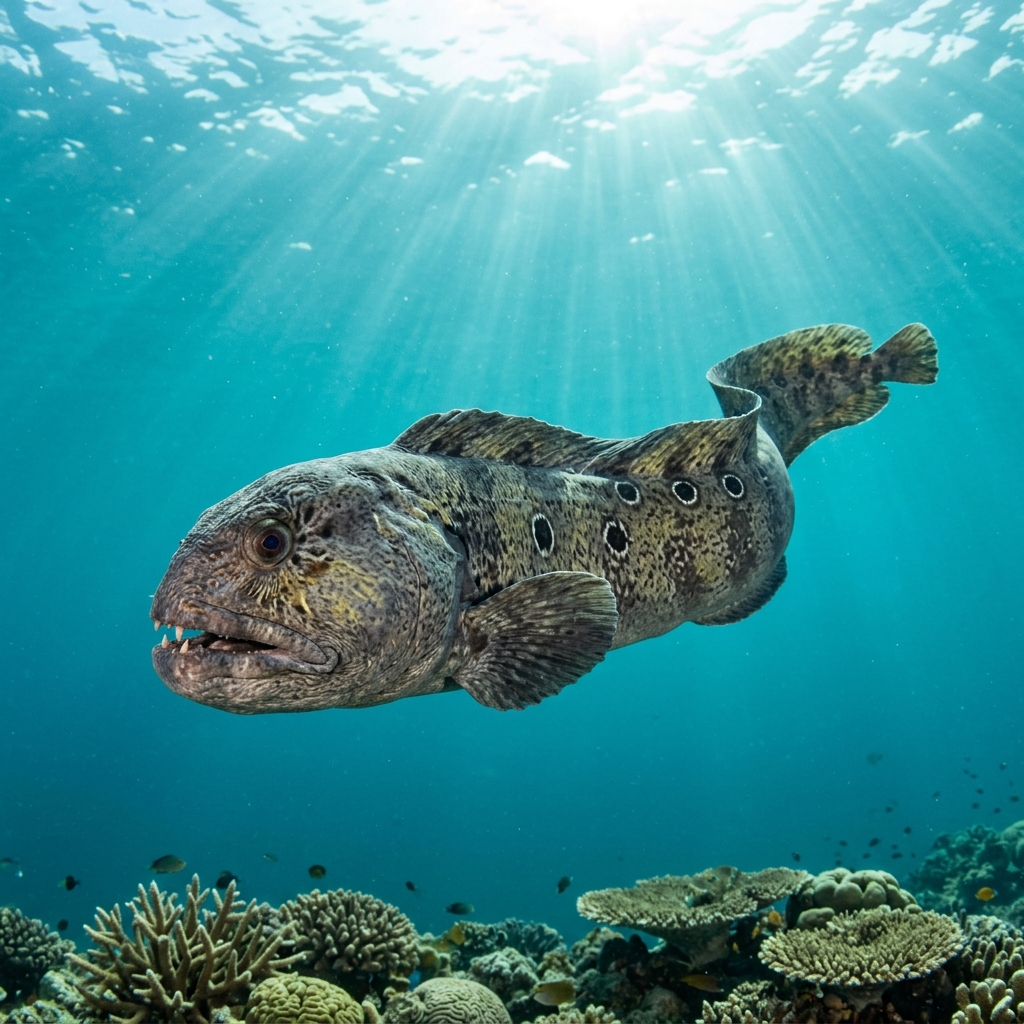
A long, sinuous body that looks more eel than fish, but wolf-eels are actually a type of blenny-relative, reaching lengths that dwarf most other reef residents. The head is the giveaway: bulbous and broad, with thick rubbery lips and prominent canine teeth visible even at rest. Body colouration is grey to brown with darker mottling and scattered pale spots, helping them blend into rocky crevices. Juveniles are far more vivid, showing bright orange with white-ringed dark spots before fading to adult tones.
Wolf-eels spend most of their time wedged inside rocky dens or crevices, with just the head and shoulders visible, so you are more likely to find one than to watch one swim. They are notably tolerant of slow, calm divers and will often hold position and make direct eye contact rather than retreating. Pairs are frequently found sharing a single den, a behaviour linked to their long-term monogamous bond.
Wolf-eels mate for life and pairs share the same den for years, with both adults coiling around and guarding their egg mass until the eggs hatch.
There is no clear seasonal peak in the sighting data, so wolf-eels appear to be present year-round at their known sites. They occupy cold water in the 8-15 °C range, which is a permanent feature of northeastern Pacific diving rather than a seasonal window.
Wolf-eels are logged almost exclusively along the northeastern Pacific coast, split between the US Pacific Coast and British Columbia in Canada. Both regions produce reliable sightings, with some sites in British Columbia and the Pacific Northwest reporting very common encounters. If you're targeting this species, cold rocky reefs in these two areas are your best bet.
Mapping where Wolf-eel is logged…
Wolf-eels are a northeastern Pacific species. Divers log them along the US Pacific Coast and the British Columbia coast in Canada. Both regions have sites where sightings are rated very common, particularly on rocky reefs with plenty of crevices and boulders.
Sighting data shows no strong seasonal pattern, so wolf-eels can be encountered year-round at their known sites. They live in cold water between roughly 8 and 15 °C, which is a stable condition on northeastern Pacific reefs in all seasons.
Look for a large, elongated grey-brown fish with a distinctively bulbous head, thick lips, and visible canine-like teeth, resting inside a rocky den. Adults are mottled grey or brown with faint pale spots. If you see a vividly orange animal with dark white-edged spots in the same habitat, that is a juvenile wolf-eel.
Wolf-eels are one of the largest members of their family, capable of reaching around 2.4 metres in length. Even at typical encountered sizes they are an imposing presence in a crevice, with a head width and set of teeth that make a strong first impression.
Wolf-eels are not considered dangerous to divers. They have powerful jaws designed for crushing hard-shelled prey like sea urchins and crabs, but unprovoked biting is extremely uncommon. They are generally calm around divers and can become habituated to regular human presence at popular dive sites.
Yes. Wolf-eels form long-term monogamous pairs that share the same rocky den for many years. Both parents guard the egg mass together, with the male and female coiling around the clutch to protect it until hatching. This parental bond is one of the most well-documented behaviours divers observe when finding a pair in their den.
Site and sighting data is aggregated from diver logs, iNaturalist and GBIF. For taxonomy and conservation status:
Soldierfish
3,612 sites