Pandalus montagui
Uncommon but findable in Northern Ireland and Scotland, this cold-water shrimp turns up in chilly 3-12C water on rocky reefs year-round.
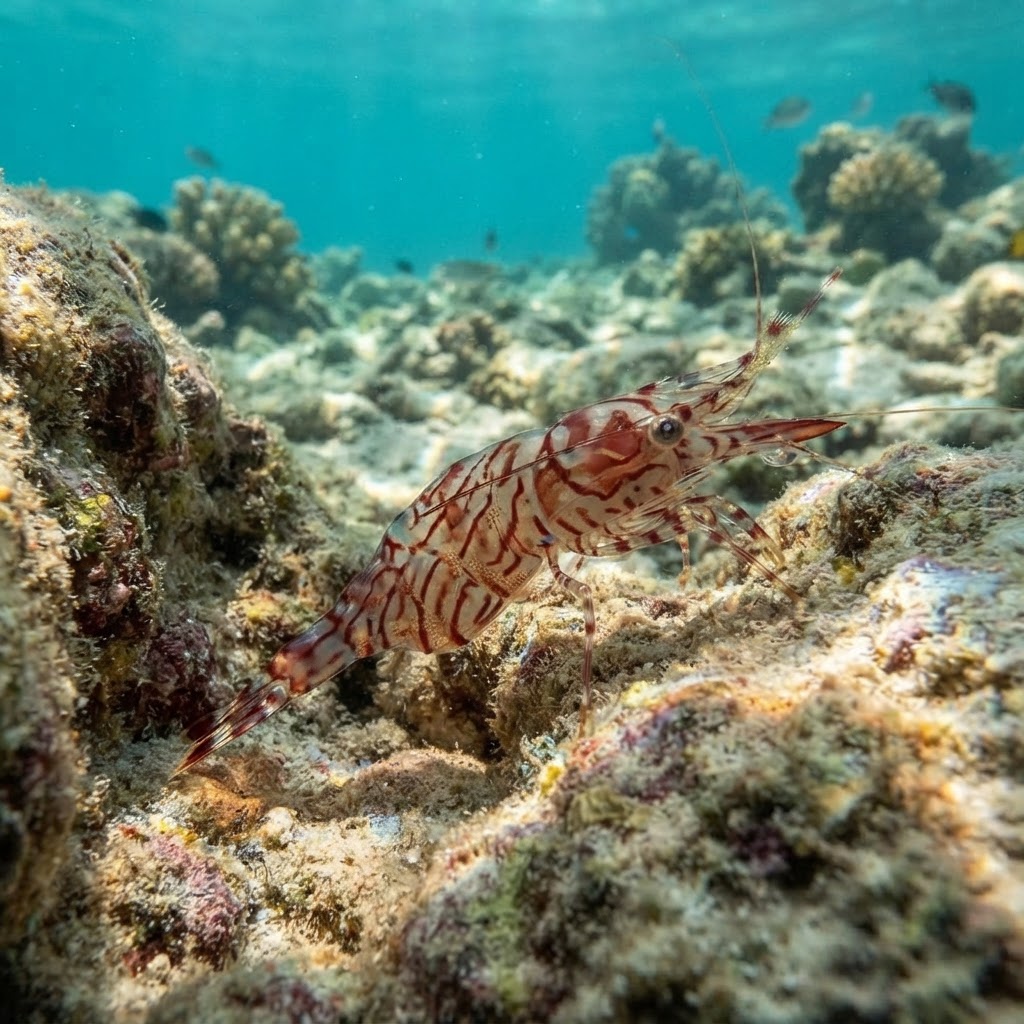
A slender, almost see-through shrimp with a reddish-orange to pinkish tint and faint mottled speckling along the body, growing to around 11 cm. Long, thin antennae reach well past the body length, which is often the first thing a diver notices in torchlight. The body has a smooth, slightly humped profile typical of pandalid shrimps, without the bold banding some reef shrimps show.
Look for it tucked against rocky ledges, kelp holdfasts, or crevices rather than out in the open water column, often sitting still with just those long antennae probing the current. It tends to hold its ground rather than dart off when a torch beam passes over it, making it a patient subject for a closer look. Most logs describe it as an uncommon to rare find, so spotting one usually means slowing down and scanning shaded nooks rather than expecting it on every dive.
Pandalid shrimps like this one are protandric hermaphrodites, meaning individuals typically function as males early in life before switching to female as they mature, a detail worth knowing if you're trying to size up what you're looking at.
Sightings don't cluster into a clear season, so treat this as a year-round find wherever the water sits in its comfort range of roughly 3 to 12C. In the cold, temperate waters where it lives, that range holds for most of the year, which likely explains the lack of a strong seasonal pattern in the data.
This is a cold-water species most reliably logged around the United Kingdom, with a strong concentration of sightings in Northern Ireland and Scotland. Divers in Canada, particularly Quebec, also report it fairly often, and there is at least one confirmed sighting off Nordland in Norway.
Mapping where Aesop Shrimp is logged…
The most consistent sightings come from Northern Ireland and Scotland in the UK, with additional records from Quebec in Canada and a single logged sighting off Nordland in Norway.
There's no strong seasonal pattern in the sightings, so it's considered a year-round find in the cold waters it favours, roughly 3 to 12C.
Look for a translucent reddish-orange shrimp around 11 cm long with notably long antennae, usually sitting tucked into rocky crevices or kelp rather than swimming in open water.
They typically reach around 11 cm in length, making them a mid-sized shrimp compared to many reef species.
No, they pose no danger to divers and are simply small, retiring crustaceans best observed with a slow approach and a steady torch.
Like many pandalid shrimps, individuals often start life functioning as males and later transition to female as they grow, a trait called protandric hermaphroditism.
Site and sighting data is aggregated from diver logs, iNaturalist and GBIF. For taxonomy and conservation status:
Sally Lightfoot Crab
2,422 sites