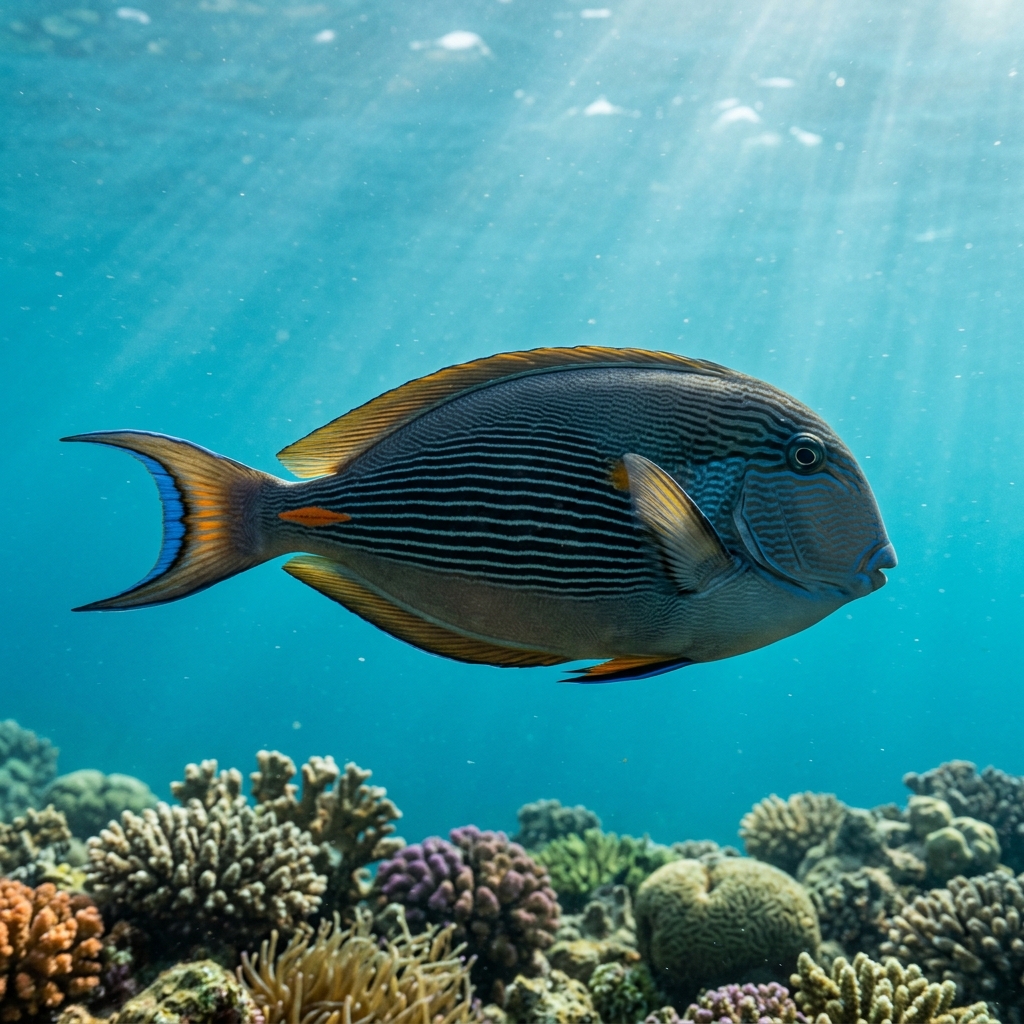
Acanthurus sohal
Bold blue, black and white stripes make this Red Sea endemic unmistakable. Most reliably seen around Sharm el Sheikh and Marsa Alam, Aug through Mar.
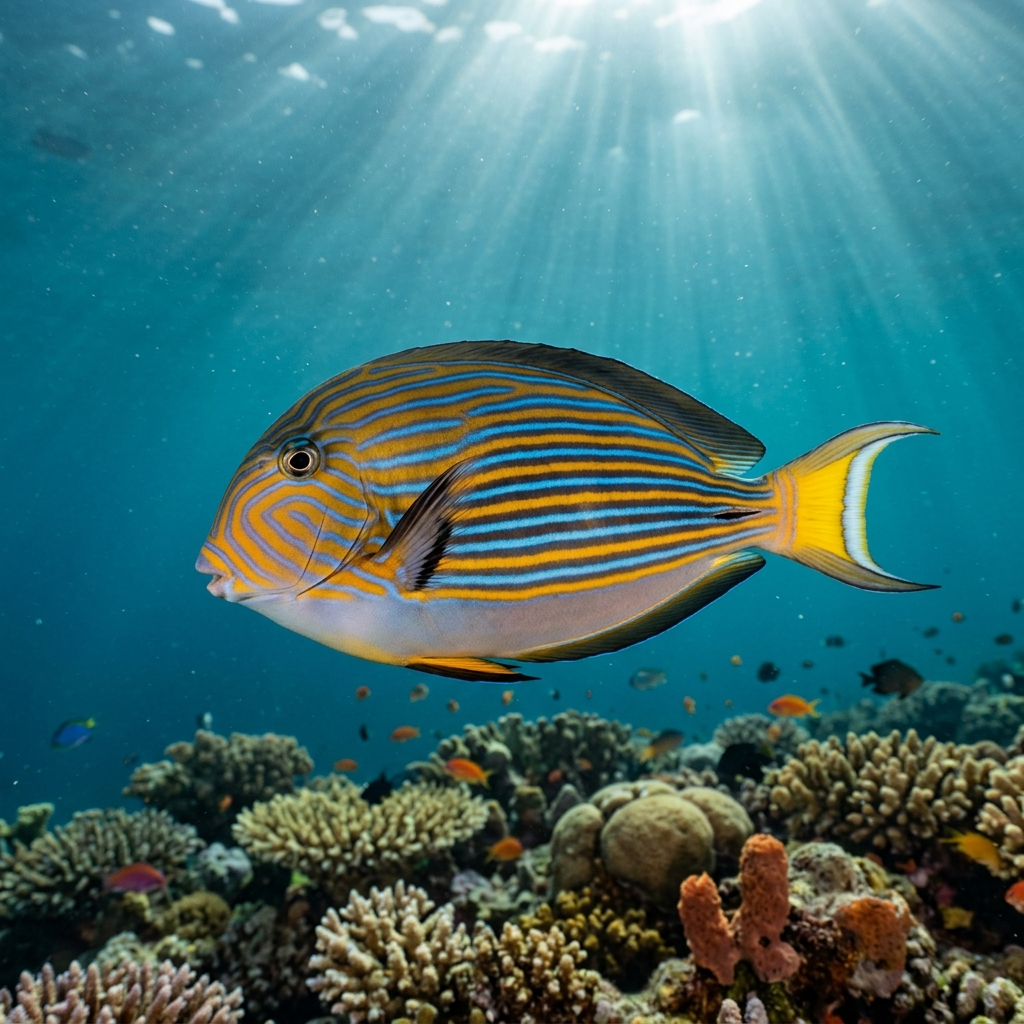
Few Red Sea fish are this eye-catching: a bold pattern of alternating blue, black and white horizontal stripes running the full length of the body, capped by a bright orange spine (the scalpel-like caudal spine that gives surgeonfish their name) at the base of the tail. The body is deep and disc-shaped, typical of surgeonfish, with a pointed snout and lyre-shaped tail. Juveniles share the same vivid striped pattern as adults, making them straightforward to identify at any size. Nothing else on a Red Sea reef combines those colours and that body shape.
Typically seen patrolling a defined patch of reef in shallow water, grazing on algae growing over rock and coral surfaces. It is a highly territorial fish and will actively chase other herbivores off its feeding patch, a display that is easy to watch without approaching too closely. Most divers encounter it alone or in pairs rather than in schools; it holds its ground and rarely flees from a diver who moves calmly.
The bright orange caudal spine is not just for show: surgeonfish can slash sideways with it when threatened, though they reserve this for fish-versus-fish disputes rather than interactions with divers.
Sightings concentrate from August through March across the sites where seasonality data exists. Water temperatures in its observed range sit between about 23 and 29 °C, so conditions stay comfortable for the species through the cooler winter months when visibility in the Red Sea is often at its best.
This is an endemic species, meaning it lives only in the Red Sea and adjacent waters, so every sighting comes from a narrow geographic range. Egypt dominates the records, with Sharm el Sheikh and Marsa Alam the two strongest areas, followed by Safaga and Hurghada. Oman's Muscat coast is the next most reliable option outside Egypt, with additional records from Saudi Arabia, Jordan's Aqaba, Israel's Eilat, and the UAE.
Mapping where Red Sea Surgeonfish is logged…
As a Red Sea endemic, it is found nowhere else in the world. The strongest concentration of dive-site records is in Egypt, particularly around Sharm el Sheikh and Marsa Alam, with Safaga and Hurghada also reliable. Outside Egypt, Muscat in Oman, Aqaba in Jordan, Eilat in Israel, and Jeddah in Saudi Arabia all have confirmed sightings.
Sighting records cluster between August and March. Winter months in the Red Sea often bring calmer seas and good visibility, and the species appears comfortable at water temperatures from around 23 °C upward, so the cooler half of the year is a solid bet.
Look for the striking pattern of horizontal blue, black and white stripes covering the entire body, combined with a vivid orange spine at the base of the tail. That combination of stripe colours and the orange caudal spine (the scalpel-like blade all surgeonfish carry) is unique in the Red Sea and makes it one of the easiest local reef fish to name on sight.
It is an endemic species, meaning it evolved in isolation within the Red Sea and Gulf of Aden and does not naturally occur in the broader Indian or Pacific Oceans. The Red Sea's semi-enclosed geography and distinct temperature and salinity conditions have produced a number of such endemics, and the sohal is one of the most recognisable among them.
It poses no real danger to divers. Like all surgeonfish it carries a sharp caudal spine, but this is used in territorial disputes with other fish rather than against people. Divers who approach calmly should have no problems; the fish is more likely to hold its patch and eye you with mild irritation than to flee or lunge.
Site and sighting data is aggregated from diver logs, iNaturalist and GBIF. For taxonomy and conservation status:
Striped Surgeonfish
3,289 sites