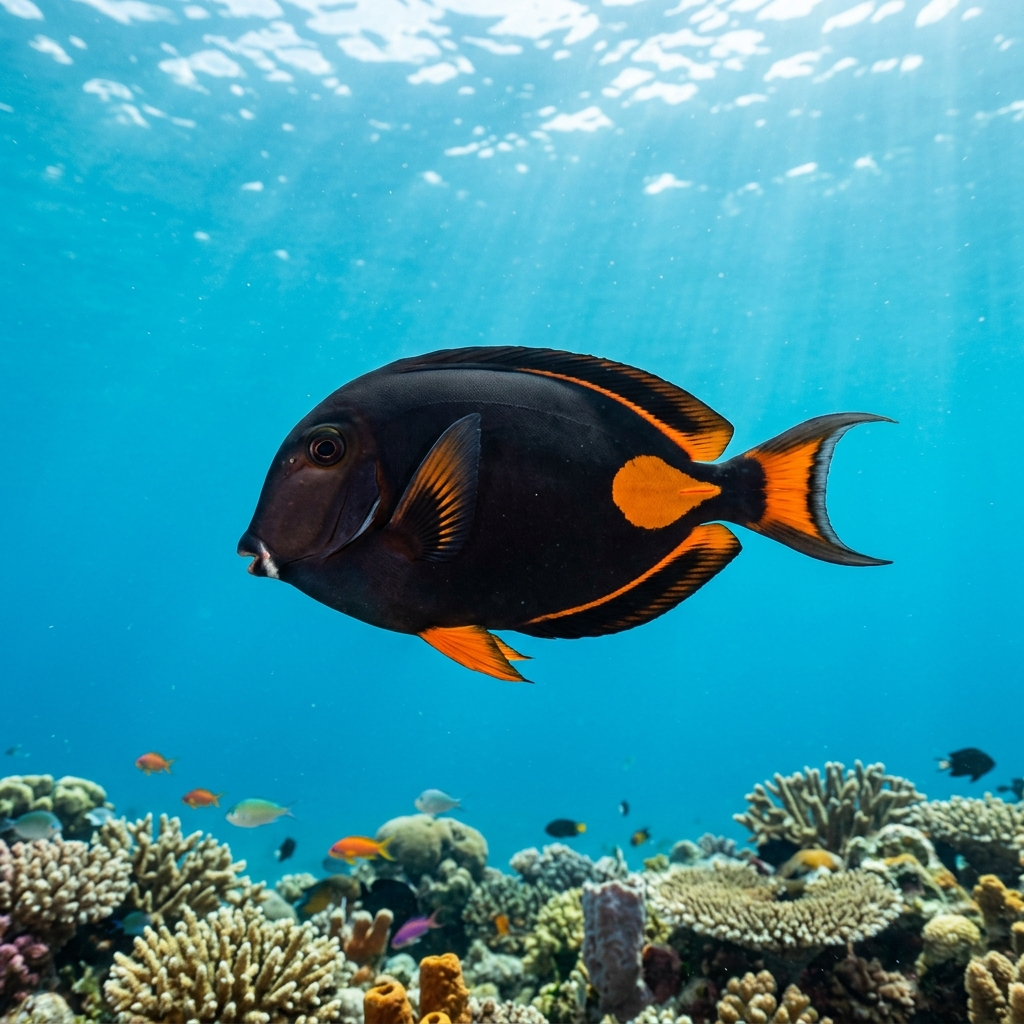
Acanthurus achilles
Spot the Achilles Tang in Hawaii or French Polynesia, look for that vivid orange teardrop patch on a jet-black body in warm Pacific reefs.
A deep black body with a vivid orange teardrop-shaped patch on either side of the tail base makes this surgeonfish unmistakable underwater. The orange patch surrounds a sharp retractable spine (the 'scalpel' all surgeonfishes carry) and connects to an orange bar that runs through the tail fin. White outlines trace the dorsal, anal, and pectoral fins, creating a crisp contrast against the dark body. Juveniles are largely black with a small orange spot that grows as the fish matures.
You will most often find Achilles Tangs patrolling exposed, surge-swept reef crests and outer slopes, where they graze algae from hard substrate. They tend to be wary, darting into reef crevices when approached too quickly, so slow movements and patience pay off. Sightings are typically of single individuals or small loose groups rather than dense schools.
The orange patch at the tail base is not just a colour marking, it flags the razor-sharp scalpel spine that all surgeonfishes can flick outward as a defence. Rivals and predators (and careless hands) get the message quickly.
In Hawaii and other Northern Hemisphere sites, sightings concentrate between June and September. Observed water temperatures run from about 24 to 27 °C, so aim for the warmer mid-year months at these sites.
The overwhelming majority of diver sightings come from Hawaii, which accounts for the lion's share of logged sites and is by far the most reliable place to look for this species. French Polynesia, particularly the atolls around Rangiroa and Tikehau, is the other strong region, with a cluster of records from Fakarava as well. Outside those two areas, confirmed sightings are very sparse.
Mapping where Achilles Tang is logged…
Hawaii is by far the most reliable destination, with sightings logged across a wide spread of sites. French Polynesia, especially Rangiroa, Tikehau, and Fakarava, is the next best option. Outside the central Pacific, confirmed encounters are very rare.
At Hawaiian sites, sightings cluster in June through September when water temperatures sit comfortably in the 24 to 27 °C range. Plan your dive trip for mid-year to give yourself the best chance.
Look for a jet-black surgeonfish with a bright orange teardrop patch on each side of the tail base and crisp white edging on the dorsal and anal fins. No other Hawaiian surgeonfish combines that black body with such a bold orange tail marking.
At most sites where it has been recorded, divers rate it as uncommon. It is logged as common at roughly a quarter of known sites, mainly on exposed outer reef crests in Hawaii. Rare sightings exist too, so an encounter is rewarding but not guaranteed even in the right habitat.
Site and sighting data is aggregated from diver logs, iNaturalist and GBIF. For taxonomy and conservation status:
Striped Surgeonfish
3,289 sites