Cadlina flavomaculata
Cream-white nudibranch with yellow spots, logged across California's cold reefs in 12-19C water year-round.
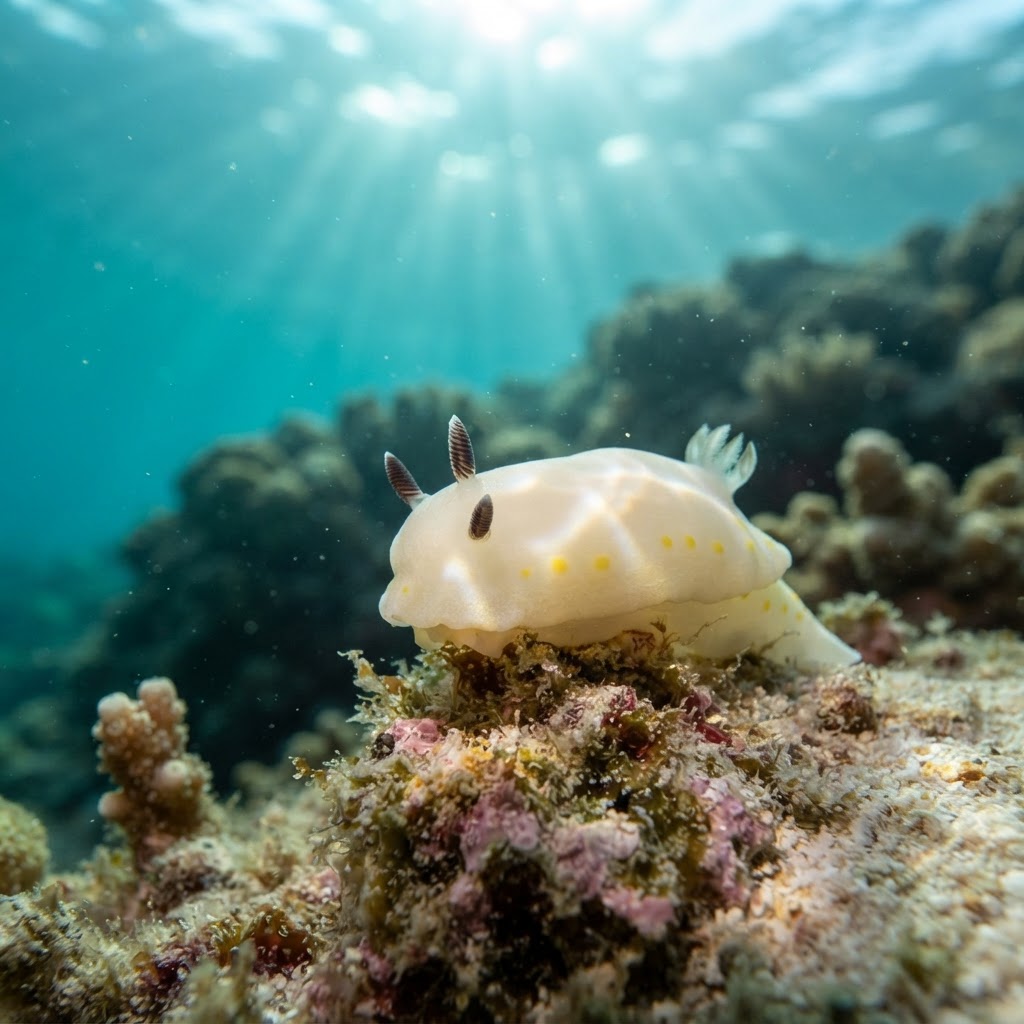
Small, oval-bodied nudibranch with a firm, ridged mantle in cream to pale white, scattered with distinct yellow spots that give it its name. Look for the two rhinophores (sensory tentacles) at the front and a rosette of gills at the rear, both retractable if the animal is disturbed. Most sightings are of animals just a few centimetres long, moving slowly across rock or rubble rather than swimming.
Divers find it moving slowly over rock, rubble and encrusting growth on the seafloor, grazing rather than reacting to divers in any obvious way. It's most often spotted at a careful, close-focus pace typical of nudibranch hunting, tucked into cracks or low over hard substrate rather than out in the open water column. Logged as uncommon at most sites, so it rewards divers who slow down and scan the bottom rather than cruise past.
Like other dorid nudibranchs, it likely feeds on sponges, using diet-derived chemicals for its own chemical defence rather than relying on speed or camouflage to avoid predators.
Sightings show no detected seasonal pattern, and with a water-temperature niche of 12.3 to 18.9C it's consistent with California's cool coastal water most of the year, so plan around general dive conditions rather than a specific month.
Almost every logged sighting comes from California, with sites concentrated along the state's coast making it the place to look for this species. If you're diving California's temperate reefs and kelp beds, this is one of the small benthic finds worth scanning rocky substrate for.
Mapping where Yellow-spotted Cadlina is logged…
Almost all logged sightings are from California, particularly along its rocky coastal dive sites. It's not commonly reported outside the US at this time.
There's no strong seasonal pattern in the sightings, and it's found in water from about 12 to 19C, so it's a year-round possibility on California dives rather than a seasonal target.
Look for a small cream-to-white nudibranch with scattered yellow spots across its mantle, moving slowly over rock or rubble. Its rhinophores and gill rosette are retractable, so a resting animal may look smoother than an actively grazing one.
Exact size data isn't available, but like most Cadlina species divers typically encounter individuals just a few centimetres long, best spotted by scanning rocky substrate closely.
No, it poses no threat to divers. It's a small, slow-moving grazer that relies on chemical defences against predators, not on any sting or bite that could affect people.
Site and sighting data is aggregated from diver logs, iNaturalist and GBIF. For taxonomy and conservation status:
Light-spotted Aegires
3,168 sites