
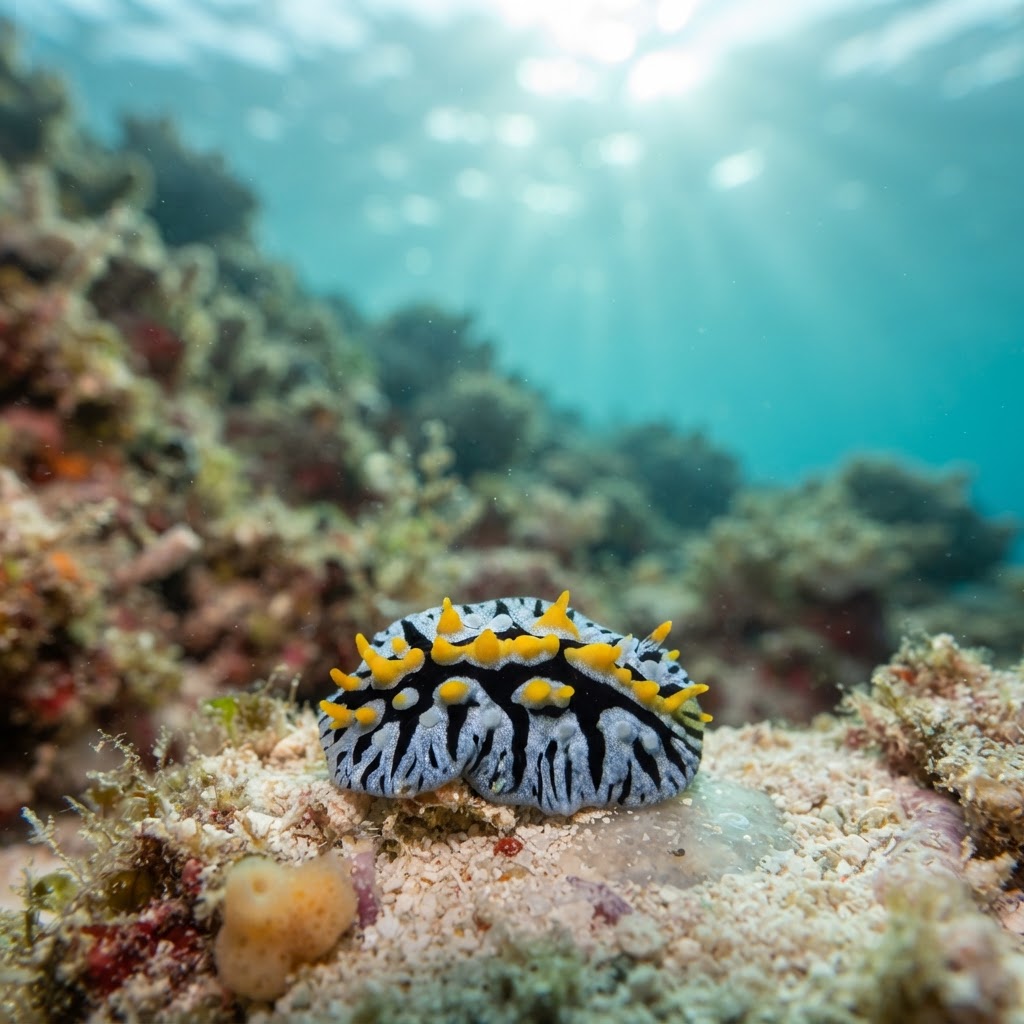
Phyllidia marindica
Look for this warty nudibranch on reefs in Reunion, Mauritius and Sumatra, in water between 24 and 30 C year-round.
Look for a firm, warty body covered in raised tubercles, each tipped in bright yellow against a pale grey or white background. The rhinophores (the small paired sensory horns on the head) are usually dark and stand out clearly against the lighter body. It moves slowly across hard substrate and rubble rather than swimming, and its texture reads as rough and bumpy rather than smooth like many other nudibranchs.
Divers most often find this slug crawling slowly over coral rubble, dead coral, or hard reef substrate, usually during the day when visibility for spotting small subjects is best. It shows no real reaction to divers beyond continuing its slow grazing pace, making it an easy macro subject once located. Most sightings log it as uncommon rather than abundant, so finding one usually takes a deliberate scan of the substrate rather than a passing glance.
Like other members of the Phyllidiidae family, its firm warty skin likely carries toxic secretions absorbed from the sponges it feeds on, a chemical defence that means it has no need to flee or hide from potential threats on the reef.
There is no clear seasonal pattern in the sightings data, and with a comfortable temperature range of roughly 24 to 30 C, it is present on tropical reefs across the year. Dive any month in its core range and keep an eye on rubble and hard bottom for a chance encounter.
This is a reliable find on reefs around Mauritius, particularly Grand Baie and Trou aux Biches, and on the reefs of Reunion around Saint-Paul. It also turns up with good regularity in Sumatra, Indonesia, and around Phuket in Thailand and Goa in India, with occasional sightings further west in Tanzania's Mafia Island and Kenya's Shimoni.
Mapping where Yellow-spined Wart Slug is logged…
It is most reliably logged in Mauritius around Grand Baie and Trou aux Biches, and in Reunion near Saint-Paul. Sumatra in Indonesia, Phuket in Thailand, and Goa in India are also strong spots for finding it.
There is no strong seasonal signal in the sightings, so it can be found year-round on reefs within its 24 to 30 C temperature range. Any month works in its core range countries.
Check for a rough, warty body in pale grey or white with tubercles tipped in yellow, and dark rhinophores on the head. It moves slowly over hard substrate and rubble rather than swimming through open water.
No, it poses no danger to divers. It has no means of harming a diver and simply continues grazing slowly over the reef if approached.
Its warty skin likely holds toxins picked up from the sponges it eats, a defence shared across the wart slug family that lets it move openly on the reef without needing to hide from predators.
Site and sighting data is aggregated from diver logs, iNaturalist and GBIF. For taxonomy and conservation status:
Light-spotted Aegires
3,168 sites





