
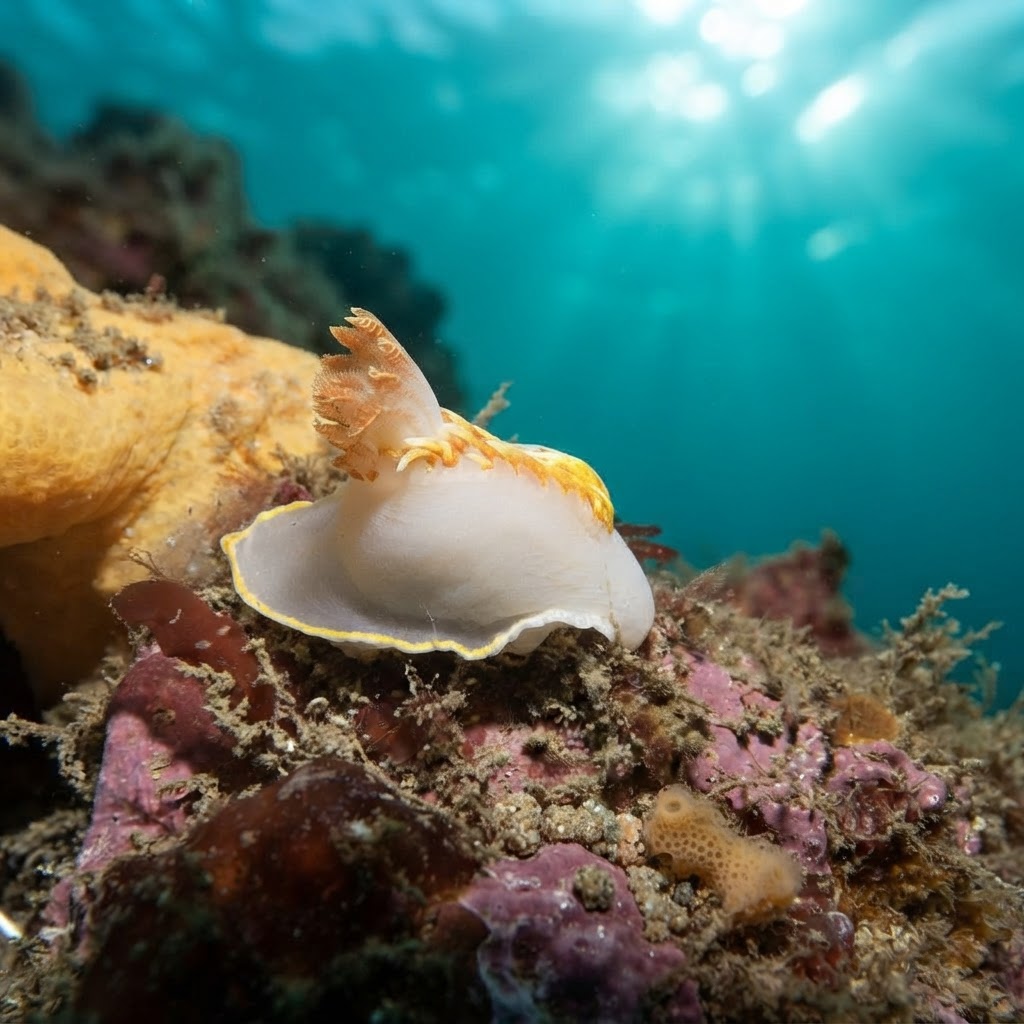
Okenia elegans
A cold-water nudibranch found off England and Wales in 9.9-15.9C water, logged year-round but always uncommon to rare.
A small, translucent-white nudibranch with a bright yellow fringe running along the edge of its mantle, like a trimmed skirt. The body is soft and low-profile, easy to miss against rock and rubble unless you are looking closely. There are no dramatic colour blotches or spots to key on, just that yellow border against the pale body.
Look for it tucked into rocky reef and rubble where it grazes slowly, doing little to react to a torch or a close approach. It is not a fast mover and does not hide aggressively, so patient, close-focus searching on the substrate is the best way to spot one. Most divers log it as an incidental find while scanning a site for other nudibranchs rather than as a target sighting.
Like other members of the Goniodorididae family, it likely feeds on encrusting bryozoans, using its diet to help explain why it turns up on the same rocky, colonised surfaces dive after dive.
There is not enough seasonal data to call a peak month, so treat it as a year-round possibility in UK waters. It has been observed across a cold-water range of roughly 9.9 to 15.9C, which covers most of the diveable season in England and Wales.
This one is a UK speciality: every logged sighting in the data comes from British waters, with England the strongest showing and a handful of sites in Wales. Divers most often report it in England generally rather than any single standout hotspot, so it is worth checking with local dive centres about recent finds before a trip.
Mapping where Yellow Skirt Slug is logged…
Sightings are concentrated in the United Kingdom, with England producing the most logged records and Wales adding a smaller number of sites. It has not been reported outside British waters in current diver data.
There is no clear seasonal pattern in the data, so it is best treated as a year-round find in UK waters within its observed 9.9 to 15.9C range.
Look for a small, pale, translucent nudibranch with a distinct yellow fringe running along the edge of its mantle. It lacks bold spots or patterns, so the yellow-edged skirt is the main feature to check.
No, this species poses no danger to divers. It is a small, slow-moving nudibranch with no sting or bite of concern.
It is logged as uncommon at most sites where it appears and rare at others, so it is a find worth photographing rather than something you can expect on every dive.
Site and sighting data is aggregated from diver logs, iNaturalist and GBIF. For taxonomy and conservation status:
Light-spotted Aegires
3,168 sites





