Berthella plumula
Uncommon in the cool waters off England and Northern Ireland, this pale sea slug turns up year-round between 8.5 and 14.5°C.
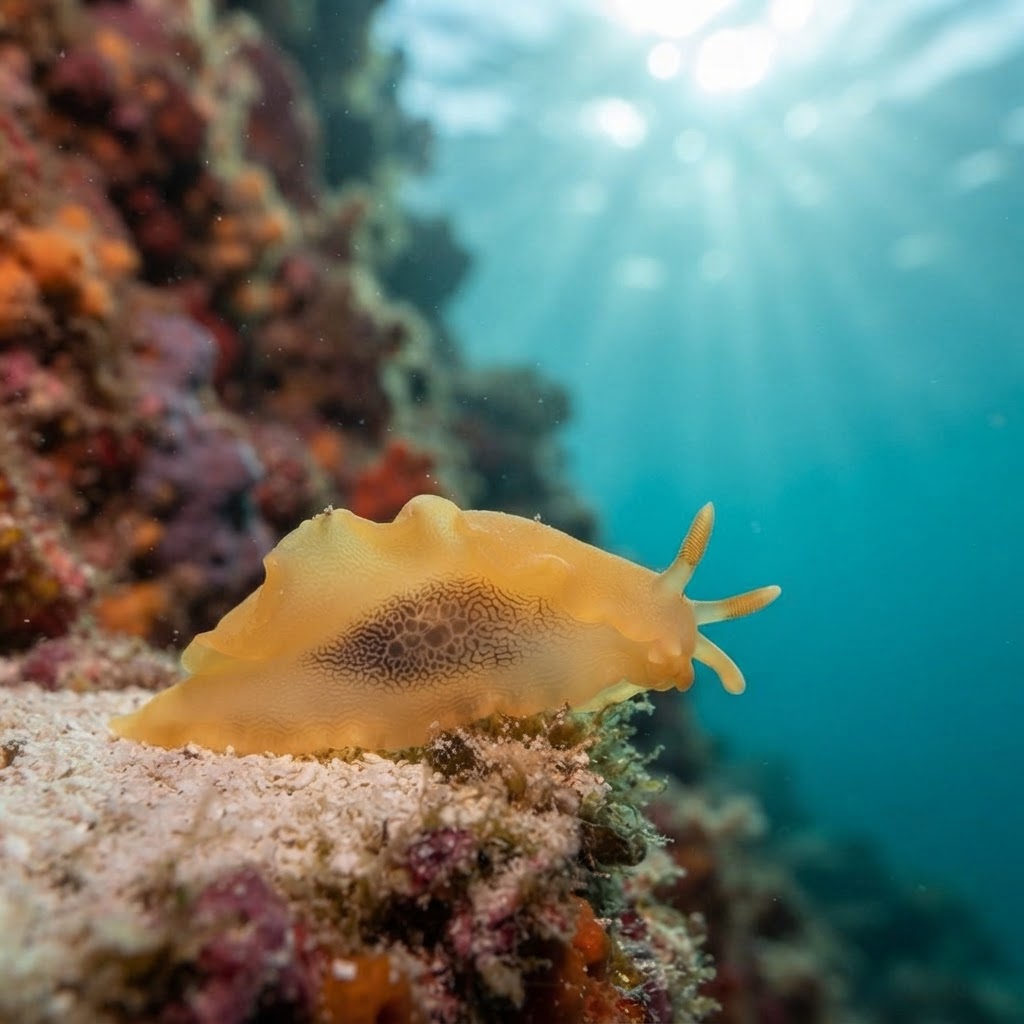
Look for a soft, oval, slug-like body with a wavy, ruffled mantle edge draped over the foot, coloured pale cream to yellowish and often translucent enough to hint at internal organs beneath the skin. It lacks the branching gills (cerata) of showier nudibranchs, instead breathing through a plume-like gill tucked under the right side of the mantle, which you will only see if it lifts the mantle edge. There are no obvious spots, stripes or bright accent colours, so it reads as a smooth, understated blob against rock or algae rather than something that jumps out visually.
Divers usually find this slug sitting still or grazing slowly on rock faces and among encrusting life, moving little and showing no reaction to a torch or a close look. It is a benthic, bottom-dwelling animal, so check ledges, boulders and low-current corners rather than open water, and expect an uncommon rather than a guaranteed find on any given dive.
Like other pleurobranchs, it feeds on sea squirts (ascidians) and other soft encrusting invertebrates, rasping them off the rock with a specialised feeding structure rather than grazing algae.
Sightings do not show a clear season, and the species holds to a narrow cool-water range of roughly 8.5 to 14.5°C, so it is realistically a year-round find on temperate reefs rather than a summer-only species.
This is a cold-water species best known from the United Kingdom, most logged across sites in England and Northern Ireland, with a smaller but reliable presence in Wales. Outside the UK it turns up along Brittany in France and Galicia in Spain, making the northeast Atlantic coastline its stronghold.
Mapping where Yellow-plumed Sea Slug is logged…
It is most reliably found around England and Northern Ireland, with further sightings in Wales, Brittany in France, and Galicia in Spain. These northeast Atlantic coastlines represent its known diving range.
There is no strong seasonal pattern in sightings, and it tolerates a cool 8.5 to 14.5°C range, so it can realistically be found on any dive throughout the year rather than during a specific season.
Look for a smooth, pale cream to yellowish soft-bodied slug with a ruffled mantle edge and no bright spots or branching gills on its back. It sits still on rock or encrusting growth, looking more like a subtle blob than a colourful nudibranch.
No, it poses no danger to divers. It has no stinging cells or venom and simply rests or grazes slowly on the reef, unaffected by a close approach.
It feeds on sea squirts and other soft encrusting invertebrates, scraping them from rock surfaces with a specialised rasping feeding organ rather than grazing on algae.
Site and sighting data is aggregated from diver logs, iNaturalist and GBIF. For taxonomy and conservation status:
Blue Dragon
3,163 sites