Lomanotus vermiformis
A 1cm slug that's easy to miss: found uncommonly on Visayas reefs in warm 24-30C water, year-round if you know where to look.
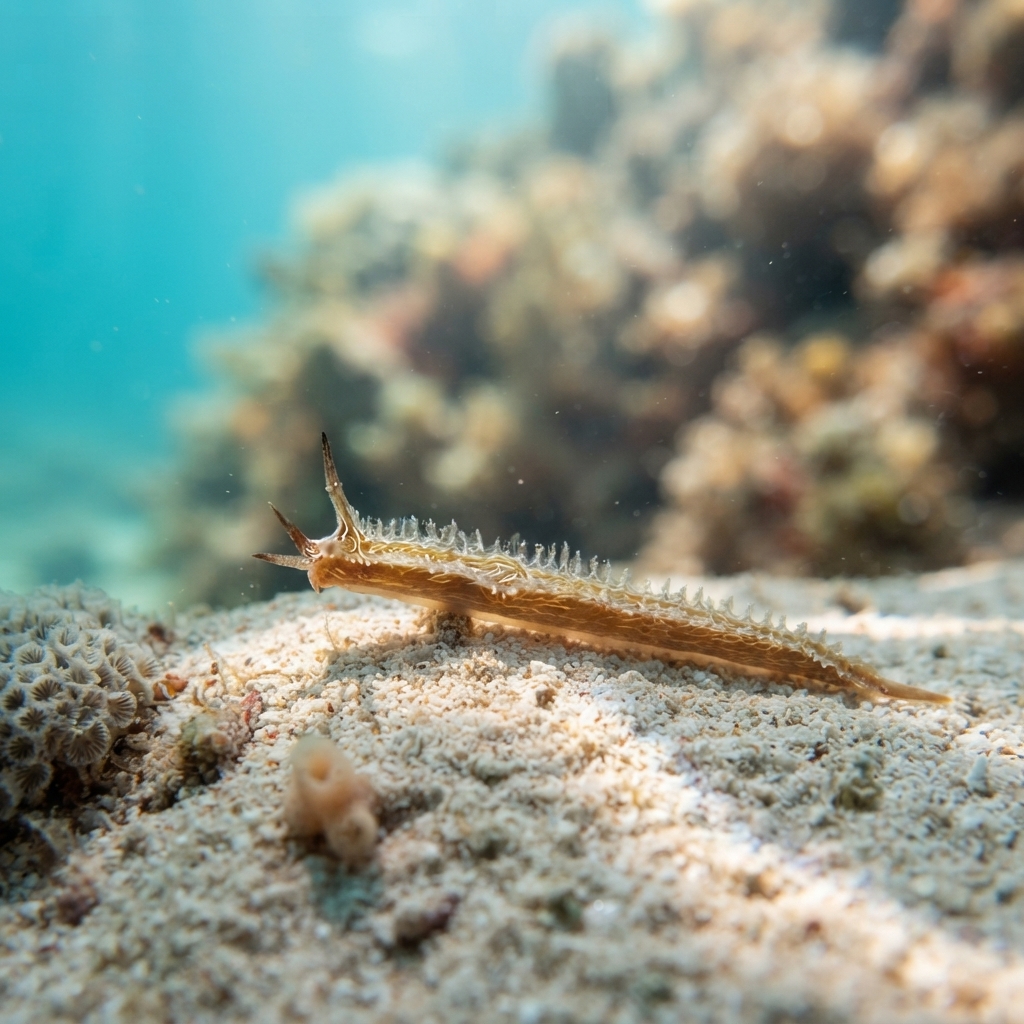
At about 1 centimetre long, this is a slug you find by looking closely rather than by spotting from a distance. The body is slender and elongated, almost worm-like (hence the name), with soft finger-like projections (cerata) running along the back that give it a slightly frilly, textured outline rather than a smooth slug shape. Colour tends toward translucent or muted tones that blend into the substrate, so a torch and a patient eye do most of the work here.
This is a slow-moving grazer that stays close to the reef surface, tucked among rubble and low-growing invertebrate cover where it likely feeds on hydroids, as many lomanotids do. It shows no reaction to divers beyond simply continuing its business, since at this size and speed a diver's presence barely registers. Best found during a slow macro-focused dive with a torch, scanning encrusted surfaces rather than open water.
The elongated, papillate body shape that gives this species its common name is a family trait of lomanotids, whose soft dorsal cerata mimic the texture of the hydroids they graze on, helping them blend into their food source.
No clear seasonal pattern shows up in the sighting data, and the recorded water temperature range of 23.6 to 30.1C spans the Visayas' conditions year-round, so there's no obvious month to target over another.
Logged sightings so far come from the Philippines, specifically the Visayas region, which is currently the only confirmed spot on the map for this species. Treat any Visayas reef as your best shot, but go in expecting a careful, slow search rather than a guaranteed find.
Mapping where Wormy Nudibranch is logged…
Confirmed sightings are concentrated in the Visayas region of the Philippines, currently the only country with logged records. It's an uncommon find even there, so search slowly on rubble and encrusted reef surfaces.
There's no detected season in the sighting data, and the recorded water temperatures of 23.6 to 30.1C cover typical Visayas conditions year-round, so any time of year is fair game.
Look for a tiny, elongated slug around 1cm long with soft, finger-like cerata along its back giving it a worm-like, textured profile. It's typically found on rubble or low invertebrate cover rather than open sand.
They stay small, typically around 1cm in length, making them a real macro subject that's easy to swim past without noticing.
No, this species poses no danger to divers. Its tiny size and slow movement mean the main challenge is spotting it, not avoiding it.
Site and sighting data is aggregated from diver logs, iNaturalist and GBIF. For taxonomy and conservation status:
Blue Dragon
3,163 sites