
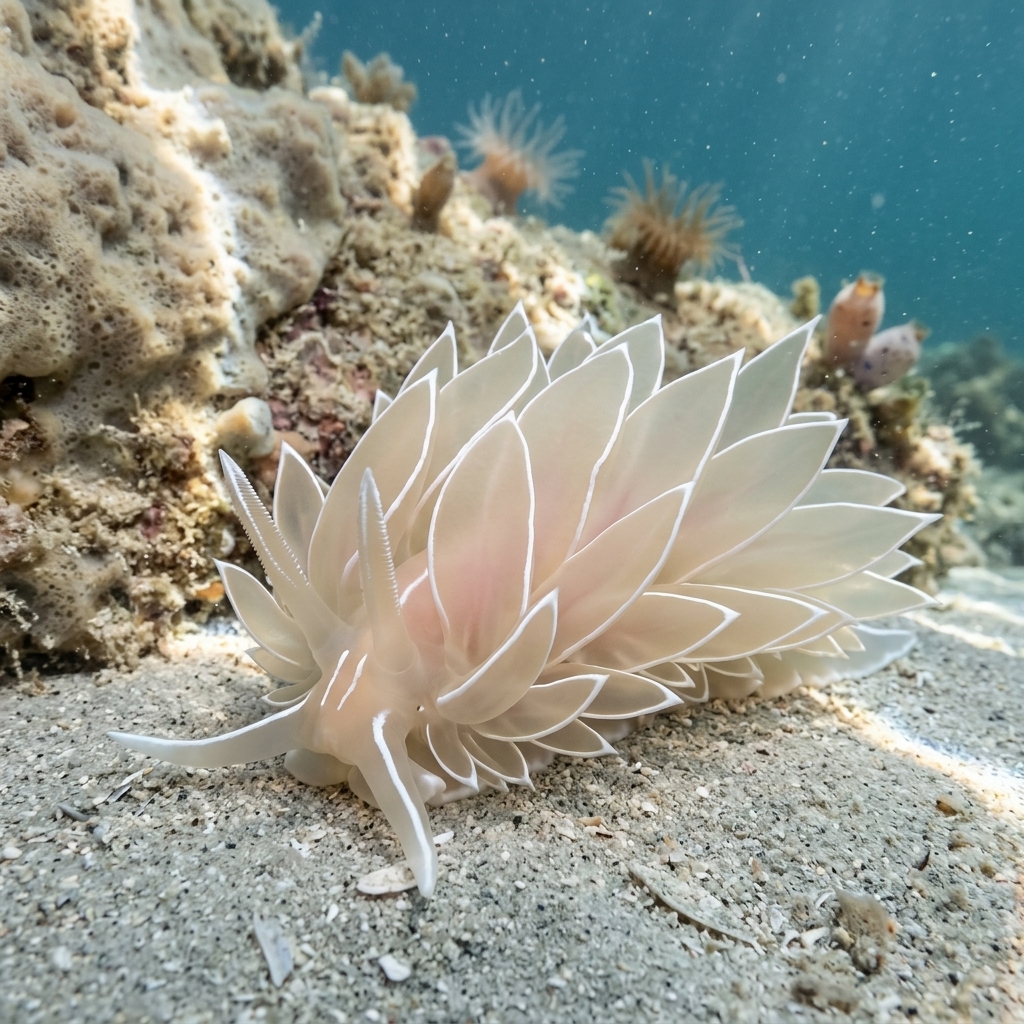
Dirona albolineata
Spot White-lined Dirona along British Columbia and the US Pacific Coast in chilly 8-13°C water. Present year-round, here's how to find and ID one.
At up to 12 cm, this is a large nudibranch by temperate Pacific standards, and its most striking feature is the brilliant white margins that outline every one of its broad, flattened cerata (the leaf-like projections covering the body). The body itself tends towards pale translucent white, cream, or faintly pinkish, making the crisp white edging stand out sharply underwater. Body shape is distinctive: the cerata are wide and pointed, arranged in rows along the back, giving the animal a frilly, layered silhouette quite unlike most other nudibranchs in its range.
Encounter one and it will almost certainly keep doing exactly what it was doing before you arrived: moving slowly across the rocky substrate in that unhurried, deliberate way nudibranchs do. It shows no particular wariness toward divers, so you can observe closely without it retreating. Daylight dives give you the best chance to catch the white-edged cerata in full colour against the dark reef.
Despite being one of the larger and more recognisable nudibranchs of the cold Pacific Northwest, its diet has never been firmly established, which is unusual for a species this well-studied by recreational divers and scientists alike.
Sighting data shows this species present year-round with no concentrated peak season, which fits its cold-water niche of roughly 8 to 13°C, the near-constant temperature range of temperate Pacific sites where it lives.
The vast majority of sightings come from the British Columbia Coast and Vancouver Island, making Canada the top destination by a considerable margin. The US Pacific Coast, including both Pacific Coast and Alaska sites, also holds strong populations, and the species has been logged as far afield as the British Virgin Islands and Mexico, though those records are few. Cold-water divers in the Pacific Northwest are most likely to encounter one.
Mapping where White-lined Dirona is logged…
The British Columbia Coast and Vancouver Island are the standout locations, with a large number of confirmed sightings logged across the region. The US Pacific Coast, including Alaskan sites, is also a reliable area. A handful of records exist from the British Virgin Islands and Mexico, but the Pacific Northwest is where you have the best shot.
Sighting data shows them present year-round with no defined peak season. Their preferred water temperature of around 8 to 13°C is typical of Pacific Northwest sites throughout the year, so any season works. Just pick conditions that suit your cold-water diving comfort.
Look for a large, pale nudibranch, up to 12 cm, covered in wide, pointed cerata each outlined with a sharp white margin. The white edging is the key feature: it catches the light and makes the animal stand out even against pale substrate. No other common nudibranch in its Pacific Northwest range shares quite this combination of size and white-trimmed cerata.
They reach up to 12 cm, which makes them noticeably large for a nudibranch. In the water they appear substantial and easy to spot once you know what you are looking for, unlike many nudibranchs that require close focus to find.
At most sites where they are recorded, sightings are classed as uncommon, with some sites rating them rare and a smaller number rating them common. Patience and slow, attentive diving on rocky benthic habitat gives you the best odds, particularly across the British Columbia and Pacific Coast sites where they are most frequently logged.
Site and sighting data is aggregated from diver logs, iNaturalist and GBIF. For taxonomy and conservation status:
Light-spotted Aegires
3,168 sites





