Cratena lineata
A small, bright nudibranch often logged in Queensland and New South Wales, on reefs between 19 and 25 C, year-round.
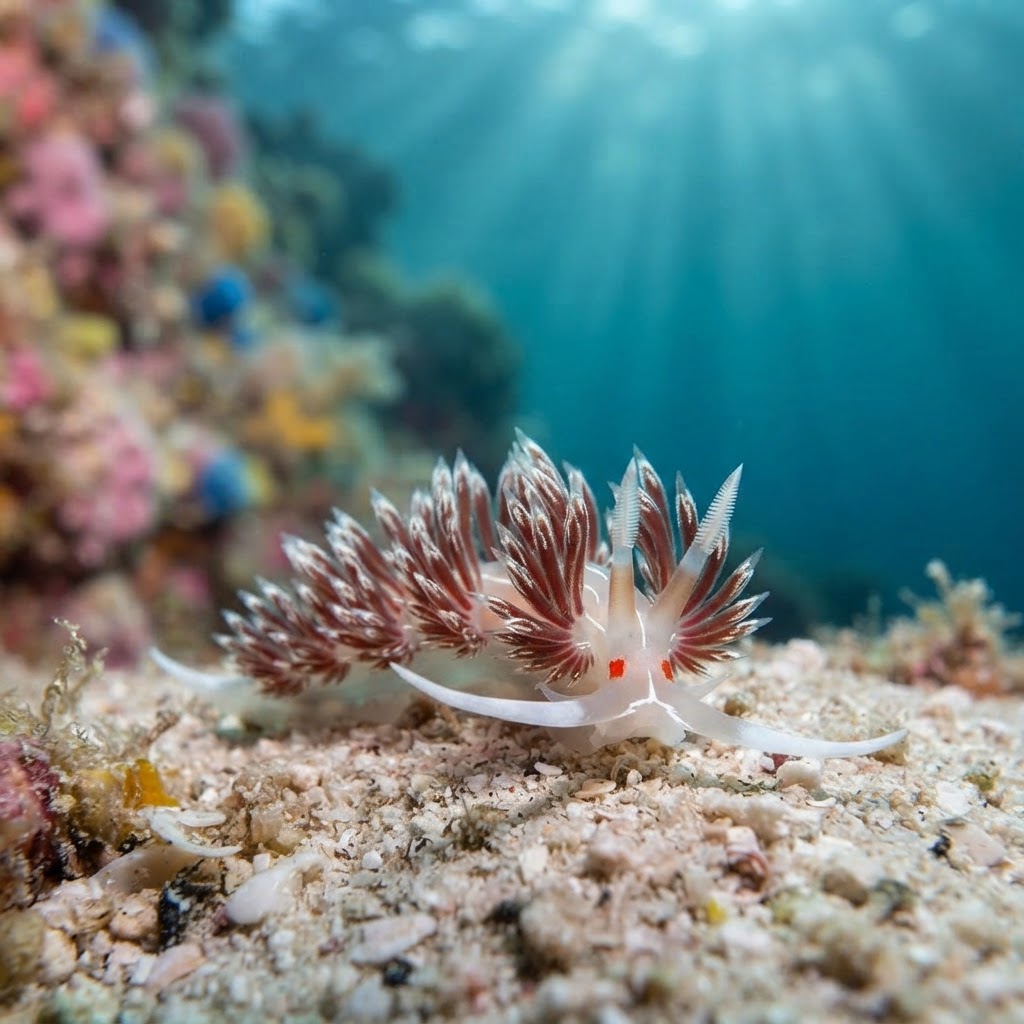
Small, slender sea slug with a translucent white to pale body covered in finger-like projections (cerata) tipped bright orange-red. Two thin white lines run along the head between the rhinophores (the sensory tentacles on top of the head), giving the species its common name. Look for it moving slowly across sponge or hydroid-covered surfaces rather than swimming, usually spotted at close range on a slow reef scan.
Divers find it grazing slowly across hydroids and bryozoans on rock and reef surfaces, usually well within camera macro range since it has no real means of fleeing. It pays no attention to divers and will keep feeding through a photo session, making it a favourite subject for macro shooters doing slow bottom-time scans. Most logs describe it as an uncommon find rather than something you stumble on every dive, so patience on close-focus searches pays off.
Those orange-tipped cerata are not just decoration, they store stinging cells taken from the hydroids it eats and reuse them as its own defence against predators.
No clear seasonal pattern shows up in the sighting data, and its comfortable temperature range of roughly 19 to 25 C spans both cooler and warmer reef conditions, so it is worth looking for on any dive year-round.
Most reliably logged on Australian reefs, with strong site counts across Queensland, New South Wales and Western Australia, making Australia the dependable place to look for this species. It has also turned up at a single site in Sai Kung, Hong Kong, so it is not exclusively an Australian animal, just far more consistently recorded there.
Mapping where White-lined Cratena is logged…
Australia is by far the most consistent place to find it, with sightings spread across Queensland, New South Wales and Western Australia. A single Hong Kong site (Sai Kung) has also logged it, so it turns up outside Australia too, just less predictably.
There is no detected seasonal pattern in the sighting data, and it tolerates a fairly wide temperature range of about 19 to 25 C, so divers report it year-round rather than in a specific window.
Look for a small, pale translucent body with orange-red tipped cerata covering its back and two fine white lines running along the head. It moves slowly across sponge and hydroid patches rather than swimming, which makes it easy to approach for a close look.
No. It poses no threat to divers and can be safely observed and photographed at close range without any risk of sting or injury.
It feeds on stinging hydroids and then repurposes the hydroid's own stinging cells within its orange cerata as a defence against predators, a trick shared by many nudibranchs in this family.
Site and sighting data is aggregated from diver logs, iNaturalist and GBIF. For taxonomy and conservation status:
Light-spotted Aegires
3,168 sites