Bulbaeolidia alba
A tiny white nudibranch found on shallow reef flats in Queensland and Peninsular Malaysia, comfortable in water up to 29.5 C.
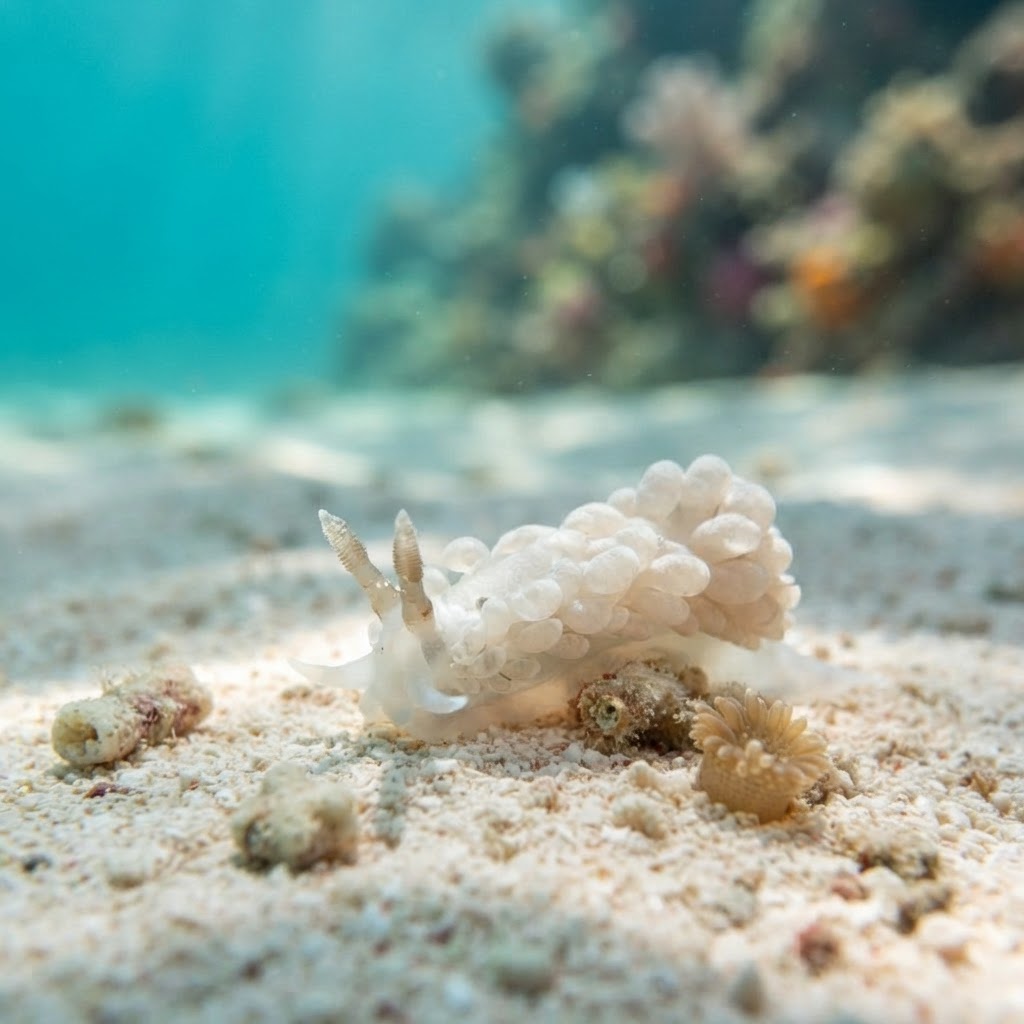
A small, pale white to cream nudibranch with a slender body covered in fine, finger-like projections called cerata (bristly outgrowths on its back that hold stinging cells borrowed from its prey). It sits low against the substrate and can be easy to miss against light coral rubble or algae given its size and colouring. Look closely at shallow reef flats rather than deeper reef structure, since this is where it turns up.
Divers and snorkellers find it grazing slowly across shallow reef flats, usually within a metre or so of the surface, moving at the unhurried pace typical of nudibranchs as it hunts. It shows no reaction to divers beyond the odd retraction of its cerata if disturbed, and it is most often spotted by snorkellers scanning the substrate closely rather than by divers cruising past at depth.
Like other aeolid nudibranchs, it feeds on hydroids and can store its prey's stinging cells in the tips of its own cerata, turning a borrowed defence into its own protection.
No clear seasonal pattern shows up in the sighting data, so treat it as a year-round find. It sits comfortably in water from 22.5 to 29.5 C, which covers tropical reef conditions in its range for most of the year.
Most reliably logged on reef flats in Queensland, Australia, and along Peninsular Malaysia's east coast, with a secondary presence in Mindanao and Luzon in the Philippines. A handful of sightings also come from Hawaii, so it turns up across a wide stretch of the Indo-Pacific and beyond, always in shallow water.
Mapping where White Aeolid is logged…
It is most commonly found on shallow reef flats in Queensland, Australia, and along Peninsular Malaysia's east coast, with further sightings in Mindanao and Luzon in the Philippines and in Hawaii.
There is no strong seasonal pattern in the sightings, so it can be found year-round on reefs within its warm-water range of roughly 22.5 to 29.5 C.
Look for a small, pale white to cream nudibranch with slender, finger-like cerata covering its back, usually sitting low on shallow reef flats. Its size and pale colouring make it easy to overlook against rubble or algae.
Exact size data is not established for this species, but like most aeolid nudibranchs it is small, typically only a few centimetres long, which is part of why it is logged as uncommon to rare even where present.
It feeds on hydroids and can repurpose their stinging cells, storing them in the tips of its own cerata as a borrowed form of defence against predators.
No, they pose no threat to divers or snorkellers and are safe to observe closely without any risk of sting or injury.
Site and sighting data is aggregated from diver logs, iNaturalist and GBIF. For taxonomy and conservation status:
Light-spotted Aegires
3,168 sites