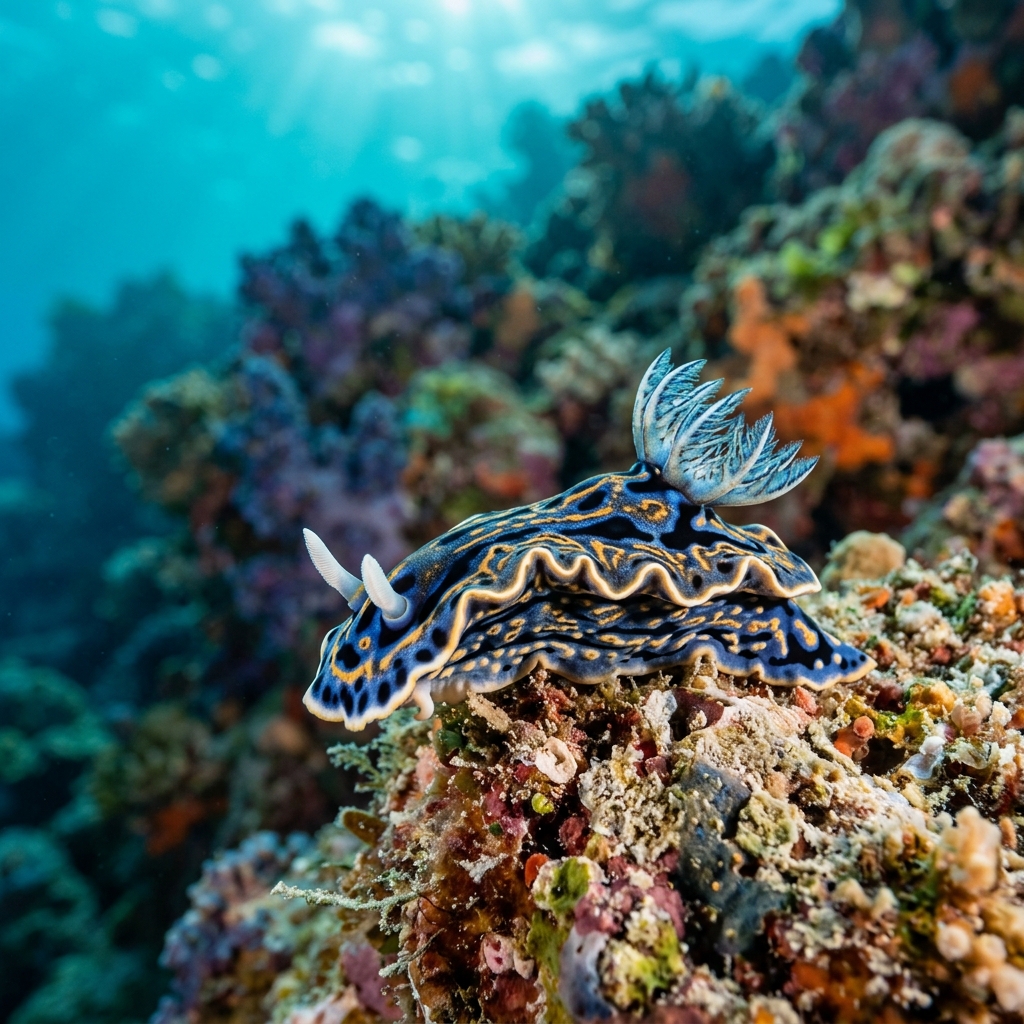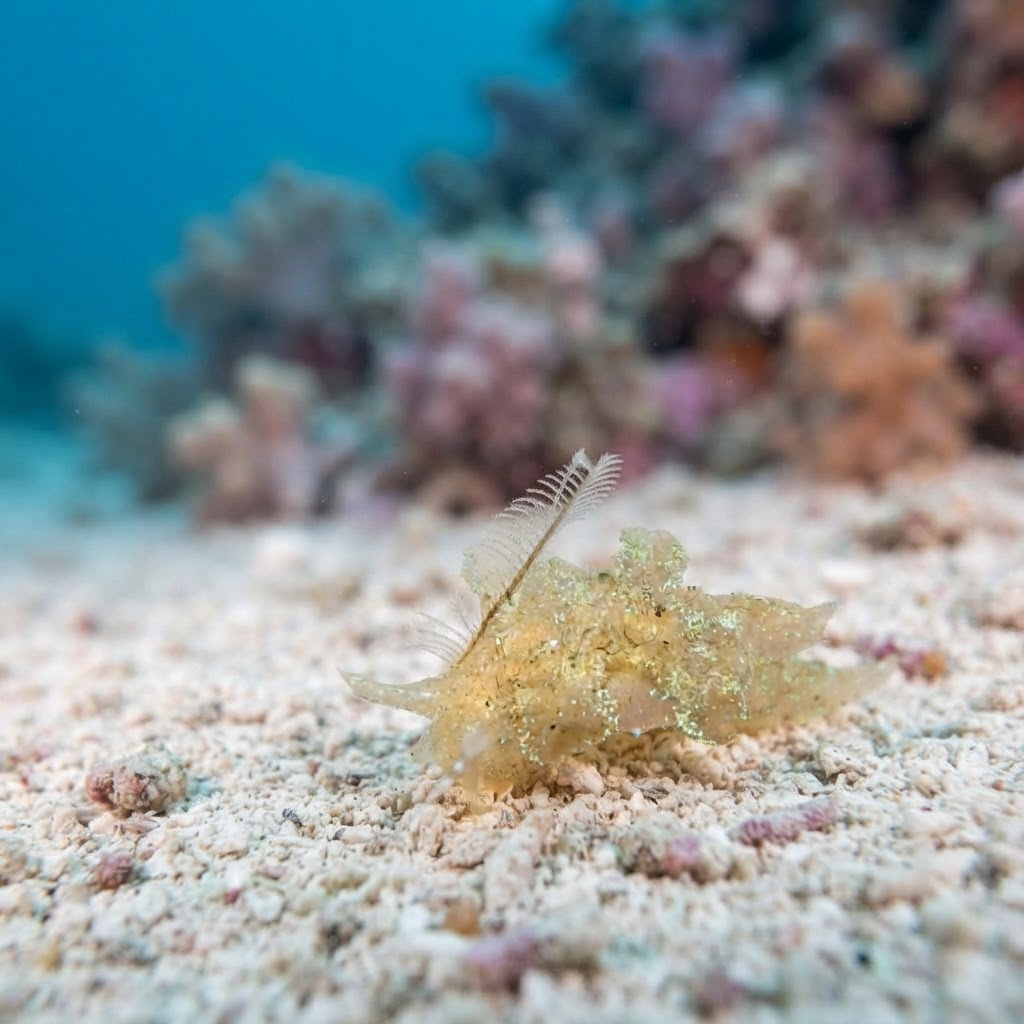
Notobryon wardi
Spot Ward's Nudibranch on Bali's reefs, where this small uncommon slug turns up year-round in 23.5 to 29.5 C water.
Look for a tiny, mostly translucent body just 2 cm long, topped with branching, leaf-like projections called cerata running down its back. The body tends to pick up a faint greenish or brownish tint from its diet, making it blend into the algae and hydroids it sits on. There's no bold pattern here, so divers usually spot it by scanning slowly for the texture of those cerata rather than any flashy colour.
This is a slow-moving grazer that sticks close to the substrate, usually found parked on or near the hydroids and algae it feeds on rather than out swimming in open water. It shows no real reaction to divers beyond continuing its crawl, since it has no eyes or ears in any meaningful sense and relies on chemical cues to find food. Most sightings come from divers doing a careful macro scan of the reef surface rather than spotting it from a distance.
The branching cerata running along its back aren't just decoration, they increase surface area for gas exchange and often store stinging cells or chemical defences absorbed from the hydroids it eats.
There's no detected seasonal pattern, and with a comfortable range of 23.5 to 29.5 C it can turn up on tropical reefs at any time of year. Treat it as a year-round find rather than something tied to a particular month.
Bali, Indonesia is by far the most reliable place to look, with sightings logged across more sites there than anywhere else. South Sinai in Egypt and Hawaii in the United States also produce occasional finds, and it has turned up on single dives in Xiaoliuqiu, Taiwan and Kwajalein Atoll in the Marshall Islands.
Mapping where Ward's Nudibranch is logged…
Bali, Indonesia is the most consistent place to find it, with fewer but confirmed sightings in South Sinai, Egypt and Hawaii, United States. Single records also exist from Xiaoliuqiu, Taiwan and Kwajalein Atoll in the Marshall Islands.
There's no clear season for this species, it's logged year-round wherever water stays within its comfortable 23.5 to 29.5 C range. Any month works as long as the reef is warm.
Look for a translucent, 2 cm body covered in branching, leaf-shaped cerata along its back, often tinted faintly green or brown from its diet. It lacks bold colour patterns, so slow, close-up scanning of algae and hydroid patches is the best way to spot it.
They stay small, reaching only around 2 cm in length, so they're easy to miss without a careful macro-focused search of the reef.
No, this species poses no threat to divers. It's a small, slow-moving grazer with no capacity to harm anyone observing it closely.
Its branching cerata can store defensive chemicals or stinging cells absorbed from the hydroids it feeds on, turning its own food source into a form of protection.
Site and sighting data is aggregated from diver logs, iNaturalist and GBIF. For taxonomy and conservation status:
Blue Dragon
3,163 sites