
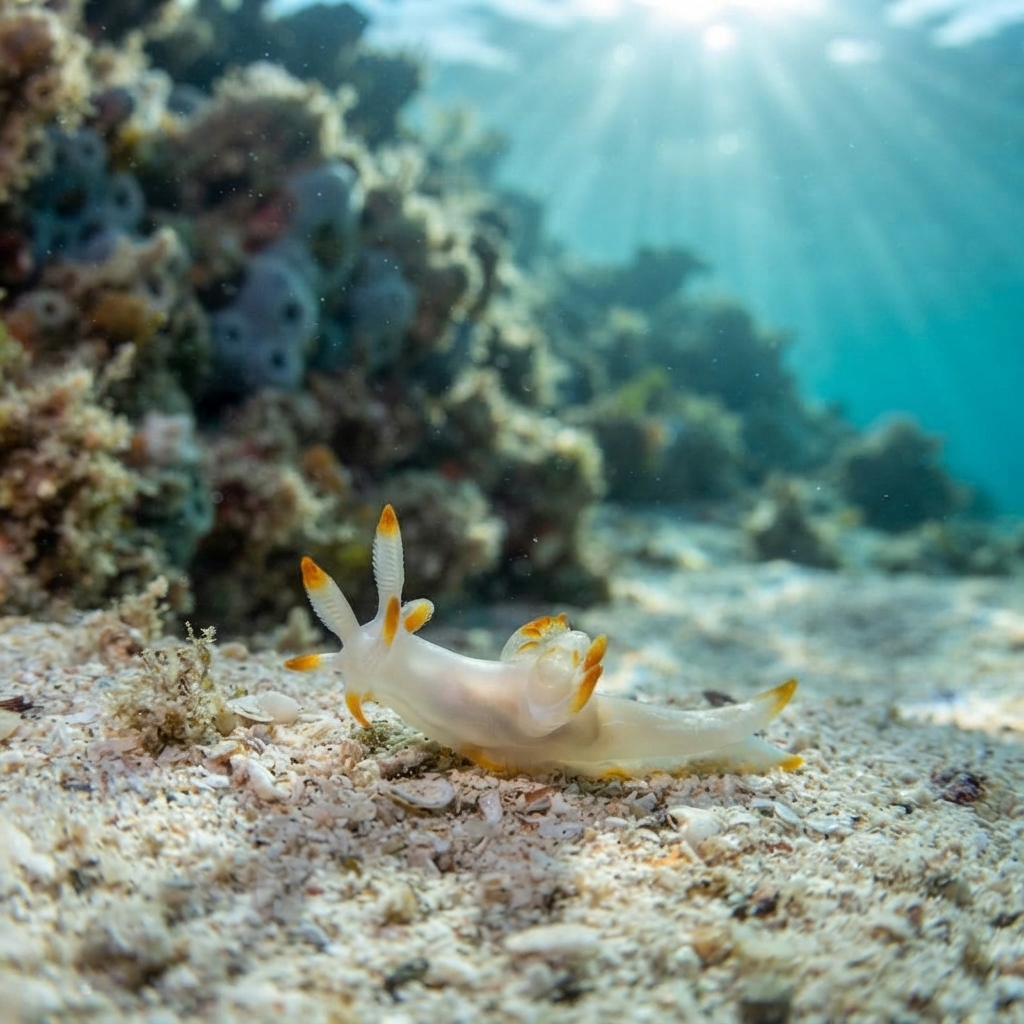
Trapania tartanella
A small pale nudibranch turning up on cool-water reefs from the Lisbon Coast to Andalusia, best spotted on a slow macro dive.
A tiny nudibranch, easy to miss unless you slow down and scan rubble and rocky crevices closely. Body is pale, slender and elongated with feathery gill tufts and a pair of extended, tapering processes trailing off the back end, a feature typical of the Trapania group. Look for the frilly rhinophores (paired sensory tentacles on the head) held upright as it glides over encrusted rock.
Divers find it sitting still or slowly grazing over rock and rubble, usually tucked into low light where sponges and hydroids grow, its likely food source. It shows no reaction to divers beyond retracting its rhinophores if bumped or lit too closely, so a slow approach and a steady light are all you need for a good look.
Like other Trapania species, it likely feeds on small encrusting animals such as bryozoans or sponges, so patient macro divers do best scanning the same low-lying, encrusted surfaces rather than open sand or rock faces.
Logged year-round with no clear seasonal spike in the data, which fits its cool-water niche of roughly 11.8 to 19.5 C. Dive it whenever conditions suit you locally rather than planning around a season.
Most reliably logged along Portugal's Lisbon Coast and in Andalusia, Spain, with a steady presence in the Algarve and Valencia too. In the UK it turns up across England and Wales, making it one of the more consistent small nudibranchs for divers working temperate Atlantic and Mediterranean-adjacent coasts.
Mapping where Tartan Trapania is logged…
It is most often logged along Portugal's Lisbon Coast and in Andalusia, Spain, with further sightings in the Algarve, England and Wales. It favours temperate rocky reef and rubble habitats rather than tropical coral.
Sightings are spread across the year with no strong seasonal pattern, and it tolerates a fairly wide cool-water range of about 11.8 to 19.5 C. There is no need to time a trip around a particular month.
Look for a small, pale, slender nudibranch with feathery gills and a pair of trailing tail-end extensions typical of the Trapania genus. It is often found sitting motionless on encrusted rock or rubble, so a slow, close look is needed to spot it.
Exact size data is not confirmed, but like most Trapania species it stays small, generally in the centimetre range, making it a macro-lens subject rather than something you will spot from a distance.
No, it poses no risk to divers. It has no means of stinging or biting and simply retracts its sensory tentacles if disturbed.
Site and sighting data is aggregated from diver logs, iNaturalist and GBIF. For taxonomy and conservation status:
Light-spotted Aegires
3,168 sites





