Orienthella trilineata
Spot the Three-lined Aeolid on cold Pacific Coast dives from Dec, Jun. Tips for ID, best regions, and where divers log it most.
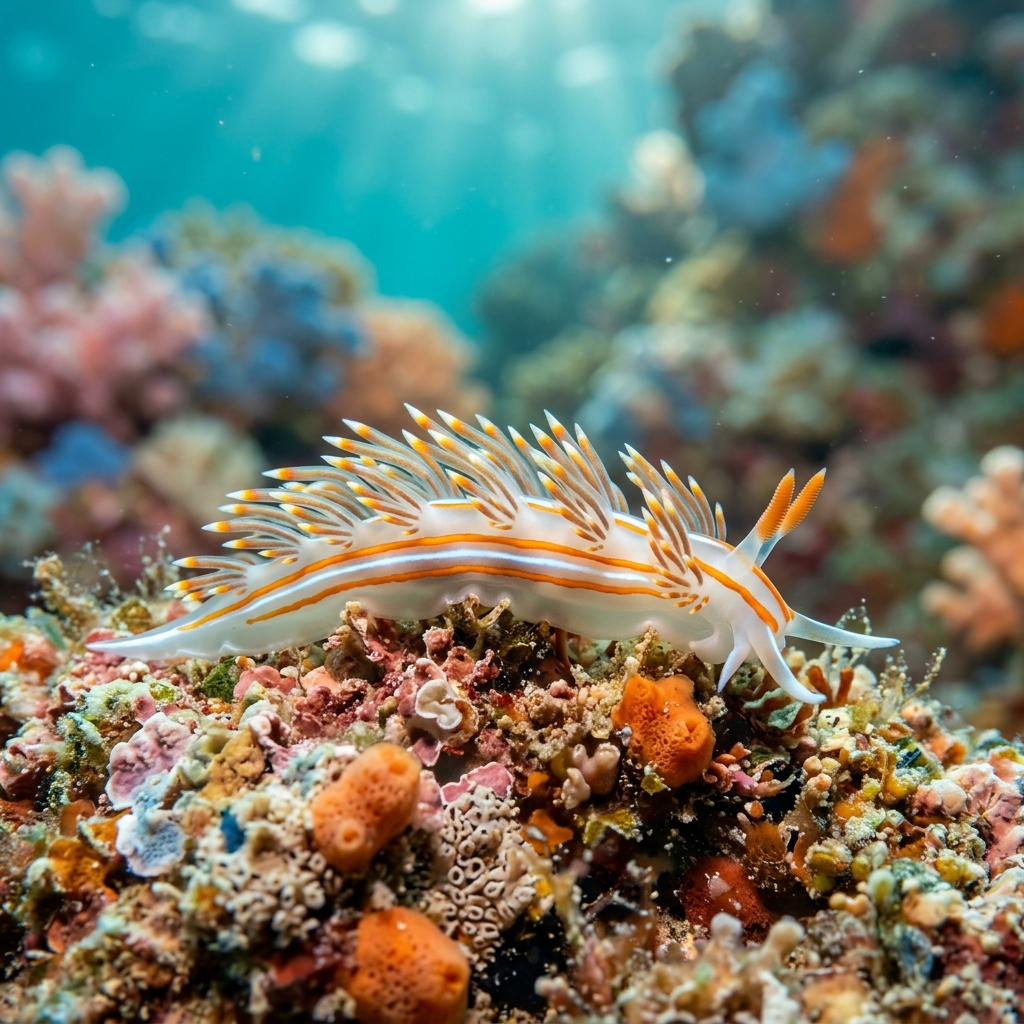
Three pale or white lines running lengthwise along the body are the key feature to lock onto underwater, the common name spells out the ID. Like all aeolids, the back is covered in rows of cerata (finger-like projections that house digestive glands and provide extra surface area), giving it a bristly, elongated silhouette. It is a small nudibranch, easy to overlook against encrusting algae or coralline rock. The lines remain the most reliable field mark when lighting and angle make other details hard to read.
When divers encounter this nudibranch, it is typically moving slowly across hard substrate, rock, encrusting organisms, or kelp-associated surfaces, in the methodical way aeolids hunt their hydroid or anemone prey. It is small and unobtrusive; most sightings are the result of deliberate, slow searching rather than a chance meeting at depth. Give it space: at this size, even gentle water movement from a diver's fins can dislodge it or interrupt feeding.
Aeolid nudibranchs like this one are able to sequester nematocysts (stinging cells) from the cnidarian prey they eat and store them in the tips of their cerata as a chemical defence, a neat trick that turns a meal into a weapon.
In the Northern Hemisphere, sightings cluster between December and June, suggesting winter and spring are the most productive months to search for this species. The observed water temperature range of roughly 8 to 16 °C points firmly to cool-season conditions on temperate Pacific reefs.
Sightings are almost entirely concentrated along the Pacific Coast of the United States and the British Columbia coast of Canada, making temperate northeastern Pacific sites the place to look. A smaller cluster of records extends north into Alaska, and the species has also been logged at a handful of Caribbean and Mexican Pacific sites. If you are diving the cold rocky reefs of California, Oregon, Washington, or coastal British Columbia, you are in the heart of its range.
Mapping where Three-lined Aeolid is logged…
The vast majority of diver records come from the Pacific Coast of the United States and the British Columbia coast of Canada, with additional sightings logged in Alaska. A small number of records exist for Caribbean sites and the Mexican Pacific coast. Cold, rocky northeastern Pacific reefs are by far the most reliable place to search.
Sightings in the Northern Hemisphere concentrate between December and June. The species favours water temperatures of roughly 8 to 16 °C, so the cooler winter and spring months on temperate Pacific reefs align well with those conditions.
Look for three pale lines running along the length of the body, paired with the bristly rows of cerata typical of all aeolid nudibranchs. The three longitudinal lines are the clearest field mark and the reason for its name. It is a small animal, so slow, close searching of hard substrate and encrusting growth is the best approach.
It is classed as uncommon at most sites where it has been recorded, and rare at a significant number of others. Only a small handful of sites report common sightings. Expect it to be a find that rewards patient, methodical searching rather than something you stumble across regularly.
Site and sighting data is aggregated from diver logs, iNaturalist and GBIF. For taxonomy and conservation status:
Light-spotted Aegires
3,168 sites