
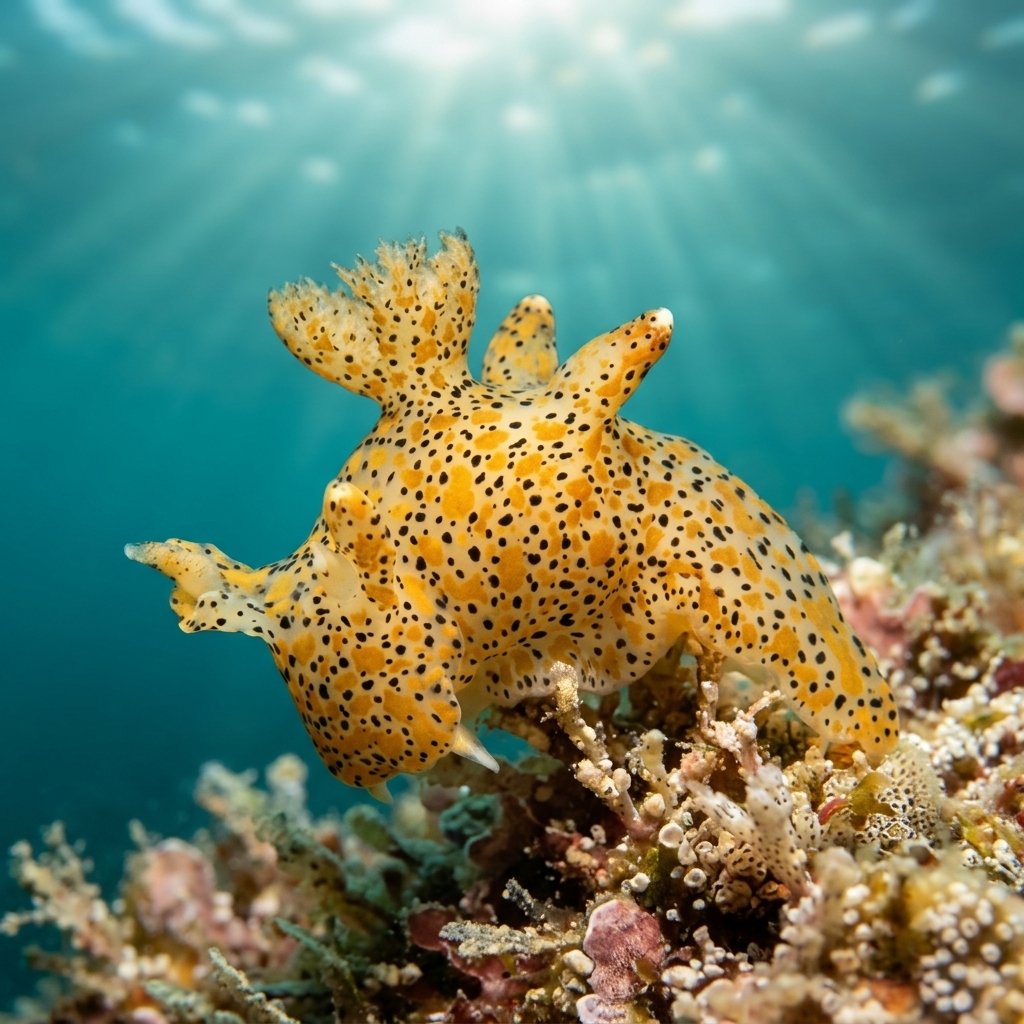
Thecacera pennigera
Spot Thecacera in Zeeland's cold waters or around Victoria and New South Wales, most sightings fall between April and September in the north.
A small, pale-bodied nudibranch with distinctive orange or yellow-tipped projections (cerata) and bold black spots or blotches scattered across its white to translucent body. The combination of that vivid orange-tipped colouring and the spiky cerata cluster is the key field mark underwater. It tends to sit fully exposed on open substrate, which makes the colour pattern easy to read once you know what you are looking for.
Thecacera is typically found crawling slowly over rocky reef, rubble, or bryozoan (moss-animal) encrusted surfaces, often in plain sight rather than tucked into crevices. It does not appear to react strongly to diver presence and will continue foraging at its own unhurried pace. Look low and slow near encrusting growth, this is not a species you spot from a distance, but once your eye is in, the bold colouring makes it unmistakable.
Like other polycerids, Thecacera pennigera is thought to feed specifically on bryozoans, which means searching likely patches of that encrusting growth is a practical search strategy rather than just scanning open rock.
In the Northern Hemisphere, sightings concentrate from April through September, when Zeeland and the UK sites are most productive. In the Southern Hemisphere, Australian records cluster from June through March, broadly covering the austral autumn, winter, and spring.
By a wide margin, the Netherlands, particularly the Zeeland region, accounts for the bulk of logged sightings, making it the most reliable destination for this species. The United Kingdom (South West England, Wales, and the South Coast) and Australia (Victoria and New South Wales) are the next best bets, with smaller numbers of records from France and Japan.
Mapping where Thecacera is logged…
The Netherlands, specifically the Zeeland region, is by far the most frequently logged location. Strong populations are also recorded along South West England, Wales, the South Coast of England, and in Australia across Victoria and New South Wales. Smaller numbers of records exist for Brittany and the Izu Peninsula in Japan.
In European waters, the Netherlands and UK, sightings peak between April and September. In Australia, records concentrate from June through March, covering most of the cooler months. The species tolerates cold water, with observed sightings as low as 6.5°C.
Look for a small nudibranch with a white or translucent body covered in black spots and a cluster of cerata (body projections) tipped in bright orange or yellow. It sits exposed on the substrate, so the colour contrast is the giveaway. No other nudibranch commonly shared in its European range combines that exact black-spot and orange-tip pattern.
Typical size is not well documented in dive records, and like many nudibranchs the animal is small, expect to be searching at close range, within centimetres, rather than spotting it from a distance. A macro lens or dioptre will reward patient photographers.
Thecacera pennigera is a specialist feeder on bryozoans, the encrusting, colonial invertebrates that form lacy or moss-like mats on rocks and shells. If you find a patch of bryozoan growth, it is worth slowing right down and checking carefully along the edges for this nudibranch.
Site and sighting data is aggregated from diver logs, iNaturalist and GBIF. For taxonomy and conservation status:
Light-spotted Aegires
3,168 sites





