Tenellia albocrusta
A rare find in the Pacific Northwest, this small nudibranch turns up in cold water between 10.6 and 18.5C, mostly on US Pacific coast dives.
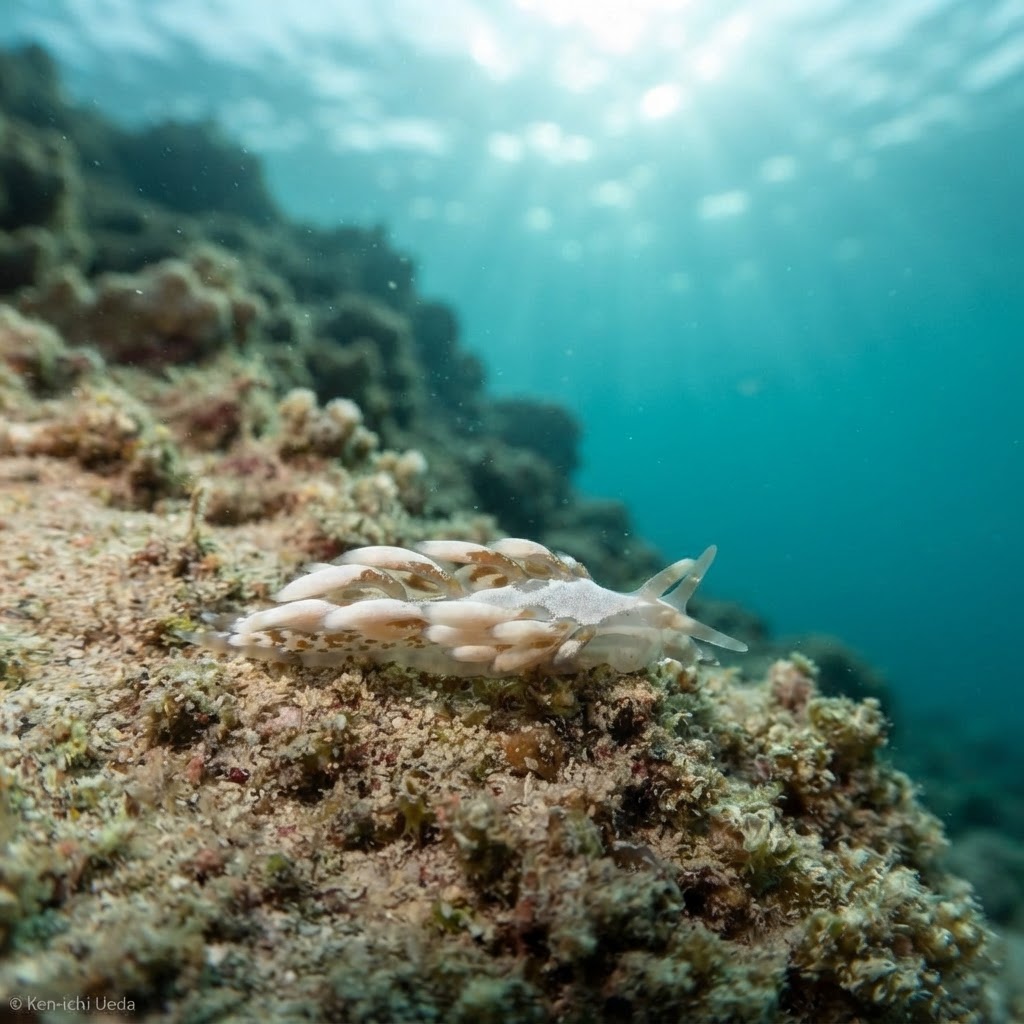
This is a small, slender nudibranch built around a row of finger-like projections (cerata) along its back, typically pale-bodied with white or cream tips on those cerata that give it a frosted look against darker rock. Look closely at the tips and the translucent body rather than any bold pattern, since this is a subtle, easy-to-miss animal on a cold-water reef wall. Size in the water is small enough that most divers need a slow, close search along rocky substrate to pick it out at all.
Divers find this nudibranch grazing slowly over rocky substrate, doing what most small sea slugs do: moving at a crawl while feeding, with no reaction to divers beyond simply being ignorable if you're not looking closely. It shows up as a solo animal tucked into cracks or low on reef structure rather than out in the open, which is part of why sightings lean rare at most sites where it's been recorded.
Like other trinchesiid nudibranchs, it likely feeds on hydroids and can incorporate stinging cells from that prey into its own cerata for defence, though this hasn't been specifically documented for this species.
Sightings don't show a clear seasonal spike, so treat this as a year-round possibility on Pacific Northwest and California dives. It's been logged across a temperature range of 10.6 to 18.5C, which lines up with typical cold-water conditions on that coast most of the year.
This one is almost entirely a Pacific coast find, most commonly logged in the Pacific Northwest of the United States, with a secondary cluster of sightings in California. Right now the data points to a single-country pattern, so anyone chasing it should be planning US West Coast cold-water dives rather than tropical trips.
Mapping where Tenellia albocrusta is logged…
Sightings are concentrated on the US Pacific coast, with the Pacific Northwest as the strongest region and California as a secondary spot. Outside the United States there's no reliable record of it yet in the data.
There's no detected seasonal pattern, so it's logged year-round on Pacific Northwest and California dives. It has been recorded in water between 10.6 and 18.5C, which covers most of the cold-water diving season on that coast.
Look for a small, slender nudibranch with a row of cerata along its back, pale-bodied with white or cream-tipped cerata that stand out faintly against rock. It's easy to overlook, so a slow close search of rocky substrate is the best way to spot one.
Exact size data isn't available for this species, but like most Tenellia nudibranchs it stays small, generally in the centimetre range rather than anything large or conspicuous.
Site and sighting data is aggregated from diver logs, iNaturalist and GBIF. For taxonomy and conservation status:
Blue Dragon
3,163 sites