Dendronotus subramosus
A tiny branched nudibranch turning up uncommonly in the Pacific Northwest and California, in water as cool as 10.3 C.
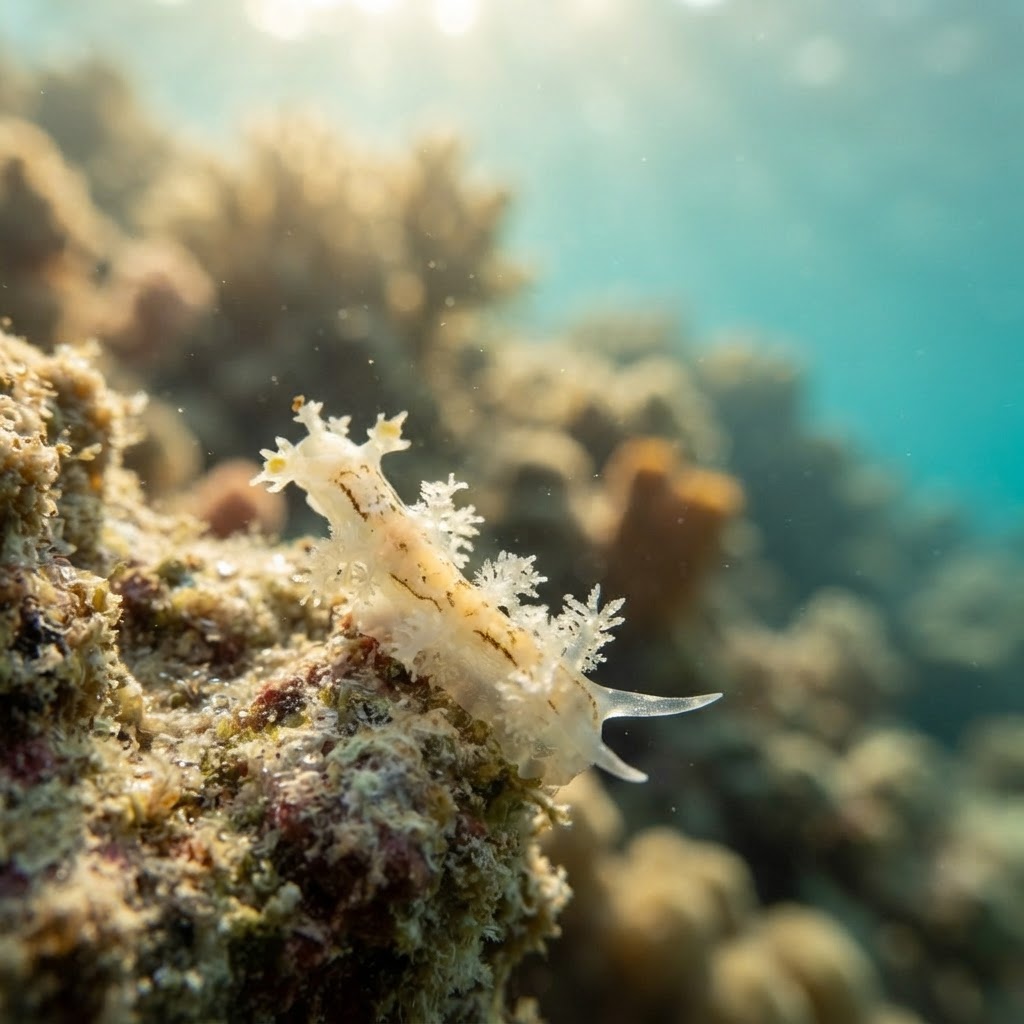
Tops out at around 2 cm, so you are hunting for a small, pale, stubby-bodied slug rather than anything showy from a distance. The giveaway is the row of short, thickly branched cerata (the finger-like projections on its back) which look compact and bushy rather than long and feathery like other Dendronotus species. Look closely at rock and algae surfaces in cooler water rather than scanning open reef.
Divers find it slow-moving and stationary on rock, algae, or hydroid-covered surfaces, doing what most small dendronotids do: grazing quietly and paying no attention to a torch or a close look. It shows up uncommonly rather than reliably, so most sightings come from divers deliberately combing cold-water reef structure rather than spotting it mid-swim.
Like other Dendronotus nudibranchs, it likely feeds on hydroids, using its branched cerata to blend into the same bushy growth it is grazing on.
Sightings show no detectable seasonal pattern, so treat it as a year-round find. It sits in a cool-water niche of 10.3 to 18.5 C, which matches Pacific Northwest and California conditions for most of the year.
Logged only in the United States so far, with the strongest showing in the Pacific Northwest and a second cluster in California. Sites in these two regions account for effectively all recorded sightings, making the US west coast the place to search for it.
Mapping where Stubby Dendronotus is logged…
It has only been logged in the United States, most often in the Pacific Northwest and secondarily in California. Both regions offer cold-water reef and rock habitat where divers have found it.
There is no clear season in the sighting data, so it is best treated as a year-round possibility. Its comfort range of 10.3 to 18.5 C lines up with typical Pacific Northwest and California dive conditions most months.
Look for a small pale slug around 2 cm long with short, densely branched cerata along its back, giving it a compact, bushy look rather than long feathery projections. It is usually found sitting still on rock or algae in cool water.
They are tiny, reaching only around 2 cm, so divers need to look closely at rock and algae surfaces to spot one.
No. It poses no danger to divers and is harmless to observe or photograph up close.
Site and sighting data is aggregated from diver logs, iNaturalist and GBIF. For taxonomy and conservation status:
Nudibranch
3,168 sites