Embiotoca lateralis
Blue-and-orange striped fish common in British Columbia's chilly 9 to 15 C water, uncommon but reliable year-round.
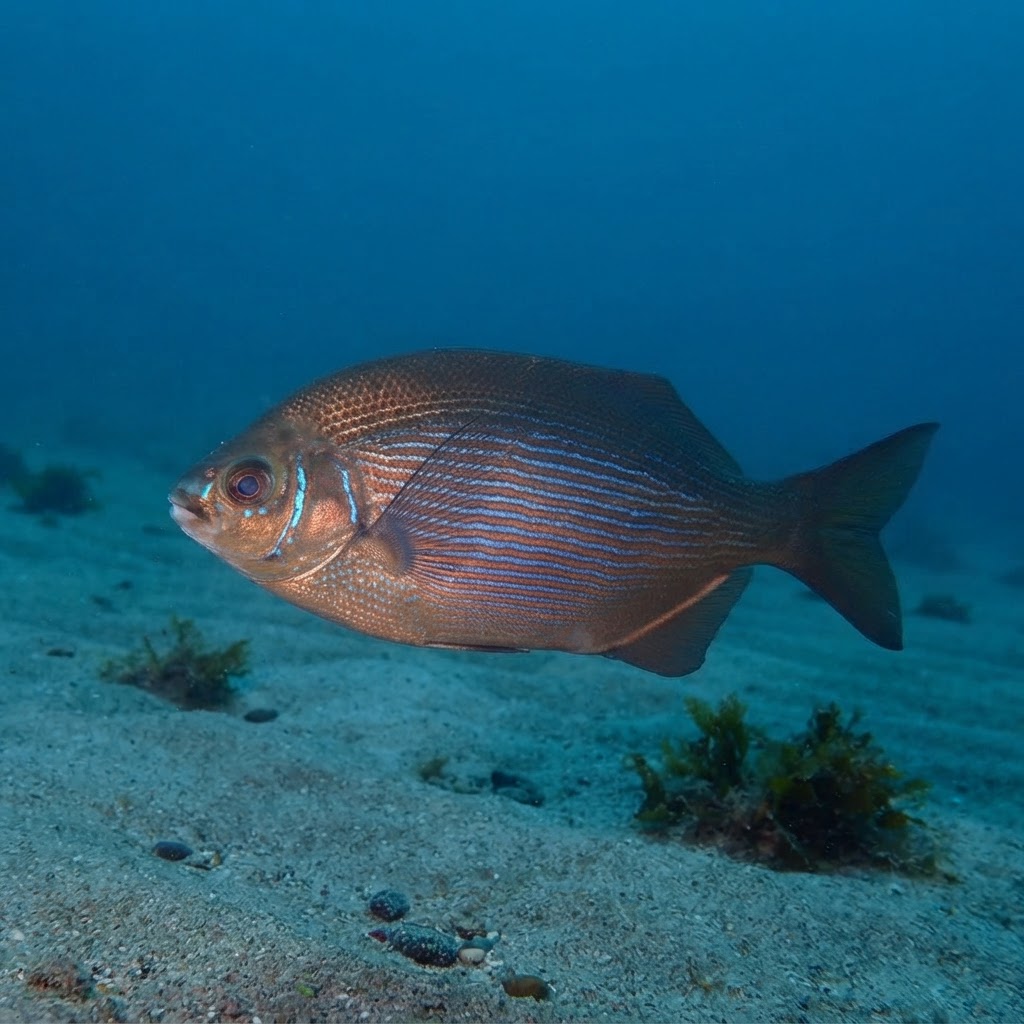
Look for a deep-bodied, laterally flattened fish around 26 cm long, striped lengthwise in alternating bands of blue and orange-brown running from gills to tail. The stripes sit horizontally rather than vertically, which separates it at a glance from most reef damselfish patterns. Males tend to show darker, more saturated orange between the blue lines, especially during the breeding season, giving them a richer contrast than females.
Divers usually find striped seaperch hovering close to rocky reef structure or kelp holdfasts, picking at small invertebrates rather than roaming open water. They are unhurried around divers, often holding position or drifting off at a calm pace rather than bolting, which makes them easy to get a good look at once spotted. Look for them singly or in small loose groups near ledges and crevices rather than in tight schools.
Striped seaperch give birth to live young rather than laying eggs, a trait shared across the surfperch family that sets them apart from most reef fish divers encounter.
Sightings show no strong seasonal pattern, so treat this as a year-round fish wherever it occurs. It sits comfortably in cold water from about 9 to 15 C, which matches the Pacific Northwest's temperature range through most of the year.
Most consistently logged in British Columbia, Canada, where cold-water rocky reefs and kelp beds hold the bulk of sightings, with a strong secondary presence along the Pacific Northwest coast and in California. Divers in these regions should expect an uncommon but dependable sighting rather than a guaranteed one at most sites.
Mapping where Striped Seaperch is logged…
British Columbia in Canada is the strongest region for this species, followed by the Pacific Northwest and California in the United States. It is logged mostly on temperate rocky reefs and kelp habitat rather than tropical reef systems.
There is no clear seasonal peak in the sighting data, so it can turn up any time of year. Water temperature in its range stays within its 9 to 15 C comfort zone for most of the year, which likely explains the lack of a tight season.
Check for a deep, flattened body around 26 cm long with horizontal blue and orange stripes running head to tail. The banded pattern and cold-water rocky reef setting make it fairly distinctive among Pacific Northwest fish.
They typically reach around 26 cm in length, a solid handspan-plus size that makes them easy to spot once you know their striped pattern.
No, they pose no known danger to divers. They are calm around divers and simply go about feeding near reef structure.
Unlike most fish divers see on a reef, striped seaperch bear live young instead of laying eggs, a distinguishing trait of the surfperch family they belong to.
Site and sighting data is aggregated from diver logs, iNaturalist and GBIF. For taxonomy and conservation status:
Yellowtail Clownfish
3,523 sites