Rostanga arbutus
A rare, cherry-red nudibranch turning up on sponge-covered reefs in New South Wales, year-round in mild 18.6-24.6 C water.
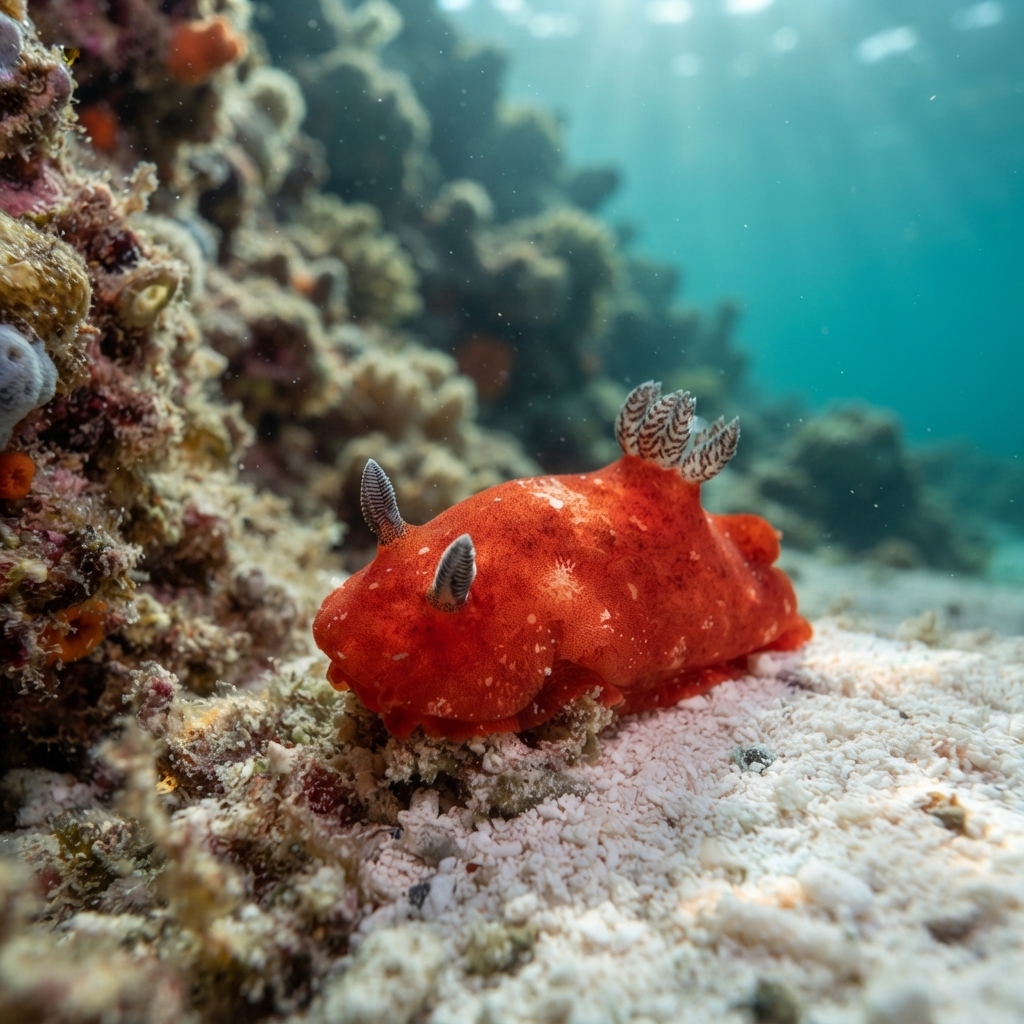
A small nudibranch draped in a deep strawberry-red to orange-red that closely matches the colour of the sponge it feeds on, making it easy to swim straight past. The body is soft and rounded with fine texture rather than tall projections, and the rhinophores (the pair of sensory stalks on the head) and gill cluster are usually the same red tone as the body, so the whole animal reads as one solid patch of colour against the sponge. There is no strong pattern or contrasting stripe to key on, it is really the uniform red colour and small size that give it away.
Divers find it sitting still on the red sponges it feeds on, usually tucked into cracks or crevices on rock reef rather than out in the open. It does not react to divers beyond staying put, since like most nudibranchs it has no real means of fleeing and relies on blending into its sponge host instead. Most logs describe it as a slow, deliberate find rather than something spotted moving across the reef.
Its red colour is not just camouflage, it is diet-derived: rostanga nudibranchs feed on red sponges and are thought to take up pigments from that sponge tissue, which is why the slug so closely matches its food source.
Sightings don't show a clear seasonal pattern, so treat it as a year-round find on NSW and Queensland reefs. It has been logged across a fairly wide temperature range from 18.6 to 24.6 C, which covers both cooler and warmer months in that region.
Almost every logged sighting comes from Australia, with New South Wales the clear stronghold and Queensland a secondary spot. Within NSW it turns up across a spread of sites rather than one single hotspot, so divers searching sponge-covered rock and reef in that region have the best odds.
Mapping where Strawberry Rostanga is logged…
Nearly all logged sightings are from Australia, particularly New South Wales, with a smaller number of records from Queensland. It is not reported as a reliable find outside these regions.
There is no strong season in the data, so it is best treated as a year-round sighting in New South Wales and Queensland. It has been recorded across a range of water temperatures from about 18.6 to 24.6 C.
Look for a small, uniformly red-orange nudibranch sitting on a matching red sponge, with no strong contrasting pattern. Its colour and small size are the main clues, and finding the red sponge host is often the fastest way to spot it.
Exact size data isn't confirmed, but like most Rostanga species it is a small nudibranch, generally reaching only a centimetre or two, so divers need to look closely at sponge surfaces to find one.
Its colour comes from feeding on red sponges, with the slug thought to absorb pigments from that food source into its own tissue. This gives it near-perfect camouflage against the sponge it lives and feeds on.
No, it poses no danger to divers. It is a tiny, slow-moving sponge-feeder with no means of harming anyone nearby.
Site and sighting data is aggregated from diver logs, iNaturalist and GBIF. For taxonomy and conservation status:
Light-spotted Aegires
3,168 sites