Spurilla braziliana
A small aeolid nudibranch logged year-round along Colombia's Caribbean Coast, in waters between 19.5 and 28.4°C.
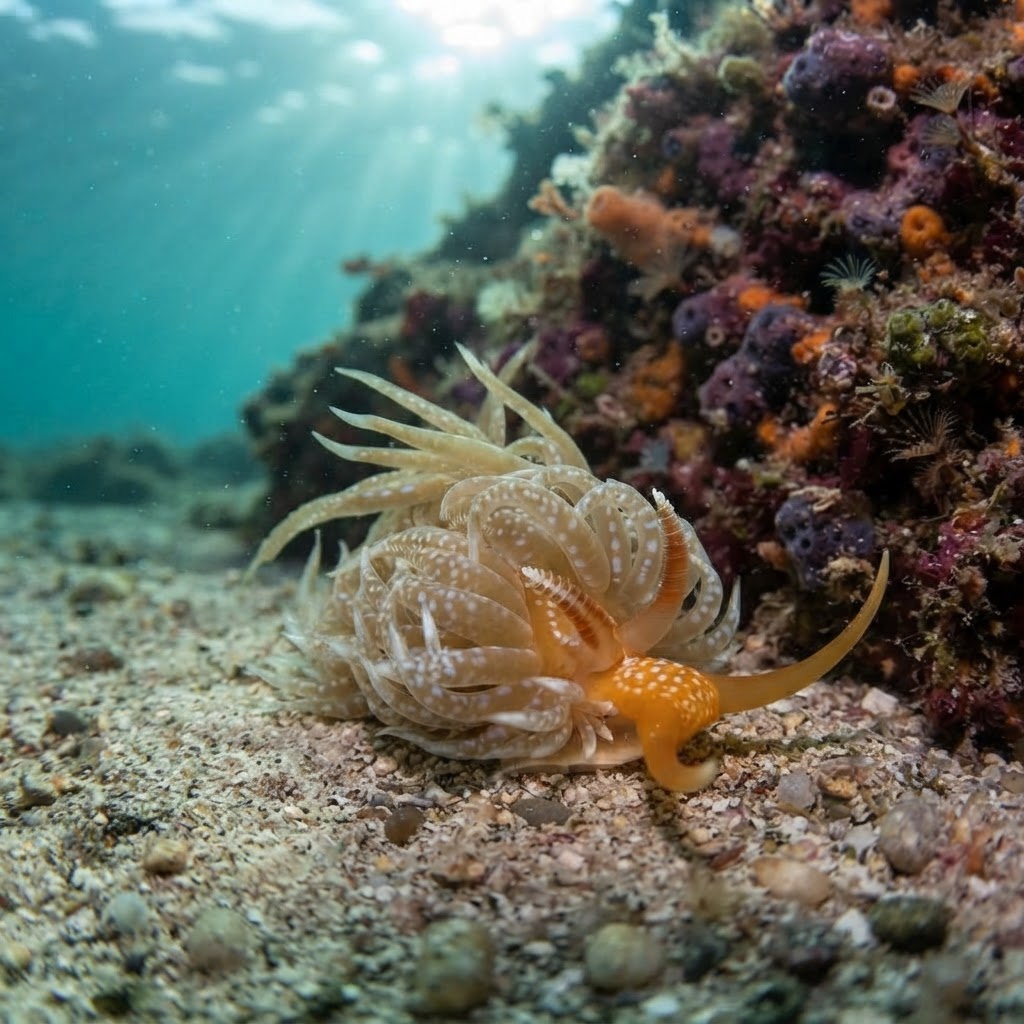
A small aeolid (a nudibranch with finger-like projections called cerata covering its back) with a slender, elongated body. The cerata are typically translucent to brownish-orange, often with paler tips, giving the animal a fuzzy, textured look rather than a smooth one. Two tapered rhinophores (sensory tentacles) sit on the head, and the whole animal tends to blend into rubble and algae rather than stand out with bold colour.
Divers typically find this one tucked into rubble, algae mats, or low reef structure rather than out in the open, moving slowly as it grazes. It shows no reaction to divers beyond retracting slightly if disturbed, and most logs come from slow, close-focus searches rather than casual reef swims. Its small size and muted colouring mean it is easy to swim past unless you are specifically looking down and close.
Like other aeolid nudibranchs, it likely feeds on cnidarians such as anemones and can repurpose their stinging cells for its own defence, storing them in the tips of its cerata.
No clear seasonal pattern shows up in the sighting data, and its recorded temperature range of 19.5 to 28.4°C spans both cooler temperate sites and warm tropical ones, so it is logged year-round wherever divers look for it.
Most reliably logged along Colombia's Caribbean Coast, which accounts for the bulk of recorded sightings and makes it the strongest bet for this species. It also turns up in Baja California in Mexico, around the Îles des Saintes in Guadeloupe, and on reefs in Queensland and New South Wales in Australia, with a smaller cluster of sightings near Puerto Madryn in Argentina.
Mapping where Brazilian Aeolid is logged…
Colombia's Caribbean Coast is by far the strongest region for this species, with additional sightings in Baja California (Mexico), the Îles des Saintes (Guadeloupe), and Queensland and New South Wales in Australia.
There's no detected seasonal pattern, and it has been recorded across a wide temperature range from 19.5 to 28.4°C, so sightings happen year-round rather than in a specific window.
Look for a small, slender nudibranch covered in translucent orange-brown cerata that give it a fuzzy texture, with two tapered rhinophores on the head. It usually sits low on rubble or algae rather than out in open water.
Exact size data isn't available, but like most aeolid nudibranchs it stays small, generally within a couple of centimetres, making it easy to overlook unless you're searching close to the substrate.
No, it poses no danger to divers. It's a small, harmless nudibranch that relies on camouflage rather than any defence that could affect a diver.
As an aeolid nudibranch, it likely feeds on stinging cnidarians and can store their unfired stinging cells in its own cerata, turning a predator's defence into its own protection.
Site and sighting data is aggregated from diver logs, iNaturalist and GBIF. For taxonomy and conservation status:
Light-spotted Aegires
3,168 sites