Eubranchus ocellatus
A tiny, uncommon nudibranch logged repeatedly around Koh Tao, Thailand, in warm 20-30C reef water year-round.
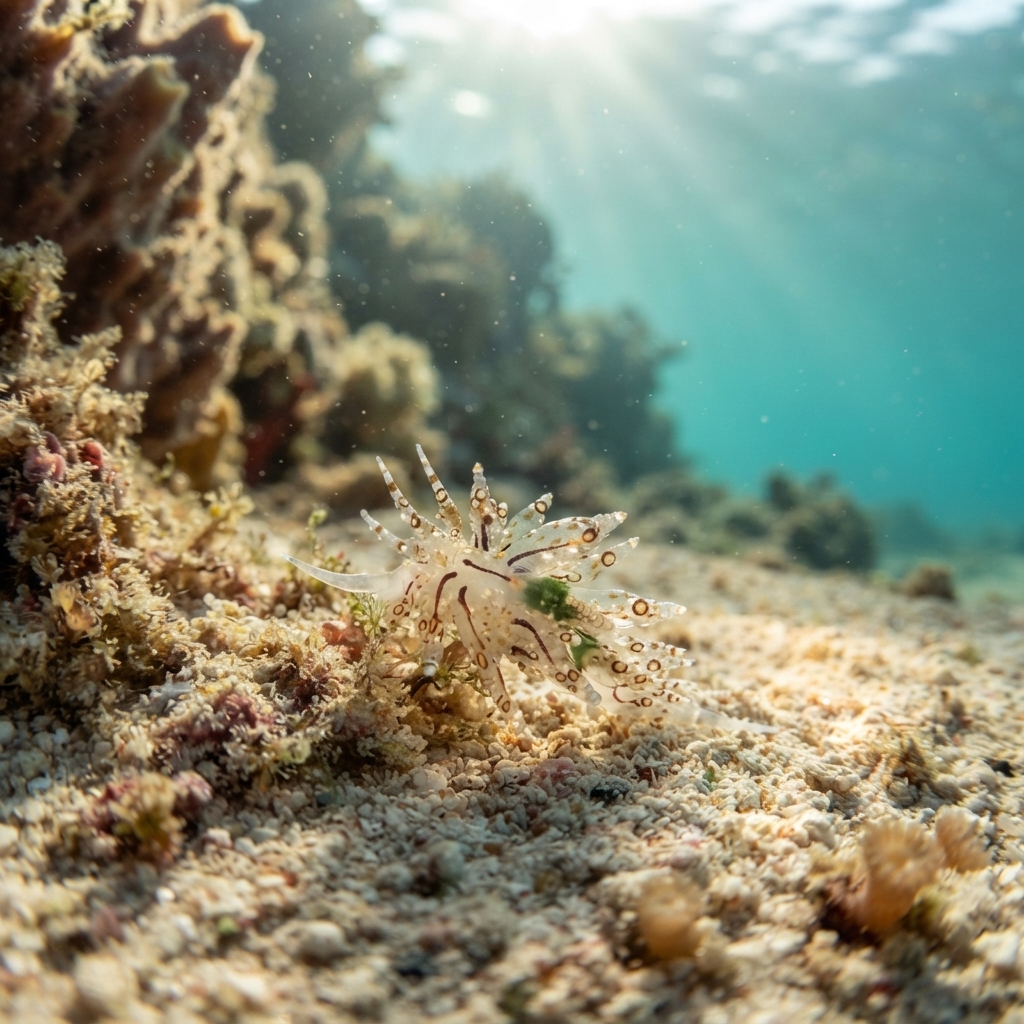
Look for a very small, slender nudibranch with a translucent to pale body and clusters of finger-like projections (cerata) along its back, each tipped or marked with dark spots that give the species its name. The head end is rounded and blunt, without the tall rhinophores that make many other nudibranchs stand out from a distance. At the sizes divers typically encounter it, this is a macro subject: you will need a careful eye or a guide pointing a torch at rubble and algae-covered surfaces to pick it out.
This is a slow-moving grazer, typically found tucked into rubble, algae mats or hydroid growth where it feeds, rather than out in the open water column. Divers who find it tend to do so on careful, slow macro-focused dives rather than while cruising the reef, since it is uncommon even at the sites where it has been recorded. It shows little reaction to divers beyond continuing its slow crawl, as is typical for small sea slugs feeding on stationary prey.
Like other members of the family Eubranchidae, this species almost certainly feeds on hydroids, using its cerata both for digestion-related gas exchange and, in many related species, for storing stinging cells taken from its prey as a defence.
Sightings do not show a distinct season, and with water temperatures observed between 20 and 30C, conditions on Koh Tao's reefs stay hospitable across the year. Plan around good macro-diving conditions generally rather than a specific month.
Every logged sighting of this species comes from Thailand, and specifically from Koh Tao, which is currently the only known reliable spot to look for it. If you are diving elsewhere in Southeast Asia, do not expect a repeat performance based on this data; Koh Tao is the place to build your search around.
Mapping where Spotted Roundhead is logged…
The only confirmed sightings logged for this species are from Koh Tao, Thailand, making it currently a Koh Tao specialty rather than a species found across multiple destinations.
There is no clear seasonal pattern in sightings, and the species has been observed in water from 20 to 30C, so it appears to be a year-round find on Koh Tao's reefs rather than tied to a particular month.
Check for a small, slender nudibranch with a pale, semi-translucent body and rows of cerata along its back marked with dark spots. It lacks tall, prominent rhinophores, and its rounded head shape is part of what gives it the common name.
Exact size data is not confirmed for this species, but as a member of Eubranchidae it falls into the macro-nudibranch category, generally just a centimetre or two long, so a magnifying lens or macro lens helps with a positive ID.
No. This is a small, harmless sea slug with no venom or behaviour that poses any risk to divers; the only challenge is finding one.
Like related Eubranchus species, it most likely grazes on hydroids, using its spotted cerata in feeding and, in many relatives, to repurpose stinging cells from prey for its own defence.
Site and sighting data is aggregated from diver logs, iNaturalist and GBIF. For taxonomy and conservation status:
Light-spotted Aegires
3,168 sites