Pruvotfolia rhodopos
A rare orange-tentacled aeolid best known from Kwajalein Atoll, seen year-round in 23-30C water. Here's how to spot one on the reef.
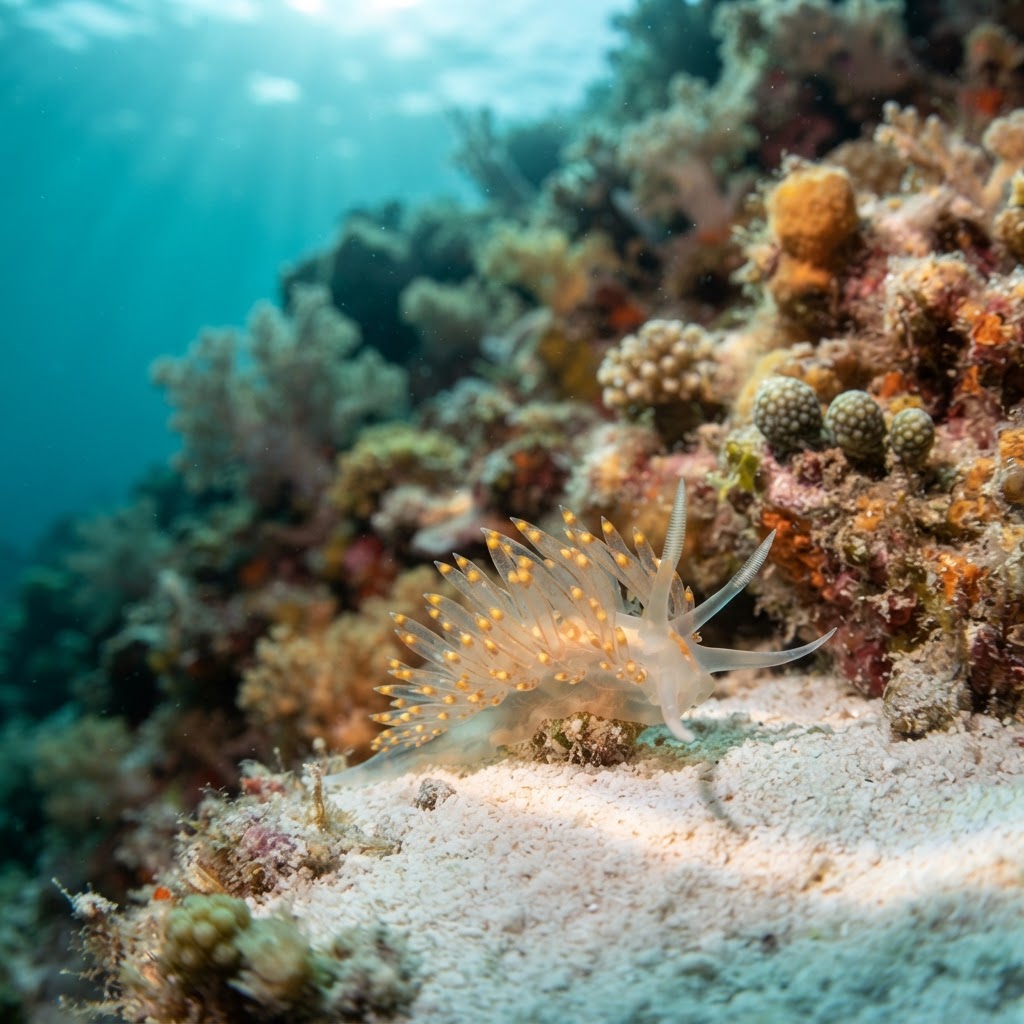
A small, slender aeolid nudibranch covered in dense clusters of finger-like projections (cerata) that give it a bristly, flame-like silhouette. The cerata typically show warm orange to reddish tips fading toward a paler translucent body, which is what gives this species its common name. Look for it tucked low on rubble or coral rather than out in open water, as it is easy to mistake for background texture until it moves.
Divers find this aeolid slow-moving and easy to overlook, grazing low on rubble, encrusting growth or coral rather than swimming in the open. It shows no reaction to divers beyond continuing to crawl, so a close, patient look with a torch or macro lens is the best way to actually notice one. Most logs describe it as a rare find even at its known sites, so treat any sighting as a highlight rather than an expectation.
Like other aeolid nudibranchs, it likely stores stinging cells from the hydroids or cnidarians it feeds on in the tips of its cerata, turning its prey's own defences into its own.
Sightings show no clear season, and the observed water temperature range of 23.1 to 29.6C spans typical tropical and subtropical conditions year-round, so there is no strong reason to time a trip around a particular month.
Kwajalein Atoll in the Marshall Islands is by far the most reliable place to look, with far more logged sites than anywhere else in the data. Eilat in Israel and Luzon in the Philippines also have confirmed sightings, so it is worth checking rubble patches and reef nooks on Red Sea and northern Philippine dives too.
Mapping where Spitfire Tentacle Aeolid is logged…
Kwajalein Atoll in the Marshall Islands has the strongest record of sightings by far. Smaller numbers have also been logged at Eilat in Israel and in Luzon, Philippines.
There is no detected seasonal pattern, and it has been recorded in water from 23.1 to 29.6C, so it can turn up on any dive throughout the year.
Look for a small, slender nudibranch covered in bristly, finger-like cerata with orange to reddish tips over a paler body. It sits low on rubble or reef structure rather than swimming, so a slow scan with a torch helps.
No, it poses no danger to divers. It is a tiny, slow-moving grazer with no ability to harm a person.
Exact size data is not confirmed, but like most aeolid nudibranchs it is a small species, typically only a few centimetres long, so divers rely on its cerata pattern rather than size to spot it.
Site and sighting data is aggregated from diver logs, iNaturalist and GBIF. For taxonomy and conservation status:
Light-spotted Aegires
3,168 sites