Flabellinopsis iodinea
Spot the vivid purple and orange Spanish Shawl along the US Pacific Coast and northern Mexico, most reliably from November through August.
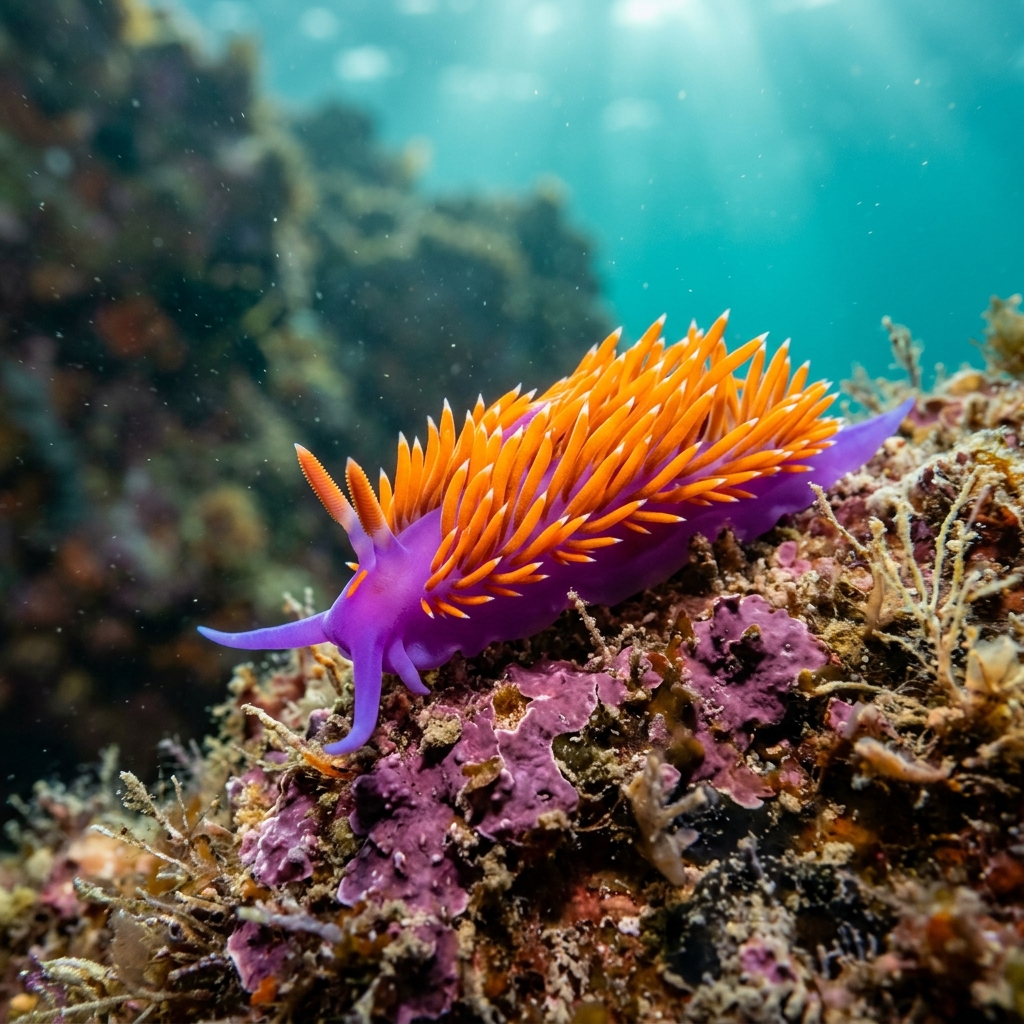
Few nudibranchs are as easy to pick out as this one: the body is a deep violet-purple, covered in clusters of bright orange cerata (the finger-like projections on its back) that give it a flame-like silhouette. The rhinophores (sensory horns at the head end) are deep red, adding a third bold colour to the package. It is a small animal, typically only a few centimetres long, so close inspection is needed, but the colour combination is essentially unique on the eastern Pacific reef.
When you find one, it is almost always moving purposefully across a rocky surface, grazing or searching for mates rather than sitting still. Like most nudibranchs it pays little attention to divers, so slow, calm approaches let you get very close without disturbing it. Scan rocky walls and rubble at any depth it occurs, especially areas with hydroid or bryozoan growth where nudibranchs tend to concentrate.
The Spanish Shawl is one of very few animals that can sequester nematocysts (stinging cells) from its hydroid prey and store them in the tips of its cerata, repurposing them as a defence against predators.
Sightings are recorded across a long season running from November through August, suggesting it is findable through most of the year on the California coast. The cooler water temperatures the species is observed in (roughly 15 to 19 °C) align well with typical Pacific Coast conditions through those months.
The Spanish Shawl is almost entirely a Pacific Coast North America species, with the overwhelming majority of dive-site records coming from along the United States Pacific seaboard, particularly California. A smaller but consistent number of sites lie along the northern Pacific coast of Mexico. Sites further inland or in Alaska are outliers; the reliable hotspot is the temperate rocky reef habitat running through California and Baja.
Mapping where Spanish Shawl is logged…
The Spanish Shawl is almost exclusively an eastern Pacific species. The vast majority of recorded dive sites are along the US Pacific Coast, with California being the most reliable region. Northern Pacific Mexico, particularly Baja, also has a solid cluster of sites. It is not found in tropical or Atlantic waters.
Sightings are concentrated from November through August on the US Pacific Coast, which covers the bulk of the year. Diver records thin out in September and October, so late autumn through to mid-summer gives you the strongest odds of an encounter.
Look for a small nudibranch with a deep purple body, clusters of vivid orange cerata covering the back, and red rhinophores at the head. That three-colour combination is distinctive and shared by no other common eastern Pacific nudibranch. It typically moves across rocky or encrusted surfaces.
Spanish Shawls are small nudibranchs, usually reaching only a few centimetres in body length. Despite their small size, the bold colouration makes them easier to spot than many similarly sized species. A slow, methodical search of rocky reef surfaces is the best approach.
The vivid colours serve as a warning to predators, a strategy known as aposematism. The Spanish Shawl feeds on hydroids and is thought to sequester the prey's stinging cells into the tips of its cerata, making it an unpleasant mouthful. The bright orange and purple signal that danger to anything considering eating it.
Site and sighting data is aggregated from diver logs, iNaturalist and GBIF. For taxonomy and conservation status:
Light-spotted Aegires
3,168 sites