Vincentia conspersa
A small, rarely-seen reef fish logged mostly in Victoria and South Australia in cool 15-18.5C water. Here's how to spot one.
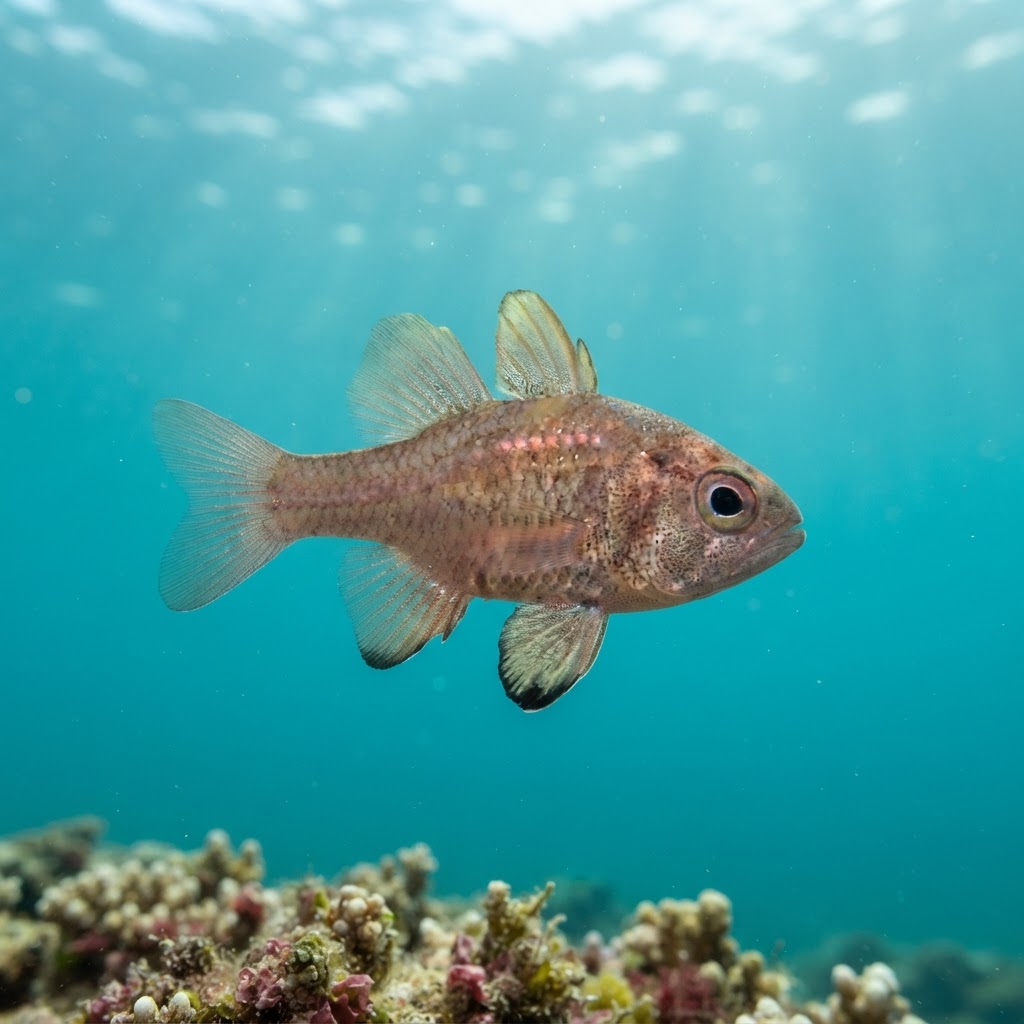
A stocky little fish that tops out around 10 cm, with a mottled brown to reddish body and a noticeably large, dark eye that catches torchlight. Look for it hovering close to a rock face or wedged into a crevice rather than swimming out in the open. Two soft-rayed dorsal fins and a slightly upturned mouth give it a blunt-headed profile typical of cardinalfish.
Expect to find it tucked into shadowed crevices, under ledges or inside small caves rather than out cruising the reef. It tends to hold its position when a torch beam passes over it, more likely to shuffle deeper into cover than bolt, which makes a slow look into dark corners worthwhile. Divers most often log it as a single fish or in small loose groups rather than large schools.
Cardinalfish in this family are known for mouth-brooding, where one parent carries the fertilised eggs in its mouth until they hatch, a trait shared across the group even though it hasn't been specifically confirmed for this species in the data.
Sightings don't show a clear seasonal pattern, and the water it's found in sits at a cool 14.9 to 18.5C, consistent with southern Australia's temperate reefs year-round. Treat it as a possible sighting on any dive in the right region rather than something tied to a particular month.
This one is an Australian speciality, most reliably logged in Victoria, South Australia and Tasmania. It turns up on temperate rocky reefs rather than tropical coral, so look for it under ledges and in caves on southern Australian dive sites rather than further north.
Mapping where Southern Cardinalfish is logged…
It's an Australian species, most often logged on temperate reef sites in Victoria, South Australia and Tasmania. Look under ledges and in reef crevices rather than in open water.
There's no strong season showing up in the data, so it's best treated as a year-round possibility on southern Australian reefs, where the water stays cool at roughly 15 to 18.5C.
Look for a small, mottled brown fish about 10 cm long with a large dark eye, sheltering in a rocky crevice or under a ledge. Its blunt head and stocky body separate it from the slimmer, brighter cardinalfish found on tropical reefs.
They're a small species, reaching around 10 cm, which is typical for cardinalfish in general.
Their conservation status hasn't been formally assessed, so there's no listing of concern to flag for this species right now.
Site and sighting data is aggregated from diver logs, iNaturalist and GBIF. For taxonomy and conservation status:
Iridescent Cardinalfish
1,781 sites