
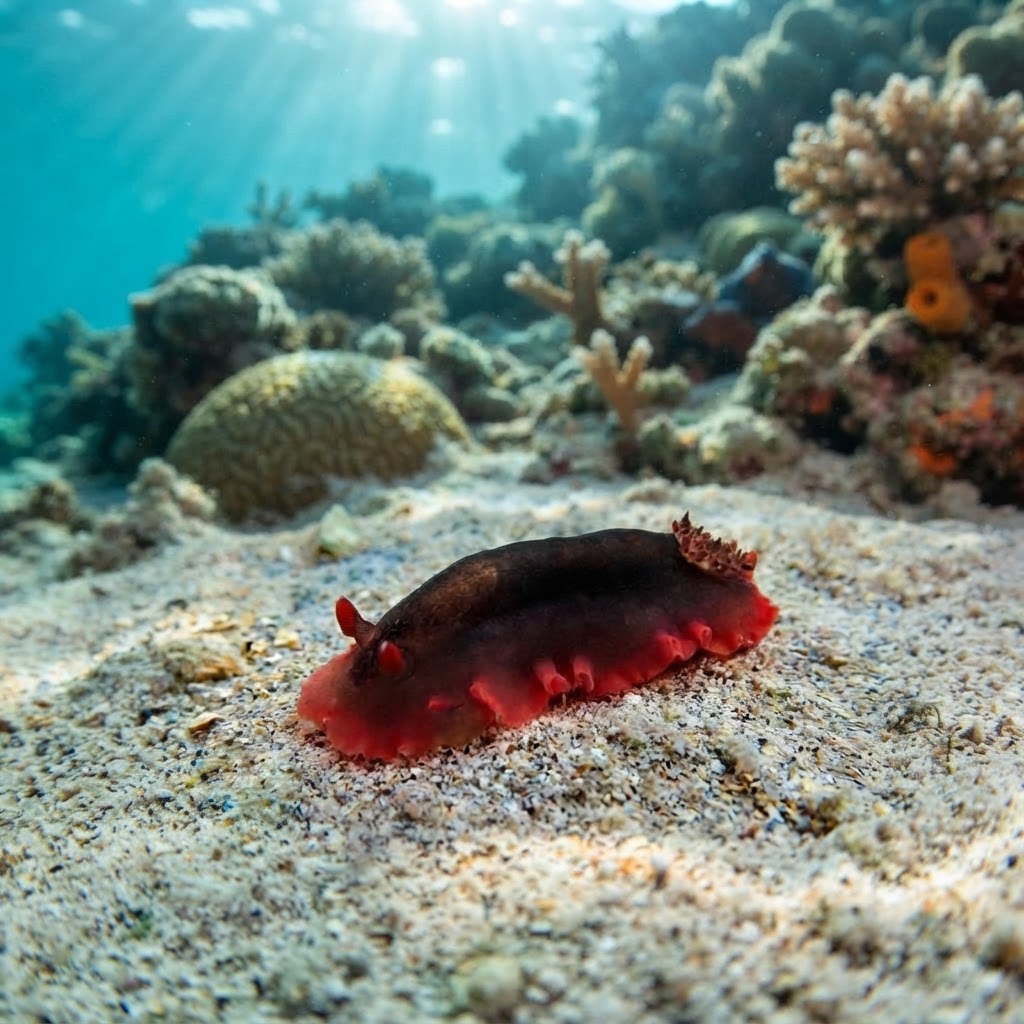
Dendrodoris fumata
A rare nudibranch find on Queensland reefs and Nouméa, comfortable in warm 20-29.5C water year-round.
Look for a soft-bodied nudibranch (a shell-less sea slug) with a smoky brown to grey mantle, often with a slightly velvety or granular texture rather than a smooth gloss. It moves slowly across the reef surface and lacks the bold contrasting stripes or spots that make many of its reef-mates easy to spot from a distance, so it tends to blend into the background until you're close.
Divers typically find it grazing slowly across hard substrate or sponge-covered surfaces, moving at the unhurried pace typical of dorid nudibranchs. It shows no reaction to divers beyond continuing its slow crawl, making it an easy subject for a close macro shot once you've spotted it.
Like other dendrodorid nudibranchs, it likely feeds on sponges and can sequester chemical compounds from its diet as a form of defence, which is part of why so few things bother eating it.
Sightings show no clear seasonal pattern, and with a comfortable range of 20 to 29.5C it can turn up on Queensland and New Caledonian reefs at any time of year.
Most diver logs for this species come from Queensland, Australia, with a further site recorded near Nouméa, New Caledonia. It's not a species you'll find on every reef, so treat any sighting on these coasts as a real highlight of the dive.
Mapping where Smoky Sucking Dorid is logged…
It has been logged mainly on reefs in Queensland, Australia, with an additional sighting near Nouméa, New Caledonia. Sightings are rare to uncommon everywhere it's been recorded, so it's a bonus find rather than a guaranteed one.
There's no detected seasonal pattern, so it can be seen year-round. Its comfortable temperature range of 20 to 29.5C covers the water conditions on Queensland and New Caledonian reefs across the calendar.
Look for a slow-moving nudibranch with a smoky brown to grey mantle and a matte or slightly granular texture. It lacks bright contrasting markings, so it's easy to overlook against similarly coloured reef surfaces unless you're scanning closely.
Exact size data isn't recorded for this species, but like most dendrodorid nudibranchs it stays in the small-to-modest macro range typical of the family, best appreciated with a close-focus lens.
No. It poses no danger to divers and has no known defensive behaviour towards people, so it's safe to observe and photograph up close without disturbing it.
As a dendrodorid, it likely feeds on sponges and may store chemical compounds from that diet in its own tissue as a deterrent to predators, a common survival trick among soft-bodied sea slugs.
Site and sighting data is aggregated from diver logs, iNaturalist and GBIF. For taxonomy and conservation status:
Light-spotted Aegires
3,168 sites





