Facelina auriculata
Cold-water nudibranch spotted along the Lisbon Coast and Northern Ireland, thriving in 9-18°C water year-round on rocky reefs.
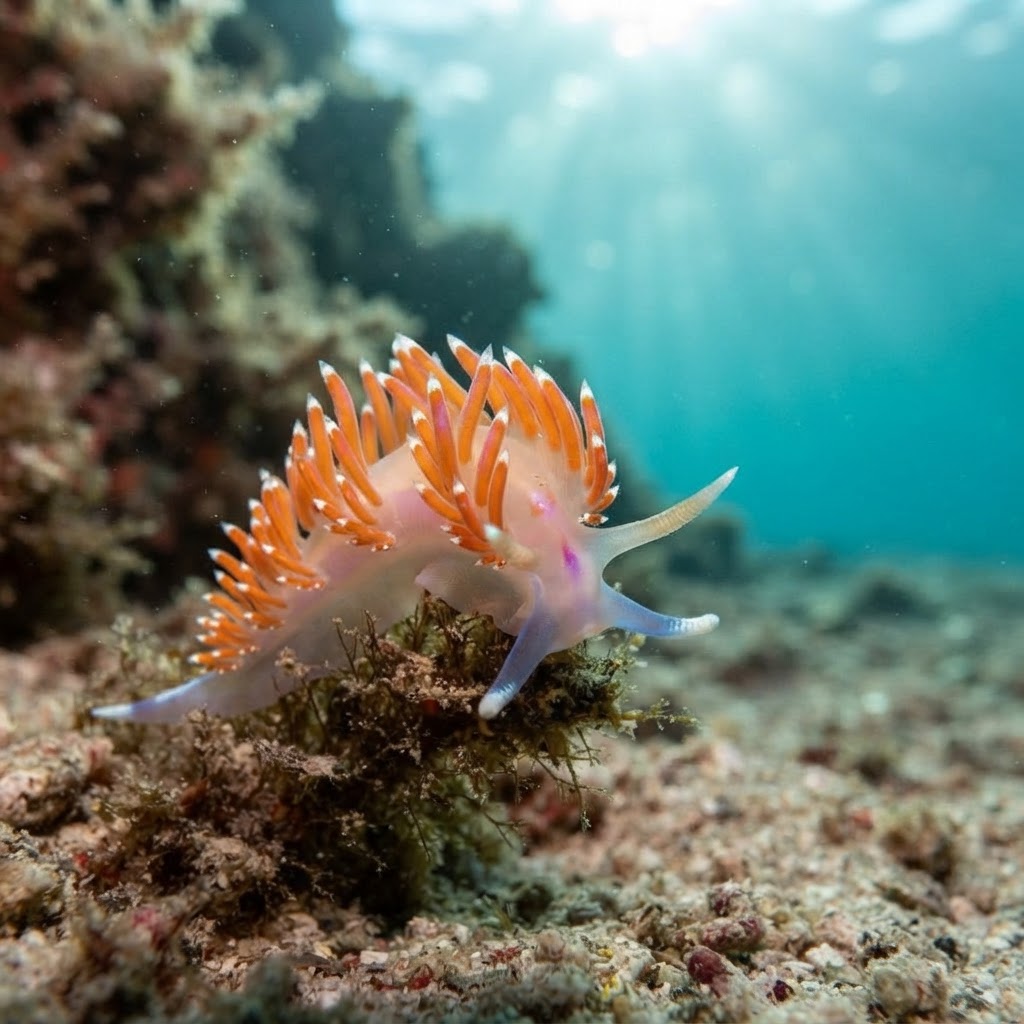
A slender, translucent white to pale grey body carried low over rock and weed, with rows of long finger-like projections called cerata (soft tentacle-like extensions on the back) tipped in vivid orange or reddish-brown. Two curled, ringed rhinophores (sensory tentacles on the head) sit up front and are one of the easier features to pick out in a torch beam. Most individuals divers log are small and easy to miss unless you're already scanning rock crevices and weed at close range.
Divers find it moving slowly over rock and algae, usually tucked into crevices or grazing low on the reef rather than out in the open. It shows no reaction to divers beyond the usual slow nudibranch pace, so a careful, close look with a torch is the best way to actually spot one rather than expecting it to come to you.
Like other aeolid nudibranchs, it feeds on hydroids and can store stinging cells from its prey in the tips of those orange cerata, turning its own food source into a defence.
There's no clear seasonal peak in the sightings data, and with a temperature range of roughly 9 to 18°C it seems to tolerate a good spread of cold to cool-temperate conditions, so treat it as a year-round find rather than a seasonal target.
This one is most reliably found around the Lisbon Coast in Portugal and across the United Kingdom, particularly Northern Ireland, England, and Wales. It also turns up along Brittany in France, Nova Scotia in Canada, and Clare in Ireland, with smaller numbers reported from Scotland, Spain, and Norway.
Mapping where Slender Facelina is logged…
It's most commonly logged along the Lisbon Coast in Portugal and across the UK, especially Northern Ireland, England, and Wales, with further sightings in Brittany, Nova Scotia, and Ireland's Clare coast.
Sightings don't show a strong season, and it's recorded across a wide cold-to-cool temperature range, so it can turn up on a dive at almost any time of year.
Look for a slender translucent white or grey body covered in long cerata tipped orange or reddish-brown, with two ringed rhinophores on the head. It moves slowly over rock and weed rather than swimming.
Exact size figures aren't well documented for this species, but like most facelinid nudibranchs it's a small, slender animal best spotted with a close, careful look rather than from a distance.
It feeds on hydroids and can recycle their stinging cells into the tips of its own cerata, using a borrowed weapon for defence rather than making its own.
Site and sighting data is aggregated from diver logs, iNaturalist and GBIF. For taxonomy and conservation status:
Light-spotted Aegires
3,168 sites