Aeolidia papillosa
Look for this fuzzy grey-brown nudibranch in Zeeland, Nova Scotia and Jutland, thriving in 7-13C water year-round.
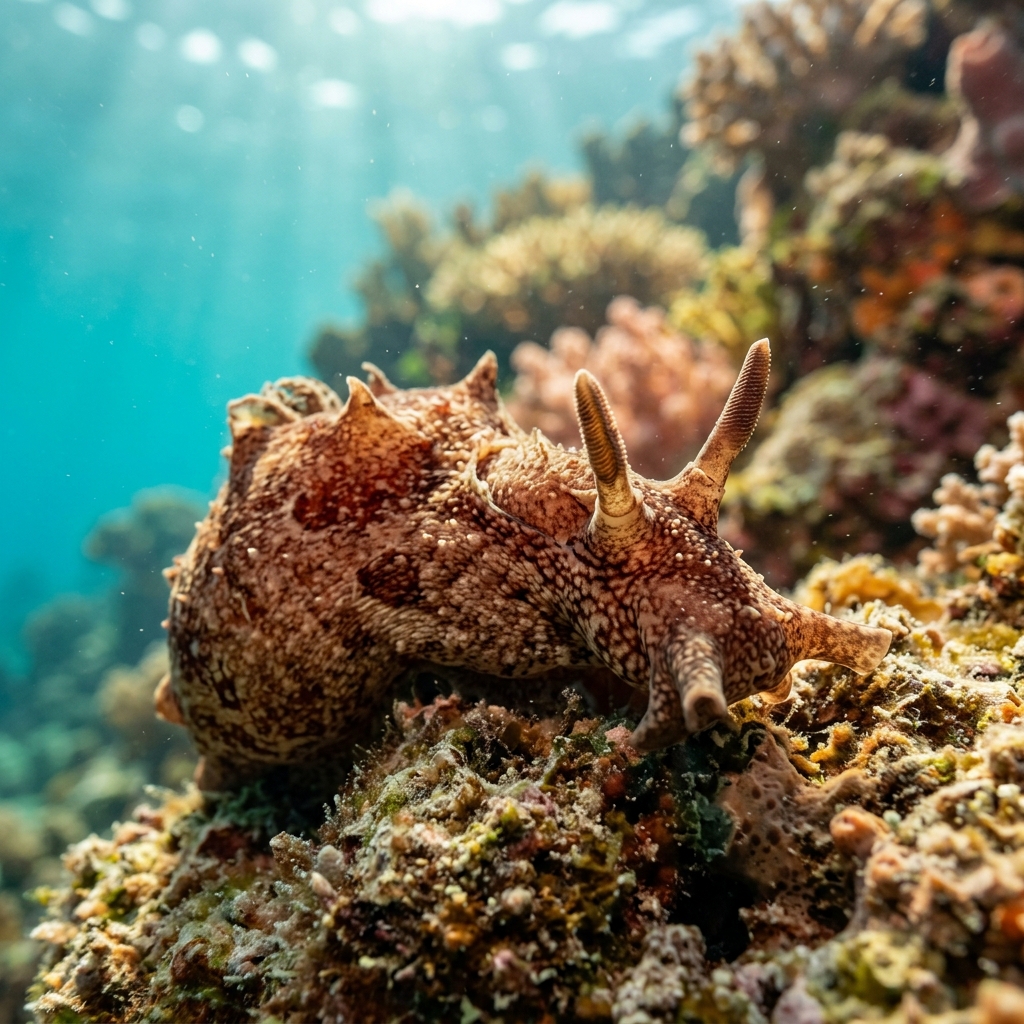
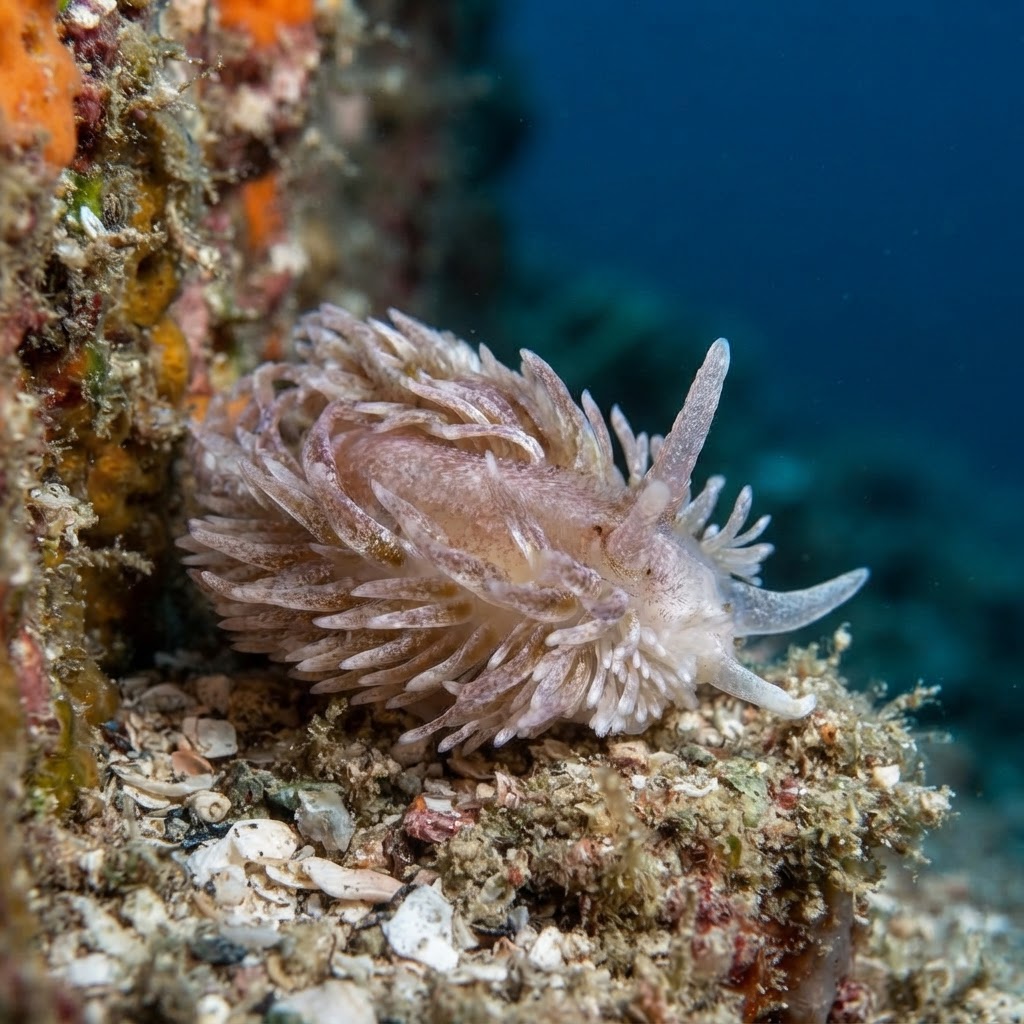
A soft, shaggy-looking body covered in dense, finger-like projections (cerata) that give it a matted, fur-like texture rather than a smooth nudibranch profile. Colour ranges from mottled grey-brown to reddish or cream, usually blending with the silty or rocky bottom it sits on. Grows to around 7 cm, with a broad, low-slung body and short head tentacles (rhinophores) that are easy to miss against the shaggy cerata. There's no obvious sexual dimorphism to spot underwater.
Found crawling slowly over rock, cobble and silty bottoms, often tucked near anemone colonies since anemones are its main prey. It ignores divers completely, relying on its dull, shaggy camouflage to go unnoticed rather than fleeing. Most sightings are made by divers deliberately scanning low-light, cooler sites rather than spotting it from a distance.
It eats anemones and can steal their stinging cells (nematocysts), storing them in the tips of its own cerata to use as a defence against predators.
No clear seasonal pattern shows up in the sightings, and with a temperature niche of roughly 6.8 to 12.8C it's built for cold water year-round rather than a warm-season pulse. Treat it as a dive-it-whenever-you're-in-the-region species.
Most reliably found in Zeeland in the Netherlands, Nova Scotia in Canada, and Østlandet in Norway, with a strong showing also in Jutland, Denmark. Smaller but real populations turn up in Quebec and British Columbia in Canada and the Northeast US, so this is very much a cold-water North Atlantic and North Sea species.
Mapping where Shag-rug Aeolis is logged…
It's most commonly logged in Zeeland in the Netherlands, Nova Scotia in Canada, and Østlandet in Norway, with additional sightings in Jutland, Denmark and along the Northeast US coast.
There's no strong seasonal pattern in the data, and it tolerates cold water down to around 7C, so it's a year-round find at cool-water dive sites rather than a seasonal special.
Look for a shaggy, grey-brown to reddish body around 7 cm long, covered in dense finger-like cerata that give it a matted, fur-like look rather than smooth nudibranch skin. It usually sits low against rock or silt near anemones.
It typically reaches about 7 cm in length, making it a mid-sized nudibranch that's still easy to overlook against a cluttered, silty seabed.
It feeds on anemones and can recycle their stinging cells into the tips of its own cerata, effectively borrowing its prey's weapons for its own defence.
No, it poses no threat to divers. It has no ability to sting through skin and simply crawls slowly over rock and silt, ignoring anyone nearby.
Site and sighting data is aggregated from diver logs, iNaturalist and GBIF. For taxonomy and conservation status:
Light-spotted Aegires
3,168 sites