Abudefduf saxatilis
Yellow-and-black striped and always in the shallows: sergeant majors are a near-guaranteed sight in the Yucatán, Florida, and Bay Islands.
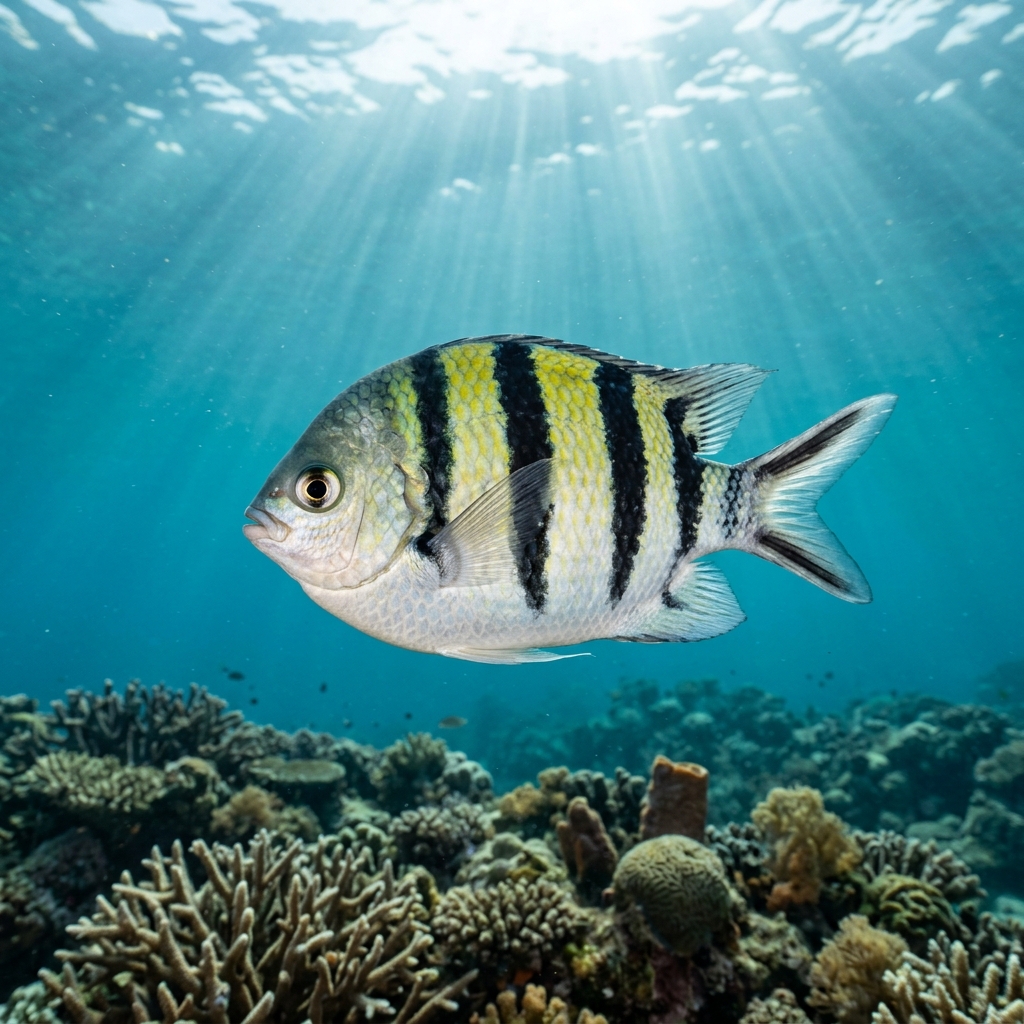
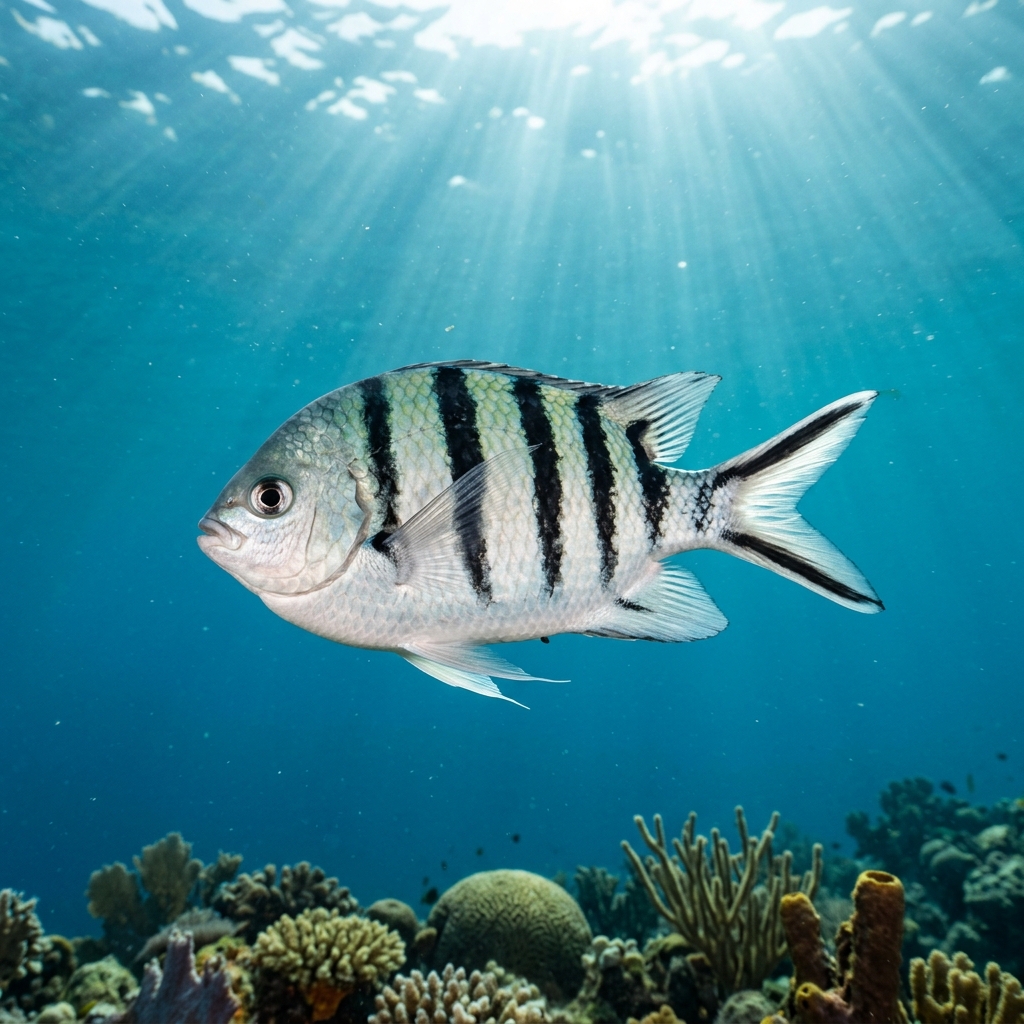
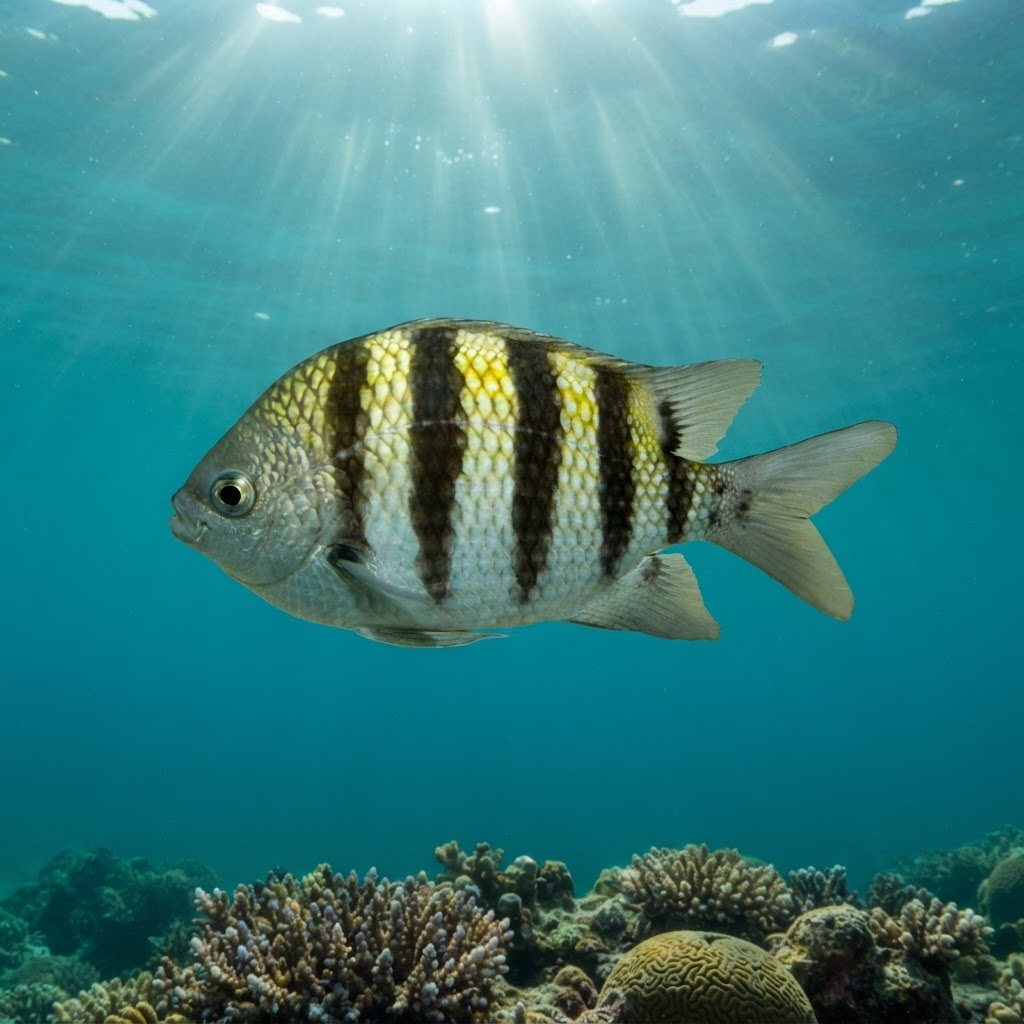
Five or six bold black vertical bars run down a body that shifts from silvery white to pale yellow above, giving it a striped, almost convict-like look. It tops out around 15 cm, deep-bodied and slightly flattened side to side, and swims in loose, hovering groups just off the reef. Breeding males darken noticeably, taking on a deep blue-grey wash across the head and upper body while guarding eggs.
Expect to find them hovering in loose aggregations over shallow reef, rubble, and even dock pilings, picking at plankton in the water column or grazing algae off the rock. They are unbothered by divers and snorkellers, often drifting close out of curiosity rather than fleeing, though territorial males guarding a nest will dart at anything that gets too near, including a fin or a hand. Most activity happens in the shallows, from the surface down to a few metres, making them a fixture of the first minutes of almost any Caribbean dive.
Males stake out a patch of rock or dead coral, clean it, then guard a purple-tinted mat of eggs laid there by a female, fanning and defending the nest until the fry hatch days later.
There is no strong seasonal pattern in the sightings, and with a comfortable range of roughly 20 to 28 C it holds territory on tropical and subtropical reefs all year, so any month works for a dive or snorkel trip.
This is one of the most reliably logged reef fish in the wider Caribbean and Gulf, with the strongest numbers coming from the Yucatán Peninsula in Mexico and Florida in the United States. It also turns up consistently through the Bay Islands of Honduras, Grand Cayman, Bonaire's Leeward Coast, the British Virgin Islands, Colombia's Caribbean coast, and Curacao, usually on shallow reef and rubble close to shore.
Mapping where Sergeant Major is logged…
They are a near-constant sight on shallow Caribbean and Gulf reefs, most reliably logged in the Yucatán Peninsula in Mexico, Florida, the Bay Islands of Honduras, Grand Cayman, and Bonaire's Leeward Coast.
There's no clear season in the data, and they tolerate a wide temperature range, so they're present on the reef year-round rather than tied to a particular month.
Look for a deep-bodied, silvery-yellow fish about 15 cm long with five or six bold black vertical bars running down each side. Breeding males turn a darker blue-grey across the head while guarding their egg nest.
They typically reach around 15 cm in length, a fairly small but easy-to-spot reef fish that often gathers in loose groups.
No. They pose no danger to divers, though a nest-guarding male may make a quick nip or bump at anything that gets too close to his eggs.
Males clean a patch of rock, coax a female to lay a purple-hued mat of eggs on it, and then guard and fan that nest alone for several days until the eggs hatch.
Site and sighting data is aggregated from diver logs, iNaturalist and GBIF. For taxonomy and conservation status:
Dascyllus
3,697 sites