Facelina bourailli
A rare aeolid nudibranch logged uncommonly on Queensland reefs at 21 to 27C, year-round on Australia's warm subtropical coast.
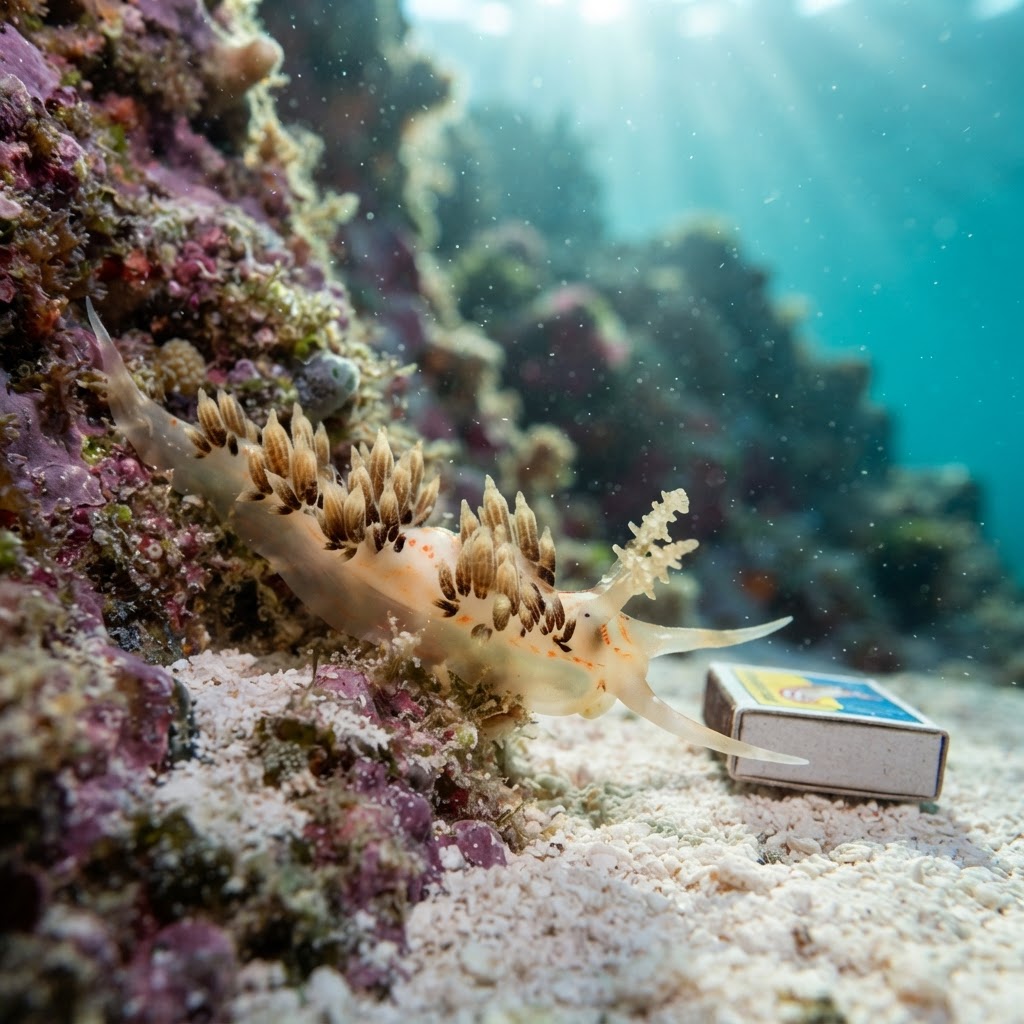
A small aeolid (a nudibranch group with tufted finger-like projections called cerata covering its back rather than a smooth mantle) recognised by the dense, feathery cluster of cerata running the length of its body. Look for fine, thread-like markings across the head and cerata tips that give it a scribbled look rather than a solid colour block. Its overall shape is slender and tapering, with paired tentacles (rhinophores) held upright near the head, and it moves slowly enough over sponge and hydroid patches to get a close look.
Found grazing slowly across sponge and hydroid-covered substrate, where it feeds on the stinging polyps and repurposes their defences for its own protection. It pays divers no attention and will simply keep browsing across the reef surface when approached, so a slow, careful look with a torch or magnifier is the best way to spot the fine scribbled patterning up close. Most sightings come from divers scanning rubble and encrusted surfaces rather than open reef.
Like other aeolids, it feeds on stinging hydroids and stores their unfired nematocysts in its cerata tips, turning a borrowed defence into its own protection against predators.
No clear seasonal pattern shows up in the sightings, and the observed temperature range of 21.3 to 27.3C spans most of the year on Queensland reefs, so it is best treated as a year-round find rather than tied to a particular month.
The only confirmed diver sightings in the data come from Queensland, Australia, making it the species' one reliable known location for now. It has not been logged elsewhere, so treat any other report with caution until more dive data comes in.
Mapping where Scribbled Tentacle Aeolid is logged…
The only documented sightings come from Queensland, Australia, where it has been logged as an uncommon find on local reefs. No other regions currently have confirmed records.
There is no strong seasonal signal in the sightings, and it has been recorded across a temperature range of 21.3 to 27.3C, so it appears to be present year-round rather than tied to a specific season.
Look for a slender aeolid nudibranch with dense, feathery cerata covering its back and fine thread-like scribbled markings across the head and cerata tips. It moves slowly over sponge and hydroid patches, making close inspection possible.
Exact size data is not available for this species, but like most aeolid nudibranchs it is small, typically only reaching a couple of centimetres, so divers usually need to look closely to spot one.
It feeds on stinging hydroids and stores their undischarged stinging cells in the tips of its own cerata, effectively hijacking its prey's defences to protect itself from predators.
No, it poses no danger to divers. It is a tiny, slow-moving grazer that can be observed safely at close range without any risk.
Site and sighting data is aggregated from diver logs, iNaturalist and GBIF. For taxonomy and conservation status:
Light-spotted Aegires
3,168 sites