Elysia viridis
Cold-water gem: this 2cm green sea slug turns up on Zeeland's reefs and French Riviera dives year-round in 11-19C water.
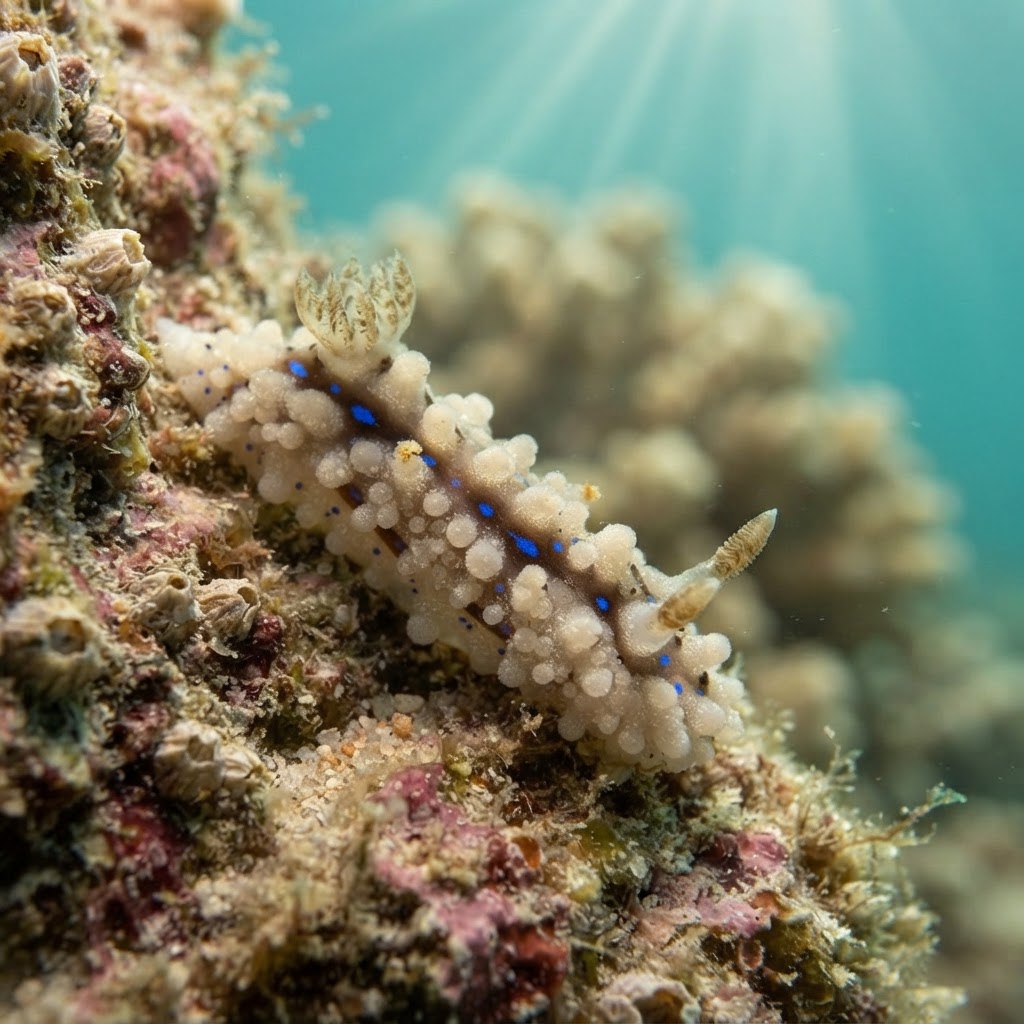
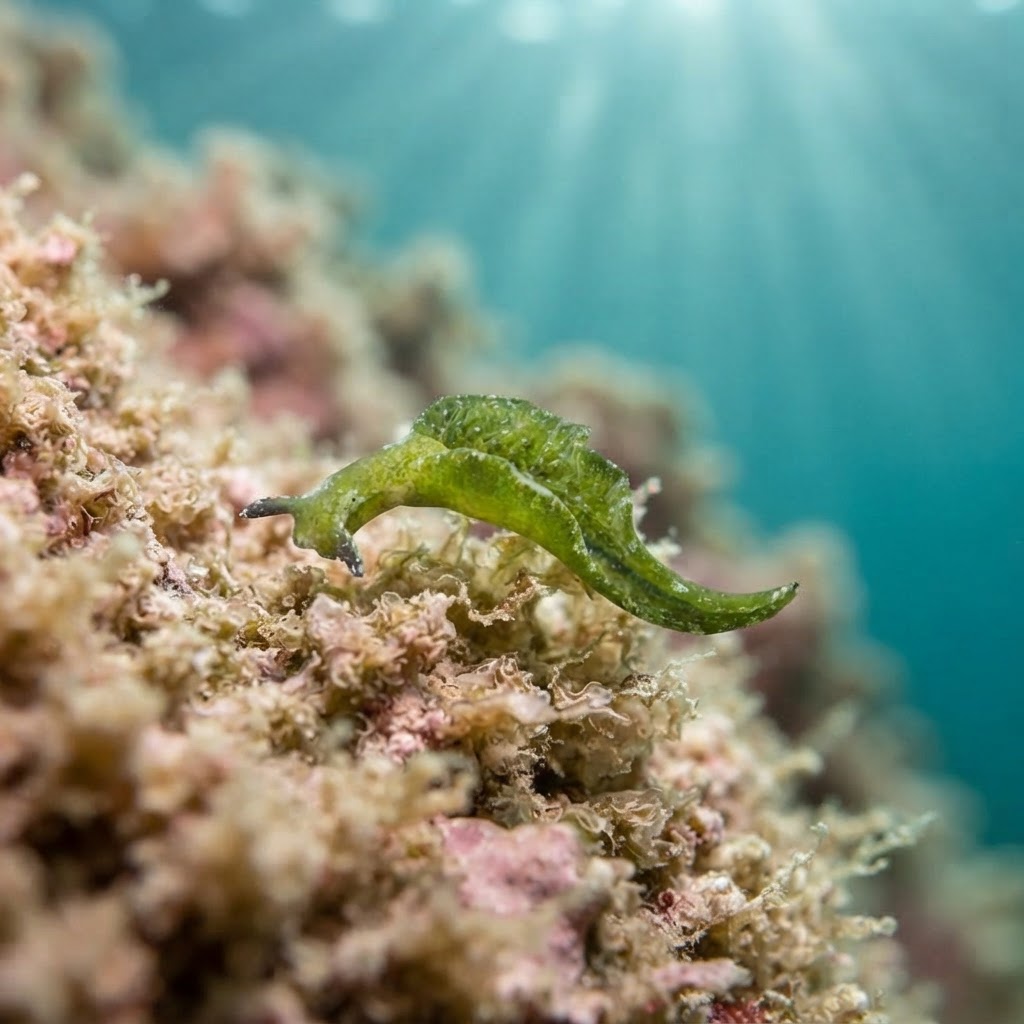
Barely 2cm long, this slug has a soft, tapering body that runs from bright grass-green to olive or reddish-brown, often speckled with tiny iridescent blue or turquoise spots. Two curled, ear-like appendages (parapodia) run along its back and can be lifted or folded flat, giving it a slightly ruffled outline. Colour varies a good deal between individuals depending on which algae it has been feeding on, so look for the blue flecking and the rolled side-flaps rather than a fixed shade of green.
Look for it sitting motionless on green algae, particularly Codium species, which it grazes on slowly and often matches in colour. It is not shy so much as easy to miss, spending most of its time tucked against algal fronds or rock crevices in shallow water rather than out in the open. Dives in the 5 to 20m range on algae-covered rock or seagrass are the places to slow down and scan closely rather than swim past.
This slug practises kleptoplasty: it feeds on green algae and retains the algae's chloroplasts in its own tissue, letting it photosynthesise for extra energy for days after a meal, which is part of why its colour tracks its diet so closely.
No clear seasonal pattern shows up in the data, and given its comfort range of roughly 11 to 19C, this slug seems to be a year-round find on the temperate reefs where it lives rather than a summer-only species.
This is a Northern European species through and through, most reliably logged in Zeeland in the Netherlands, which dominates the sightings, followed by the French Riviera and Provence and the Balearic Islands in Spain. It also turns up with fair regularity in Northern Ireland, Brittany, England, Schleswig-Holstein in Germany, and Crete, so divers working temperate rocky reefs and seagrass beds across the UK, Ireland, France, Spain, Germany, Denmark and Greece have a real shot at finding one.
Mapping where Sap-sucking Slug is logged…
Zeeland in the Netherlands is the strongest area for sightings, with the French Riviera and Provence in France and the Balearic Islands in Spain also reliable. Northern Ireland, Brittany, England and Germany's Schleswig-Holstein coast turn up sightings too.
There is no strong seasonal pattern in the sightings, and its comfort range of roughly 11 to 19C suggests it can be found on temperate reefs across most of the year rather than in one short window.
Look for a soft-bodied slug barely 2cm long, coloured green to olive or reddish-brown with scattered iridescent blue speckles, and two rolled, ear-like flaps along its back. It usually sits still on green algae, matching its background closely.
They are tiny, typically reaching only about 2cm in length, so divers need to look closely at algae fronds and rock surfaces rather than expect an obvious animal.
It steals chloroplasts from the algae it eats and keeps them functioning inside its own tissue for days, effectively letting it photosynthesise like a plant between meals.
No, they pose no danger to divers. They are small, slow-moving grazers with no sting or bite that could affect a person.
Site and sighting data is aggregated from diver logs, iNaturalist and GBIF. For taxonomy and conservation status:
Light-spotted Aegires
3,168 sites