Aegires albopunctatus
Spot the salt-and-pepper dorid on the US Pacific Coast and British Columbia in cold water from 9 to 18 °C. Sightings peak January to July.
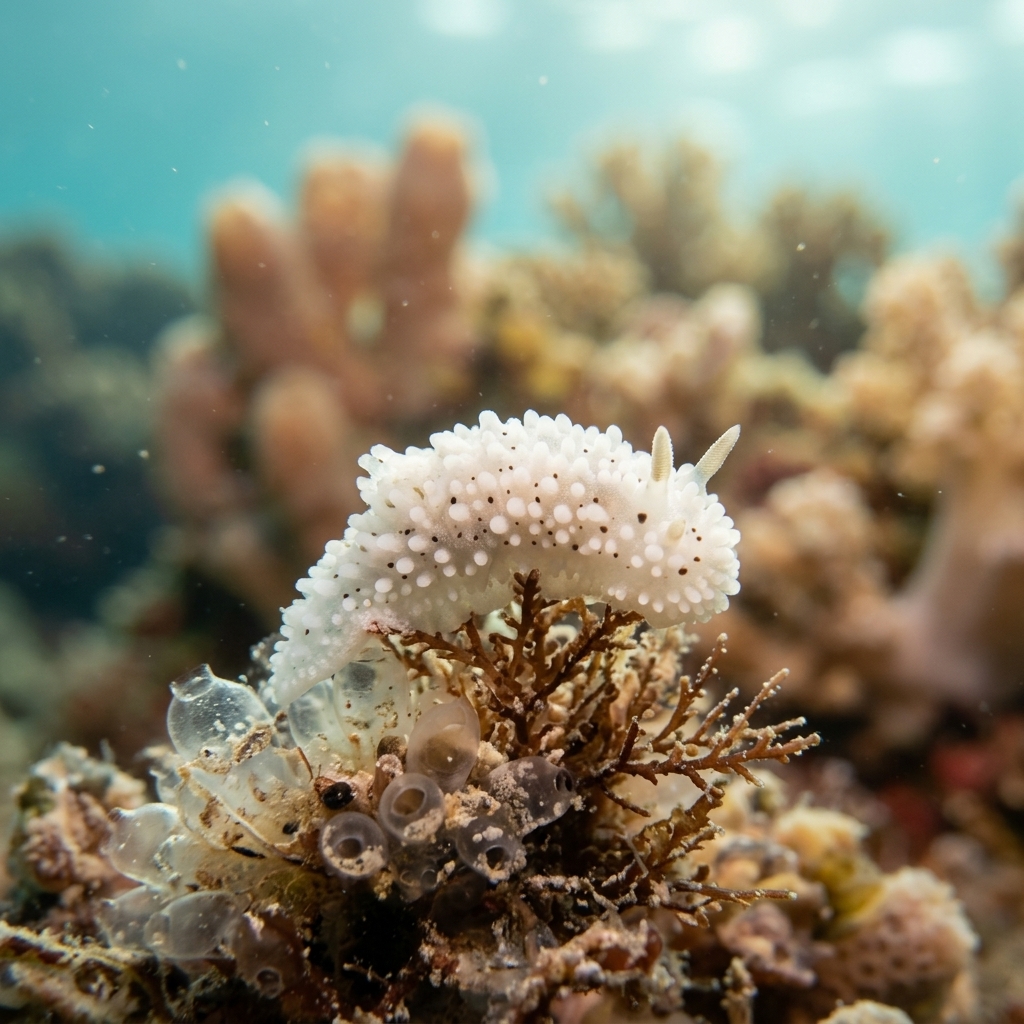
At roughly 1 cm long, this is a tiny nudibranch that demands a sharp eye and a macro lens. The body is white or pale cream and densely covered in raised, dark-tipped tubercles (wart-like bumps), giving the classic salt-and-pepper appearance that names it. Look for the stiff, club-like gills clustered at the rear and relatively simple rhinophores (scent organs) at the front. Its small size means it is most easily spotted by scanning slowly across encrusting reef and rock at close range.
When you do find one, it will almost certainly be moving slowly across hard substrate or encrusting reef, focused entirely on grazing rather than your presence. Like most nudibranchs, it shows little reaction to a diver hovering nearby. Daytime dives are your best bet, as nudibranchs in this family tend to be most active and visible during daylight hours.
Its preferred water temperature of 8.8 to 18 °C means it thrives in the cold, nutrient-rich upwelling zones of the northeast Pacific, habitats that many tropical divers overlook but that support extraordinary nudibranch diversity.
In the Northern Hemisphere, sightings concentrate between January and July, so the cooler winter and spring months are your best window on the Pacific Coast.
Reef neighbours a diver could mistake it for. Use the identification notes above to tell them apart.
Most sightings come from the US Pacific Coast, which dominates the logged sites by a wide margin. The British Columbia Coast and Vancouver Island area add further reliable locations in Canada, while a smaller number of sites are recorded in Alaska and the Northern Pacific coast of Mexico. The British Virgin Islands records are likely outliers at the warm edge of the modelled range.
Mapping where Salt-and-pepper Dorid is logged…
The species is most commonly logged along the US Pacific Coast, with additional sites on the British Columbia Coast and around Vancouver Island in Canada. A smaller number of records exist in Alaska and the Northern Pacific coast of Mexico.
Logged sightings on the US Pacific Coast and British Columbia concentrate from January through July, making winter and spring the most productive season. The species favours cold water down to about 9 °C, so it is not a warm-season target.
Look for a tiny nudibranch, around 1 cm, with a pale body covered in dark-tipped raised bumps that create a speckled pattern. The tubercle texture distinguishes it from smoother dorids. Because of its size, close approach and good lighting are essential.
They typically reach about 1 cm in length. At that size they are easy to miss against encrusting reef, so slow, deliberate searching at very close range is the only reliable approach.
Across the sites where it has been recorded, it is most frequently logged as rare, though a meaningful number of sites rate it as common or uncommon. Its tiny size likely means it is under-recorded, and patient macro divers searching cold-water rocky reef tend to find it more often than casual observers.
Site and sighting data is aggregated from diver logs, iNaturalist and GBIF. For taxonomy and conservation status:
Blue Dragon
3,163 sites