Eubranchus rustyus
A 1cm nudibranch logged across California's cold water reefs, from Monterey to the Pacific Northwest, in 10.7 to 18.9C water.
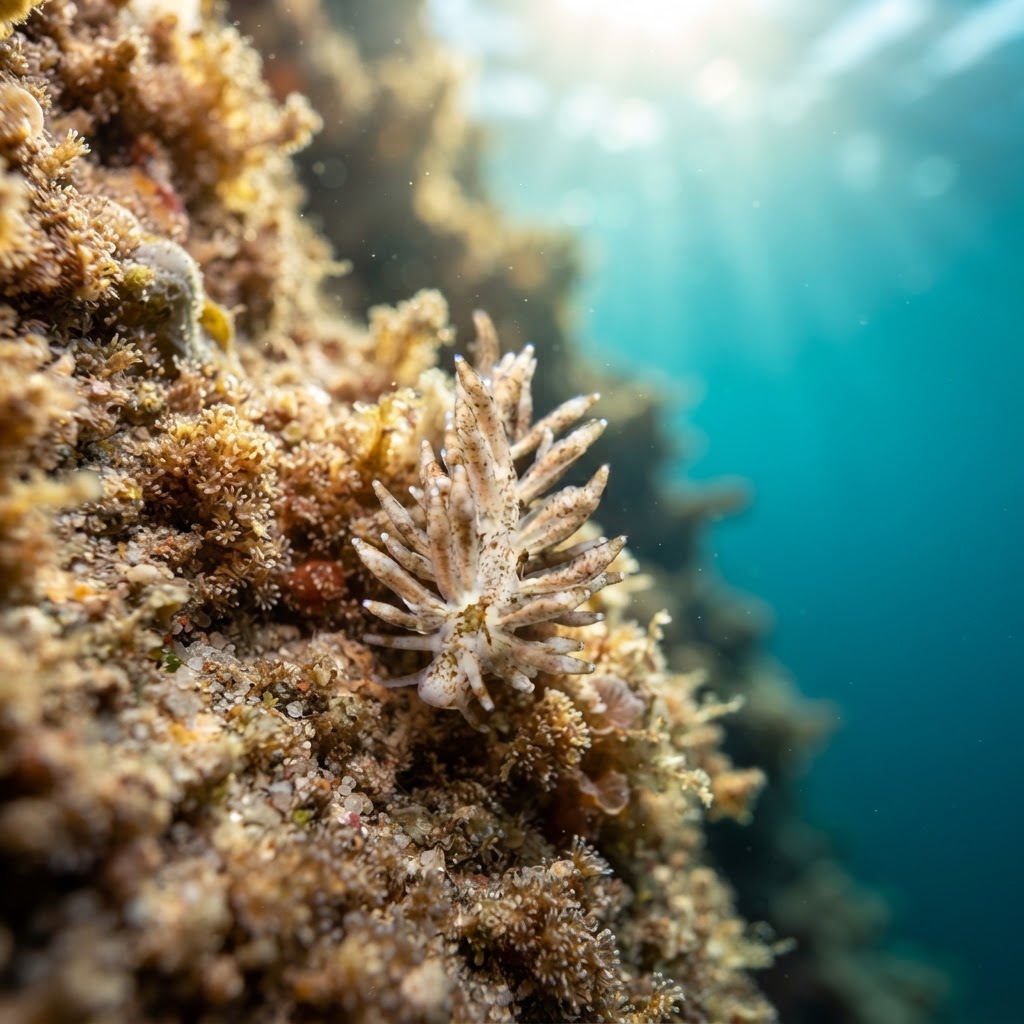
A speck of a nudibranch at about 1cm, easy to miss unless you slow down and scan holdfasts and hydroid stalks closely. Look for slender, finger-like projections (cerata) along its back with a rusty brown to reddish tone, giving it its common name. Body is translucent to pale, letting the cerata colour dominate the silhouette against grey rock or kelp.
Found creeping slowly over rocky reef and among hydroids or bryozoans, which it likely grazes on given its aeolid build. It shows no reaction to divers beyond continuing its slow crawl, being far too small and slow to flee. Most sightings come from divers doing close-focus macro work rather than mid-water scanning, since at this size it blends into the background easily.
Like other aeolid nudibranchs, its cerata probably double as both gills and a defence tool, storing stinging cells from the hydroids it feeds on to deter predators.
No clear seasonal pattern shows up in the data, so treat it as a year-round find within its 10.7 to 18.9C comfort range. That range fits California and Pacific Northwest waters for most of the year, so timing your dive around season matters less than simply searching the right substrate.
Nearly all logged sightings come from the United States, with California carrying the bulk of records and a smaller cluster in the Pacific Northwest. Divers most reliably find it working the cold-water reefs and kelp holdfasts typical of these coasts rather than warmer southern sites.
Mapping where Rustic Aeolid is logged…
Almost all recorded sightings are from the United States, concentrated in California with a smaller number from the Pacific Northwest. It turns up on cold-water rocky reef where hydroids and similar prey are present.
There is no strong seasonal pattern in the sightings, so it is considered a year-round find. Its comfort range of 10.7 to 18.9C matches California and Pacific Northwest waters for most months.
Look for a tiny, roughly 1cm slug with slender cerata in rusty brown to reddish tones along its back. Its pale, translucent body means the cerata colour is the main thing you will notice against rock or hydroid growth.
They stay tiny, typically around 1cm long, which makes them a real macro-hunting target rather than something you spot from a distance.
Like many aeolid nudibranchs, it likely feeds on hydroids and can store their stinging cells in its cerata as a borrowed defence against predators.
Site and sighting data is aggregated from diver logs, iNaturalist and GBIF. For taxonomy and conservation status:
Light-spotted Aegires
3,168 sites