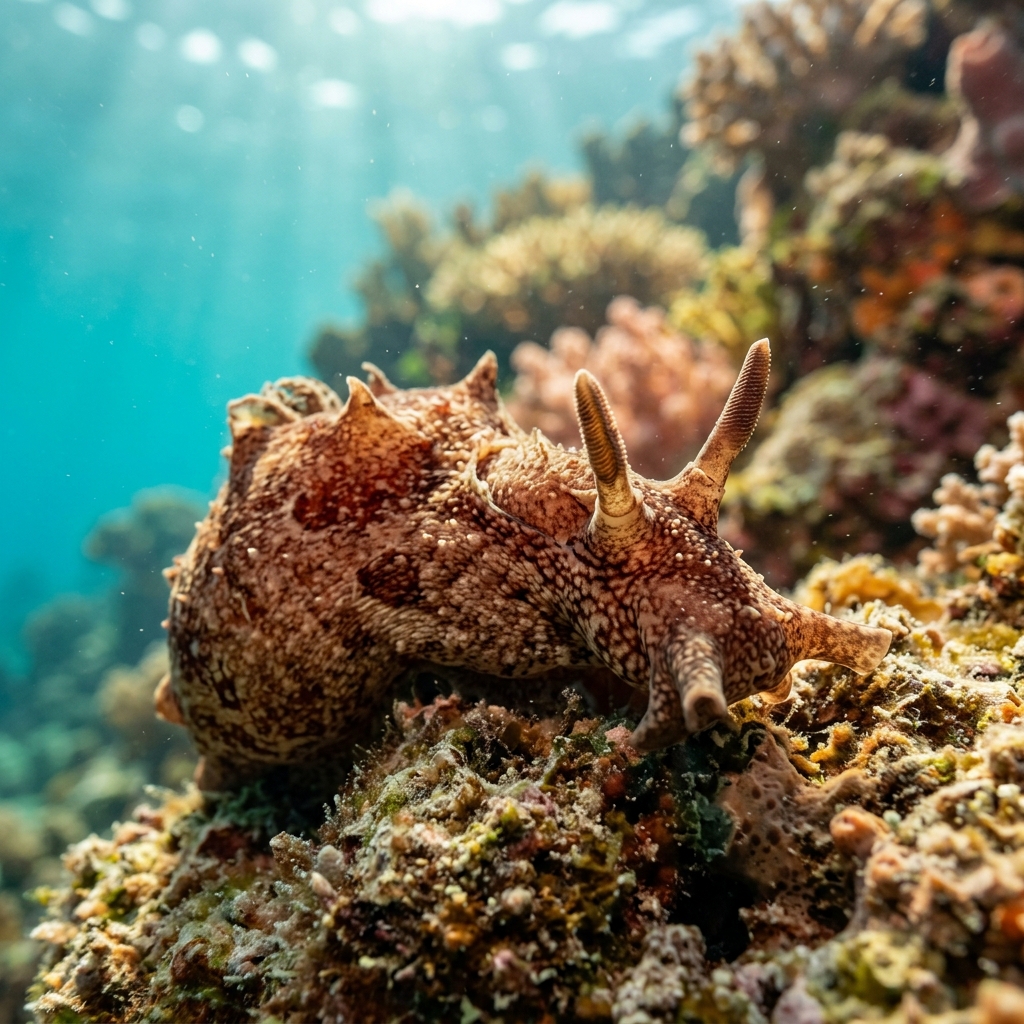
Onchidoris muricata
White, warty, and easy to miss: find Rough Doris in cold water from Nova Scotia to Bohuslän, Sweden, most days of the year.
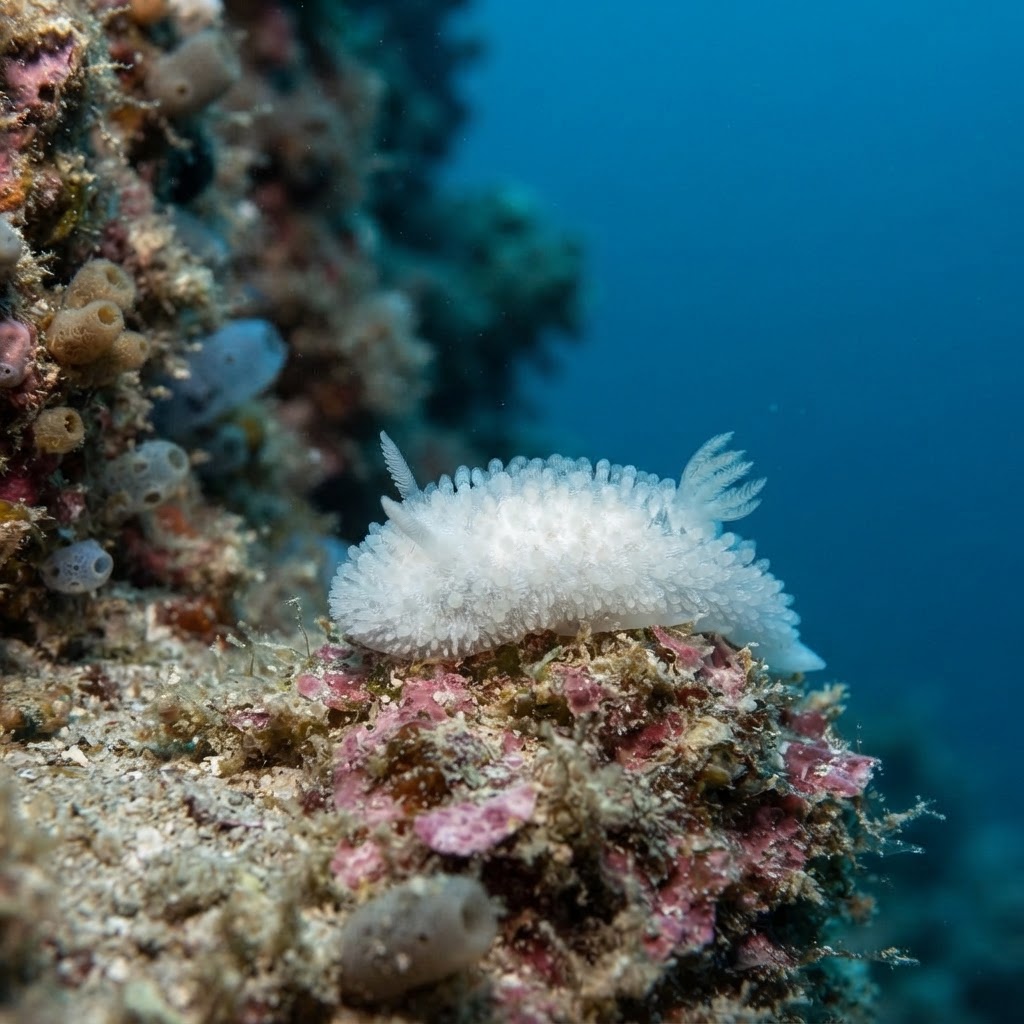
Rough Doris shows up as a small, oval, whitish to pale yellow slug covered in stubby, wart-like tubercles that give it a rough, almost frosted texture rather than a smooth back. There's no bold colour pattern to key on here, so divers rely on the bumpy, uneven surface and the small feathery gill cluster near the rear to confirm it's a dorid rather than a similar-looking pale nudibranch. It sits low and still against rock or algae, easy to swim past unless you're already looking close.
Divers find it parked motionless on rock, algae, or hard substrate at depth, doing very little that catches the eye beyond slow grazing. It shows no reaction to divers and won't move off when a light or camera gets close, which makes it an easy macro subject once spotted. Most logs describe it as an incidental find on a slow, close look at the bottom rather than something divers set out searching for.
Like other Onchidoris species, it feeds by rasping encrusting sea mats and bryozoans off rock surfaces, so finding one is a decent clue that a patch of that food is nearby.
There's no detected seasonal peak in the data, and given its narrow cold-water niche of roughly 7 to 13C, it's likely present year-round wherever that temperature band holds rather than tied to a single season.
Rough Doris turns up most reliably in cold-water diving destinations: Nova Scotia in Canada carries the heaviest logging, followed by Østlandet in Norway, Jutland in Denmark, and Bohuslän in Sweden. Divers in the Pacific Northwest and the Northeast of the United States also report it regularly, with a smaller scatter of sightings from Northern Ireland.
Mapping where Rough Doris is logged…
It's most commonly logged in Nova Scotia, Canada, and across parts of Scandinavia including Østlandet in Norway, Jutland in Denmark, and Bohuslän in Sweden. Smaller numbers turn up in the Pacific Northwest and Northeast of the United States.
There isn't a clear seasonal pattern in the sightings, and its cold-water range of roughly 7 to 13C suggests it can be found through most of the year wherever those temperatures hold.
Look for a small, pale, warty-backed slug with an uneven, bumpy texture rather than smooth skin, plus a modest feathery gill tuft near the tail. It has no strong colour pattern, so texture and shape are the main giveaways.
Exact size data isn't recorded here, but like most Onchidoris species it stays small, typically a couple of centimetres or less, so it's easy to overlook against rock and algae.
No. It's a small, slow-moving benthic slug with no sting or bite risk to divers, so there's nothing to avoid beyond not disturbing it for a photo.
Site and sighting data is aggregated from diver logs, iNaturalist and GBIF. For taxonomy and conservation status:
Light-spotted Aegires
3,168 sites