Rostanga rubra
Small, brick-red sponge dweller logged mostly around Northern Ireland in cool water down to 9C - here's how to spot it and where.
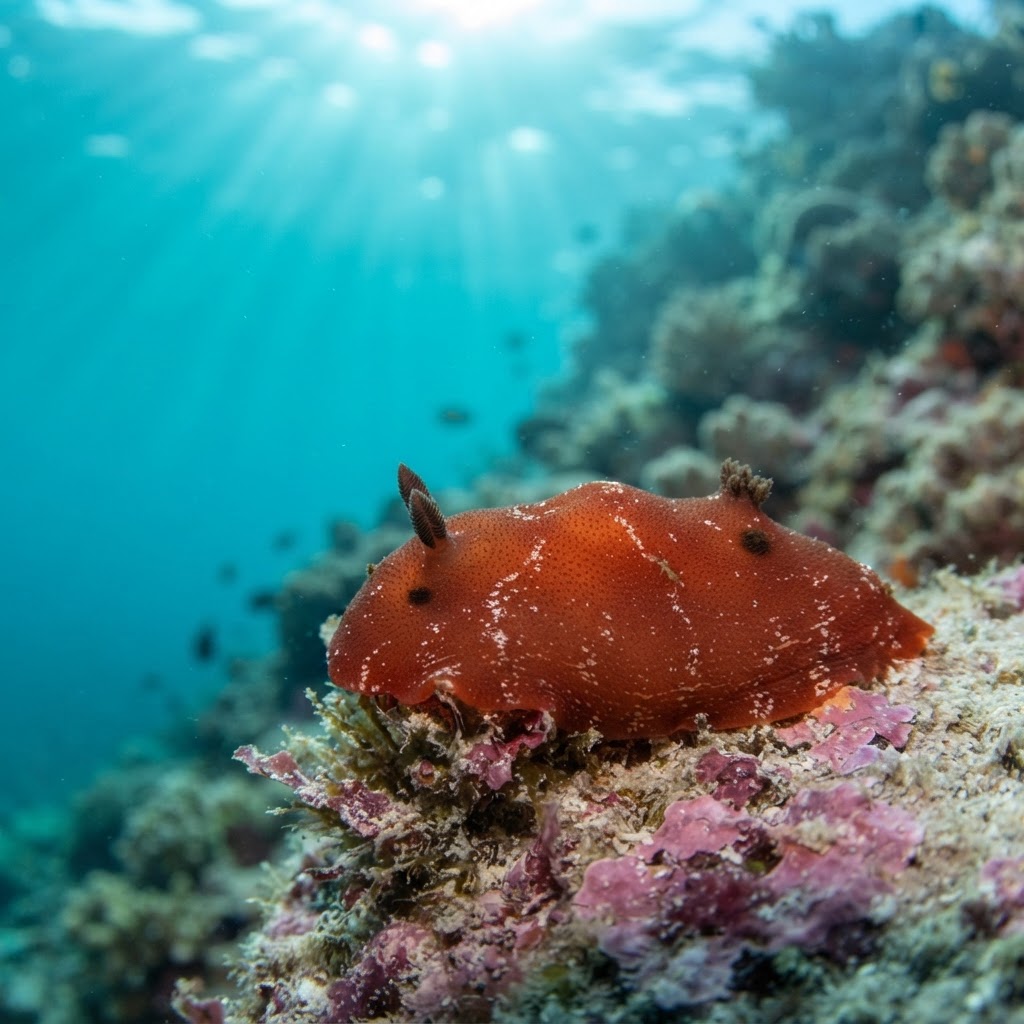
A tiny, uniformly brick-red to orange-red nudibranch that looks almost like a moving blob of the sponge it sits on, usually only a centimetre or two long in the water. The body is oval and slightly bumpy (covered in small tubercles), with short rhinophores (the paired sensory tentacles on the head) that are the same red as the rest of the body, making the whole animal easy to overlook against its background. There's no strong colour contrast or pattern to key on, so divers usually spot it by first finding a patch of red encrusting sponge and then looking closely for movement.
Found sitting still or grazing slowly across patches of encrusting red sponge, its main food source, usually tucked into rocky crevices or under ledges rather than out in the open. It shows no reaction to divers beyond simply not moving fast, since like most nudibranchs it has no real means of fleeing. Most sightings come from divers doing slow, close-focus searches along sponge-covered rock rather than mid-water swims.
Its red colour is a direct match to its food: this species feeds on and lives almost exclusively on red encrusting sponges of the genus Ophlitaspongia, and its body pigment is thought to come straight from that diet.
There's no clear seasonal pattern in the sightings, and with a temperature niche of 9 to 15C it's a species of cool UK and Atlantic water year-round rather than a warm-season specialist. Divers log it across the seasons wherever suitable red sponge is present.
Reef neighbours a diver could mistake it for. Use the identification notes above to tell them apart.
Most reliably logged around Northern Ireland, which accounts for the bulk of sightings, followed by sites across England and Wales, so it's very much a UK cold-water species. Smaller numbers turn up in Brittany, France, and along the west coast of Ireland in the Galway & Connemara area, and in the Channel Islands.
Mapping where Rostanga rubra is logged…
It's most commonly logged around Northern Ireland, with further sightings across England and Wales. Smaller numbers of records come from Brittany in France and the west coast of Ireland.
There's no strong season in the sightings data, and it tolerates cool water from about 9 to 15C, so it's seen year-round on UK and Irish reefs rather than at one particular time of year.
Look for a small, uniformly brick-red to orange oval nudibranch sitting on patches of matching red encrusting sponge. It has no bold patterning, so the giveaway is spotting movement on a red sponge patch rather than colour contrast.
It's a small species, typically only around a centimetre or two long in the water, which along with its camouflage makes it easy to swim straight past.
Its colour comes from its diet: it feeds almost exclusively on red encrusting sponges, and that pigment is thought to carry through into its own body colour, giving it near-perfect camouflage on its food source.
Site and sighting data is aggregated from diver logs, iNaturalist and GBIF. For taxonomy and conservation status:
Blue Dragon
3,163 sites