Rostanga pulchra
Spot the Red Sponge Dorid on the Pacific Coast of the US and British Columbia. Here's when to look, where to dive, and how to tell it apart.
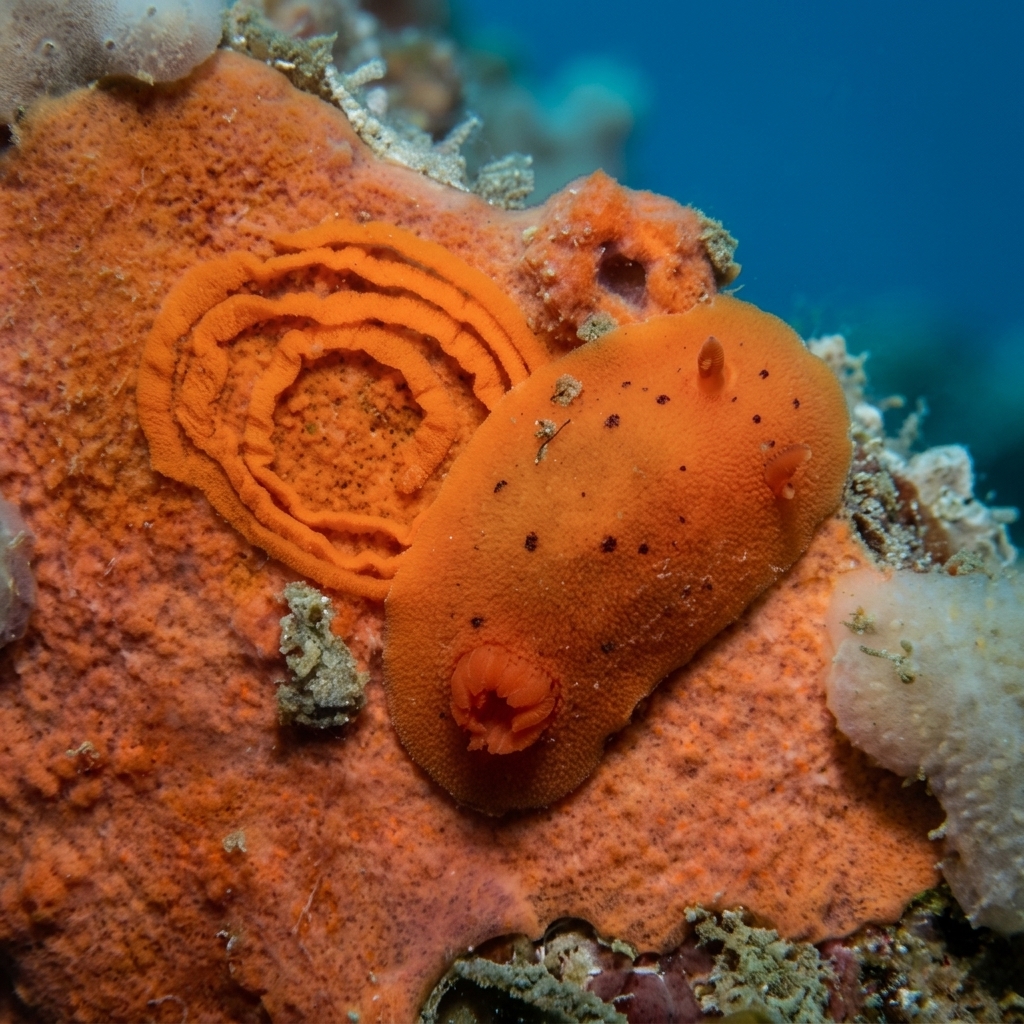
A small, flattened dorid nudibranch with a reddish to orange-brown background colour covered in dark spots and raised tubercles (bumpy projections), which helps it blend almost perfectly against red encrusting sponge. The gills and rhinophores (sensory horns) are similarly coloured, making the whole animal look like part of the reef if you're not paying close attention. Key on the distinctive spotted, bumpy texture and the warm reddish tone; most divers miss it entirely on a first pass.
When you find one, it will almost certainly be stationary or moving at a glacier's pace across encrusting sponge, which it feeds on and uses as camouflage simultaneously. It pays virtually no attention to divers; at its size, the more realistic concern is accidentally overlooking it entirely. Slow down, get your eye in for red-on-red texture, and scan rocky or sponge-covered walls carefully.
Its camouflage is functional rather than coincidental: by feeding directly on red encrusting sponge, the animal takes on the sponge's pigmentation and texture, making it one of the better-disguised nudibranchs on temperate Pacific reefs.
Northern Hemisphere sightings concentrate between January and August, so late winter through summer is the window to focus on for the US and Canadian Pacific coast. Water temperatures where it has been recorded range from around 16 °C to 28 °C, covering the cool temperate conditions typical of its range.
Reef neighbours a diver could mistake it for. Use the identification notes above to tell them apart.
Most sightings come from the Pacific Coast of the United States, which accounts for the large majority of logged dive sites, with British Columbia's coast in Canada a strong second. Baja California in Mexico rounds out the core range, so the best hunting ground runs the length of the northeastern Pacific seaboard. A handful of sites in Alaska and the Central & Mountain West add to the US tally.
Mapping where Red Sponge Dorid is logged…
The Red Sponge Dorid is most reliably logged along the Pacific Coast of the United States, with British Columbia in Canada and Baja California in Mexico also offering solid opportunities. The species hugs the northeastern Pacific seaboard, so rocky temperate reefs in those regions are your best bet.
Based on logged sightings in the Northern Hemisphere, January through August sees the most observations, making late winter, spring, and early summer the prime window. Diving the cool rocky reefs of California, Oregon, or British Columbia during those months gives you the best odds.
Look for a small, flat nudibranch with a reddish to orange-brown body covered in dark spots and a bumpy, tubercled surface. It blends tightly with red encrusting sponge, so the trick is scanning sponge patches slowly and looking for the outline of gills or rhinophores breaking the texture. The spotted, warty appearance is the key field mark.
Exact size data for this species is limited, but like most dorids in its genus it is a small nudibranch, typically only a centimetre or two in length. That small profile is a big reason why divers frequently swim right past one without noticing it.
It feeds on red encrusting sponges and in doing so acquires their colouration and texture, becoming nearly indistinguishable from its food source. The bumpy tubercles on its back further mimic the irregular surface of the sponge. It is a practical, built-in defence against predators that also makes it a challenge to spot for divers.
Site and sighting data is aggregated from diver logs, iNaturalist and GBIF. For taxonomy and conservation status:
Blue Dragon
3,163 sites