Diaphorodoris lirulatocauda
A 1cm nudibranch logged mostly in the Pacific Northwest and California, thriving in cold water down to 10 C. Here's where divers actually find it.
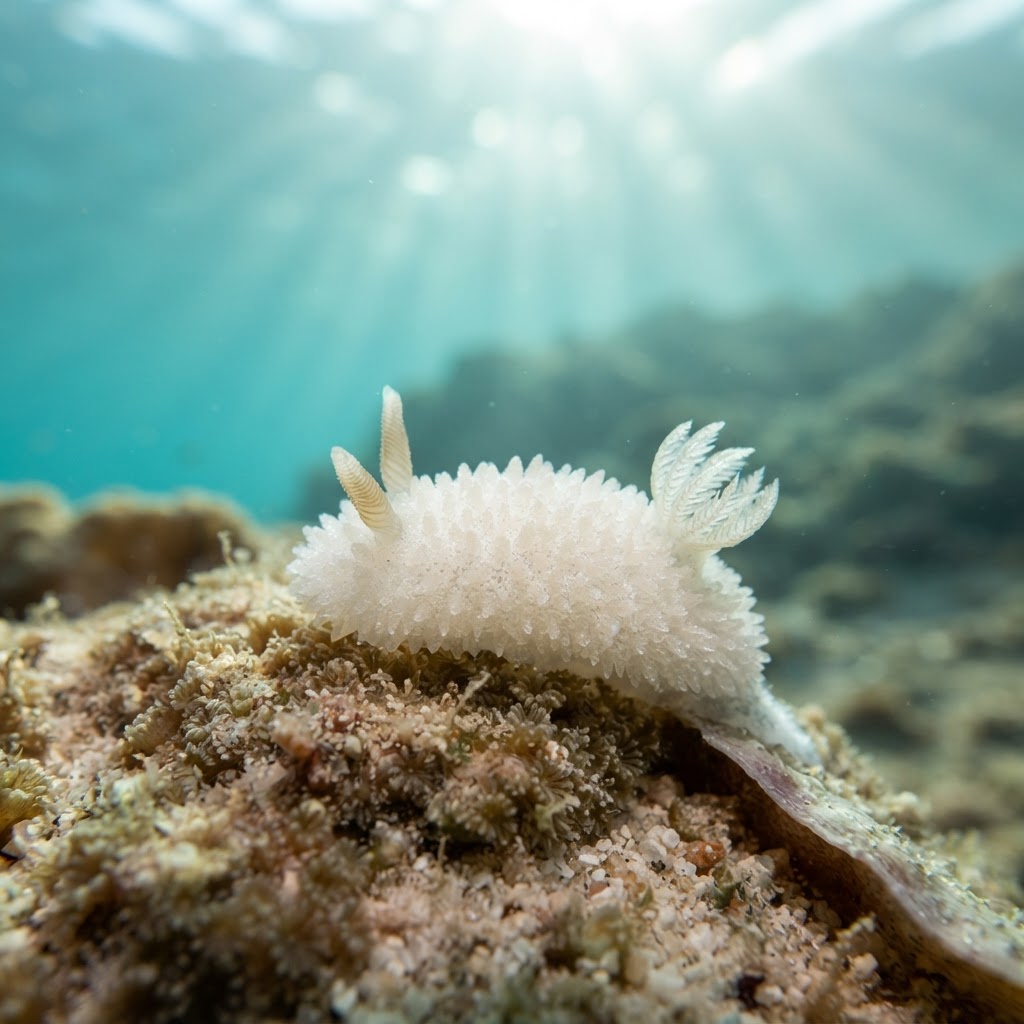
At a centimetre long, this is a nudibranch you find by looking closely, not by scanning the reef. The body is covered in small raised bumps (tubercles) that give it a rough, granular texture rather than a smooth dorid profile. Colour tends toward pale white or cream, and the size alone rules out most other dorids you'd meet on a Pacific Northwest wall.
Look for it grazing slowly across rock and rubble at typical nudibranch pace, usually tucked into crevices or low-light corners where it's easy to swim straight past. It shows no reaction to divers beyond retracting slightly if disturbed, and most sightings come from divers doing deliberate macro searches rather than casual reef cruising. Night dives and slow drift along cobble or rocky reef tend to turn it up more often than open sand.
Like other dorid nudibranchs, it likely feeds on sponges or bryozoans using a specialised radula, converting a food source most divers never notice into its own body chemistry for defence.
Sightings don't show a clear seasonal pattern, and it turns up across a wide temperature range from around 10 to 19 C, which fits the year-round cold water typical of Pacific Northwest and Californian dive sites. Plan around good visibility and slow, close-focus diving rather than a particular month.
Reef neighbours a diver could mistake it for. Use the identification notes above to tell them apart.
This one is very much a Pacific coast find, logged almost entirely at sites in the United States. The Pacific Northwest carries the strongest record, with California close behind, so cold-water divers on the West Coast have the best shot at it.
Mapping where Porcupine Dorid is logged…
Almost all logged sightings come from the United States, with the strongest records in the Pacific Northwest and California. It's a cold-water Pacific coast species rather than one found on tropical reefs.
There's no strong seasonal signal in the sightings, and it's recorded across a wide temperature range from about 10 to 19 C, suggesting it can be found year-round on Pacific coast dives.
It's tiny, reaching only around 1 cm in length. You need to slow down and search rock crevices and rubble closely to spot one.
Check for a pale, tubercle-covered body about a centimetre long on rocky substrate. The bumpy texture and small size are the main clues since it lacks the bright colour patterns of many tropical dorids.
No, it poses no threat to divers. It's a harmless, slow-moving mollusc best appreciated by looking closely, not touching.
Site and sighting data is aggregated from diver logs, iNaturalist and GBIF. For taxonomy and conservation status:
Blue Dragon
3,163 sites