Polycera faeroensis
Look for this pale nudibranch with orange-tipped gills on cold-water reefs in Wales, Brittany and England, 10-18C year-round.
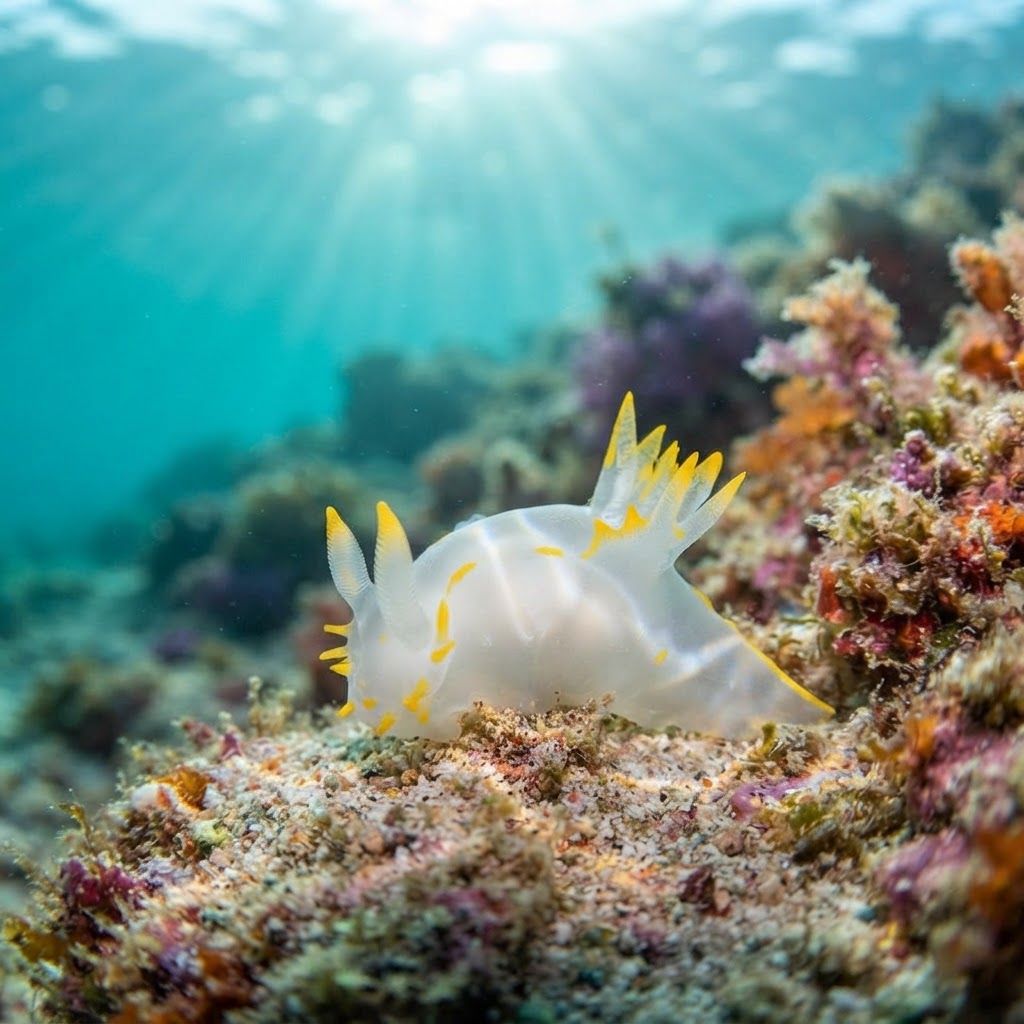
A small, slender nudibranch with a translucent white to cream body marked with faint yellow or orange lines running along the back. The giveaway is the set of finger-like projections (called extra-rhinophoral and mantle processes) tipped in vivid orange or yellow, along with a pair of similarly tipped rhinophores (sensory tentacles) at the head. It sits low on rock, kelp holdfasts and encrusting life, rarely more than a few centimetres long, so divers usually spot it by scanning slowly rather than swimming past.
Found grazing slowly over rock faces, kelp stipes and bryozoan-covered surfaces where it feeds, barely reacting to torch light or a diver hovering close by. It's a small, uncommon-to-rare find best picked out on slower macro-focused dives rather than a drift or wreck swim, and most logs come from shallower rocky reef rather than open water.
Like other polycerid nudibranchs, it feeds on bryozoans (colonial encrusting animals), and the orange tips on its body processes are thought to warn predators after it takes on distasteful compounds from that diet.
Sightings show no clear seasonal peak, and with a water-temperature niche of 10.2 to 17.9C it stays active across the UK and Brittany diving calendar, so any month with a planned dive is fair game.
Most reliably logged around Wales and England, with a strong secondary population in Brittany, France, and a scattering of records from Northern Ireland and Portugal's Lisbon Coast. This is very much a cold-temperate Atlantic species, so divers chasing it should look to UK and French Channel and Atlantic sites rather than warmer southern Europe.
Mapping where Faroe Polycera is logged…
It's most often logged in Wales and England, with a good number of sightings in Brittany, France too. Smaller numbers have turned up in Northern Ireland and along Portugal's Lisbon Coast.
There's no strong seasonal pattern in the sighting data, and it tolerates a fairly wide temperature range of roughly 10 to 18C, so it's logged across the diving year in UK and Brittany waters.
Look for a small, pale, almost see-through white or cream body with orange or yellow tipped projections along the back and on the rhinophores at the head. It moves slowly over rock and encrusting growth, staying under a few centimetres long.
Exact size data isn't confirmed, but like most polycerid nudibranchs it stays small, typically only a few centimetres long, making it an easy species to miss unless you're looking closely at rock and kelp surfaces.
It feeds on bryozoans, the small colonial encrusting animals that carpet rocks and kelp holdfasts in cold-temperate Atlantic waters. This diet is likely linked to the orange warning tips on its body.
Site and sighting data is aggregated from diver logs, iNaturalist and GBIF. For taxonomy and conservation status:
Light-spotted Aegires
3,168 sites