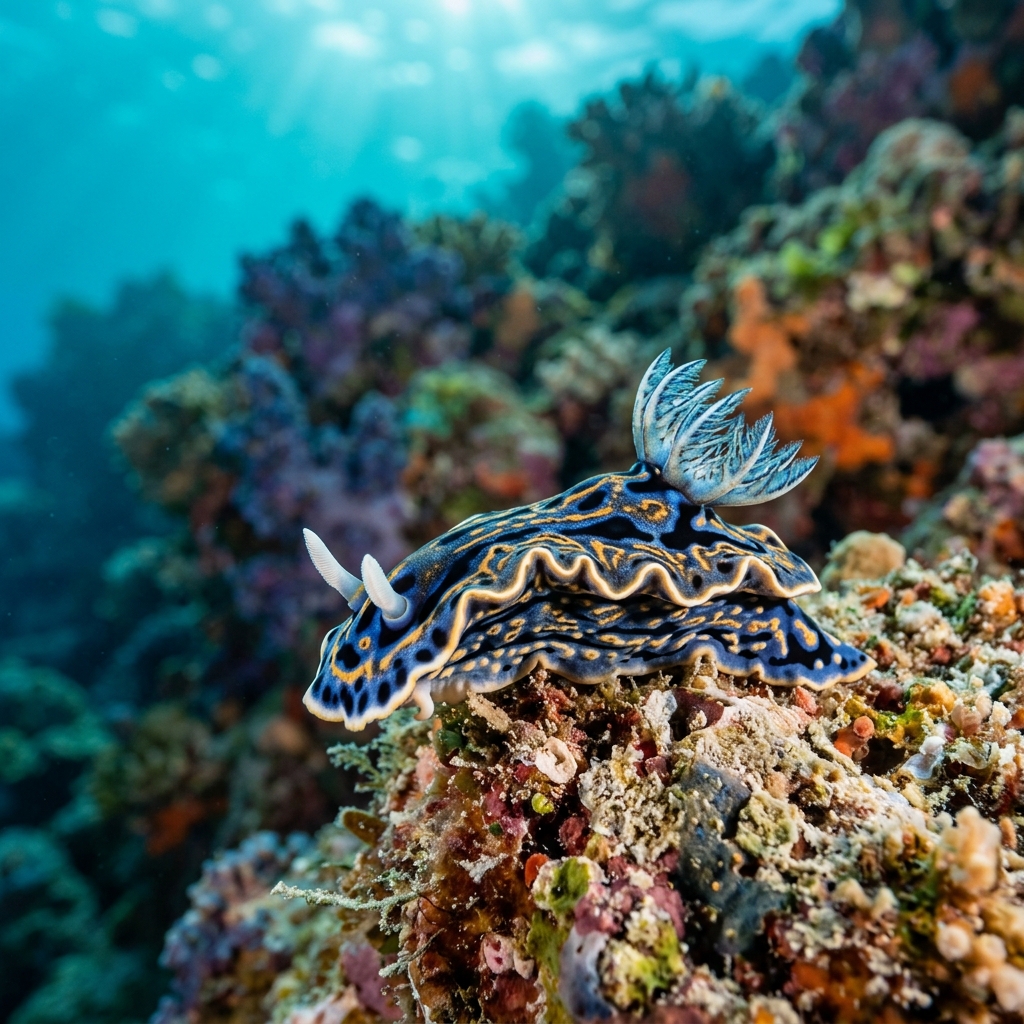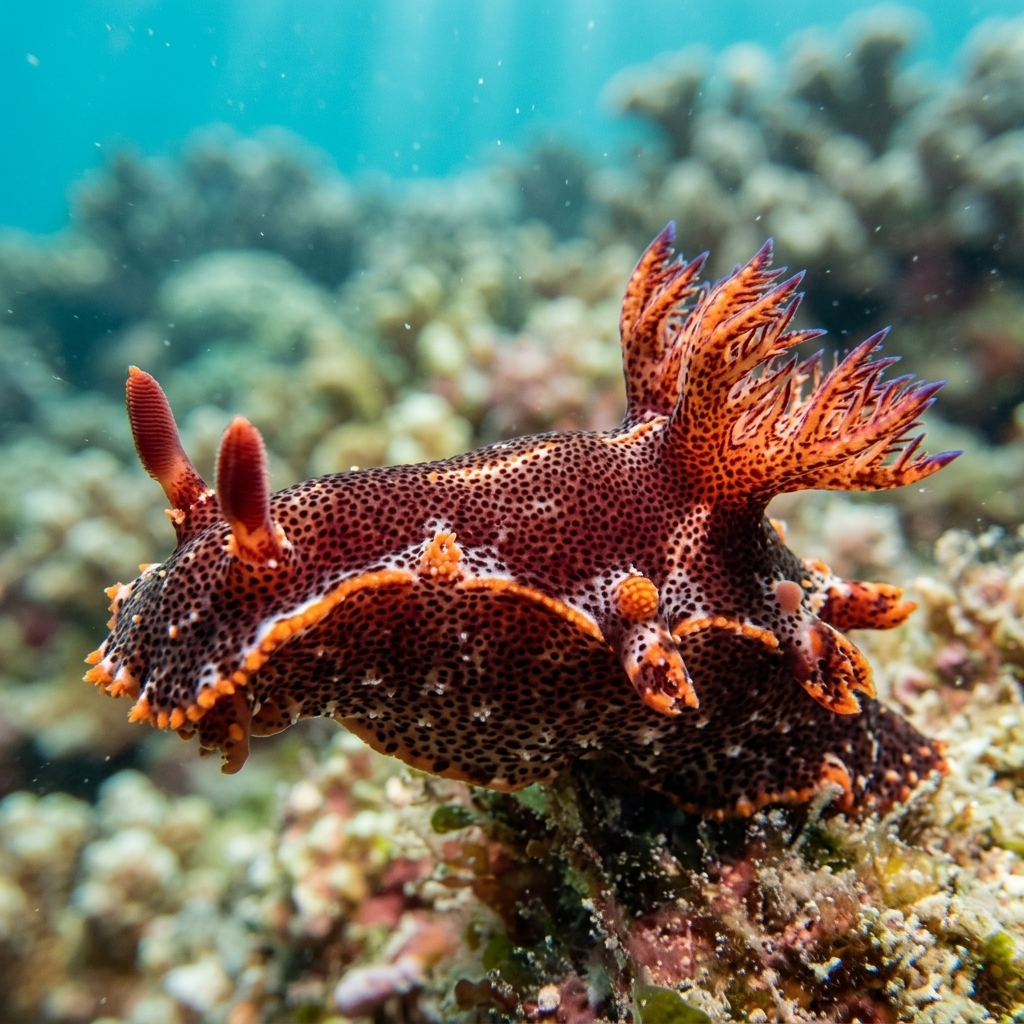
Plocamopherus imperialis
Spot Plocamopherus imperialis in New South Wales and Queensland, Australia between June and January in 18-24 °C water. Rare but unmistakable.
Look for a large, robust nudibranch body banded in vivid orange and white, with prominent club-like lateral appendages (parapodial lobes) lining each side, a feature shared by few other nudibranchs. The bushy gill plumes at the rear are often tipped with contrasting colour, making the back end just as eye-catching as the front. In the water it tends to move slowly along hard reef or rubble, which gives you time to confirm the distinctive paddle-like lobes before it tucks into a crevice.
Plocamopherus imperialis is most often spotted crawling slowly across rocky reef, rubble, or low-relief sponge gardens, typically at close range during a careful slow dive. It tends to ignore divers entirely, continuing along whatever path it was on. Encounters are usually solitary; finding two together is noteworthy.
Like other Plocamopherus species, this nudibranch is capable of bioluminescence, it can produce flashes of blue-green light from its lateral lobes, thought to startle or deter predators in the dark.
In the Southern Hemisphere, sightings concentrate from June through January, covering the cooler months into early summer when water temperatures sit in the 18-24 °C range that this species favours. There is no strong seasonal signal from Japan yet, so the Australian window is your best guide.
Almost all logged sightings come from Australia, with New South Wales, particularly around Sydney's shore dives and the central coast, accounting for the bulk of records, and Queensland contributing a solid cluster further north. A small number of sightings have been recorded around Japan's Izu Peninsula and Hachijojima. Outside these regions the species is essentially unrecorded.
Mapping where Plocamopherus imperialis is logged…
New South Wales, Australia is by far the most reliable place, with a strong cluster of records around Sydney's well-dived shore sites and the central coast. Queensland adds further sightings, and a small number have been logged around Japan's Izu Peninsula and Hachijojima. Outside Australia the species is rarely encountered.
In Australia, sightings concentrate between June and January. This spans cooler to mild water temperatures of roughly 18-24 °C, which appears to be the range this species favours. Winter and spring months in New South Wales are a solid window to target.
The bold orange-and-white banding combined with prominent paddle-like lobes running along both sides of the body are the key features to key on. No common look-alike shares that exact combination of banding and multiple lateral lobes, so if you see it, you can be fairly confident in the ID.
Yes. Like other members of the Plocamopherus genus, this species is capable of bioluminescence, producing flashes of blue-green light from its lateral lobes. This is thought to function as a defence, startling predators in low-light conditions. Night dives are the best context to witness it.
Site and sighting data is aggregated from diver logs, iNaturalist and GBIF. For taxonomy and conservation status:
Blue Dragon
3,163 sites