Platydoris sanguinea
Uncommon reddish-brown dorid most reliably found in Milne Bay, Papua New Guinea, on warm reefs from 25 to 31 C.
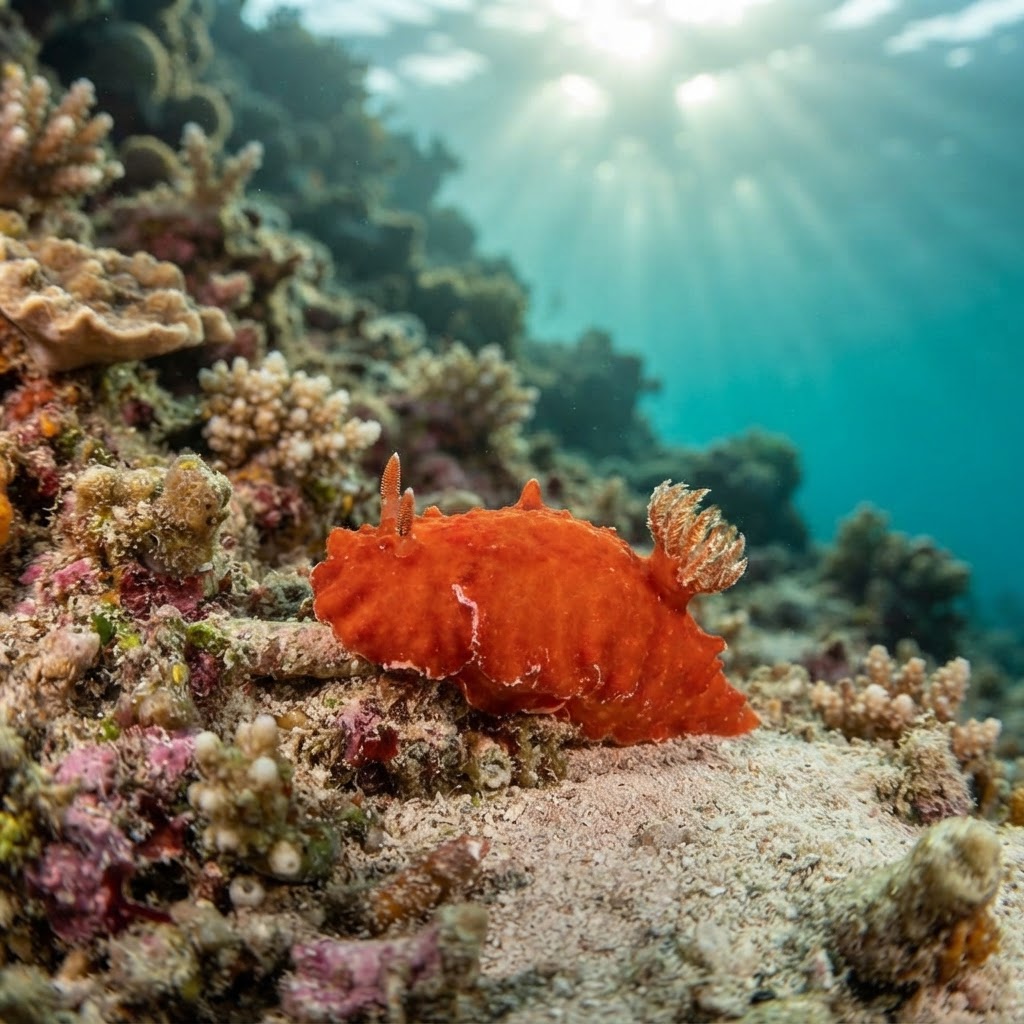
Look for a flat, oval-bodied sea slug with a thick, leathery mantle covered in small rounded tubercles (bumps), coloured in shades of brick red to reddish-brown. The rim of the mantle is often paler, giving a subtle two-tone edge that stands out against dark reef substrate. It sits low and broad on the reef rather than raised, and moves slowly enough to photograph without any chase.
Divers typically find this dorid parked on hard coral rubble or reef substrate during the day, barely moving as it grazes. It shows no reaction to divers beyond the occasional slow retraction if directly touched, making it an easy macro subject once spotted. Its low profile and matte colouring mean it is more often found by divers scanning close to the reef floor than by mid-water spotting.
Like other discodorid nudibranchs, it likely feeds on sponges, using the leathery, tuberculate mantle as both camouflage and a defence against predators that might otherwise find it an easy target.
Sightings span the year with no clear seasonal pattern in the data, consistent with a species living on warm tropical reefs between 25.4 and 31.4 C year-round. Plan around good conditions at your chosen site rather than a particular month.
Most consistently logged in Milne Bay, Papua New Guinea, where the majority of recorded sightings come from, with additional records from Bali in Indonesia and Luzon in the Philippines. Across all these sites divers should expect an uncommon find rather than a guaranteed one, so it rewards slow, careful reef scanning.
Mapping where Platydoris Sanguinea is logged…
The strongest records come from Milne Bay in Papua New Guinea, with further sightings in Bali, Indonesia, and Luzon in the Philippines. It is logged as uncommon at all known sites, so treat any sighting as a bonus rather than a certainty.
There is no detected seasonal pattern, and it turns up year-round on reefs sitting between 25.4 and 31.4 C. Dive whenever conditions suit your chosen site in Milne Bay, Bali, or Luzon.
Check for a flat, broad-bodied nudibranch with a leathery, tubercle-covered mantle in reddish-brown tones and a slightly paler mantle edge. It rests low on the reef and moves very slowly, which makes it easy to examine closely.
Exact size data isn't available for this species, but discodorid nudibranchs in this genus are generally small to moderate reef-dwellers typically found within easy macro-photography range.
No. It poses no threat to divers and can be observed or photographed up close without any risk.
As with related discodorid nudibranchs, it most likely grazes on sponges, using its tough, warty mantle for camouflage and protection while feeding slowly across the reef.
Site and sighting data is aggregated from diver logs, iNaturalist and GBIF. For taxonomy and conservation status:
Blue Dragon
3,163 sites