Thecacera pacifica
Bright yellow nudibranch with rhinophore "horns" spotted off Okinawa, Taiwan and the UAE's East Coast, uncommon but unmistakable once seen.
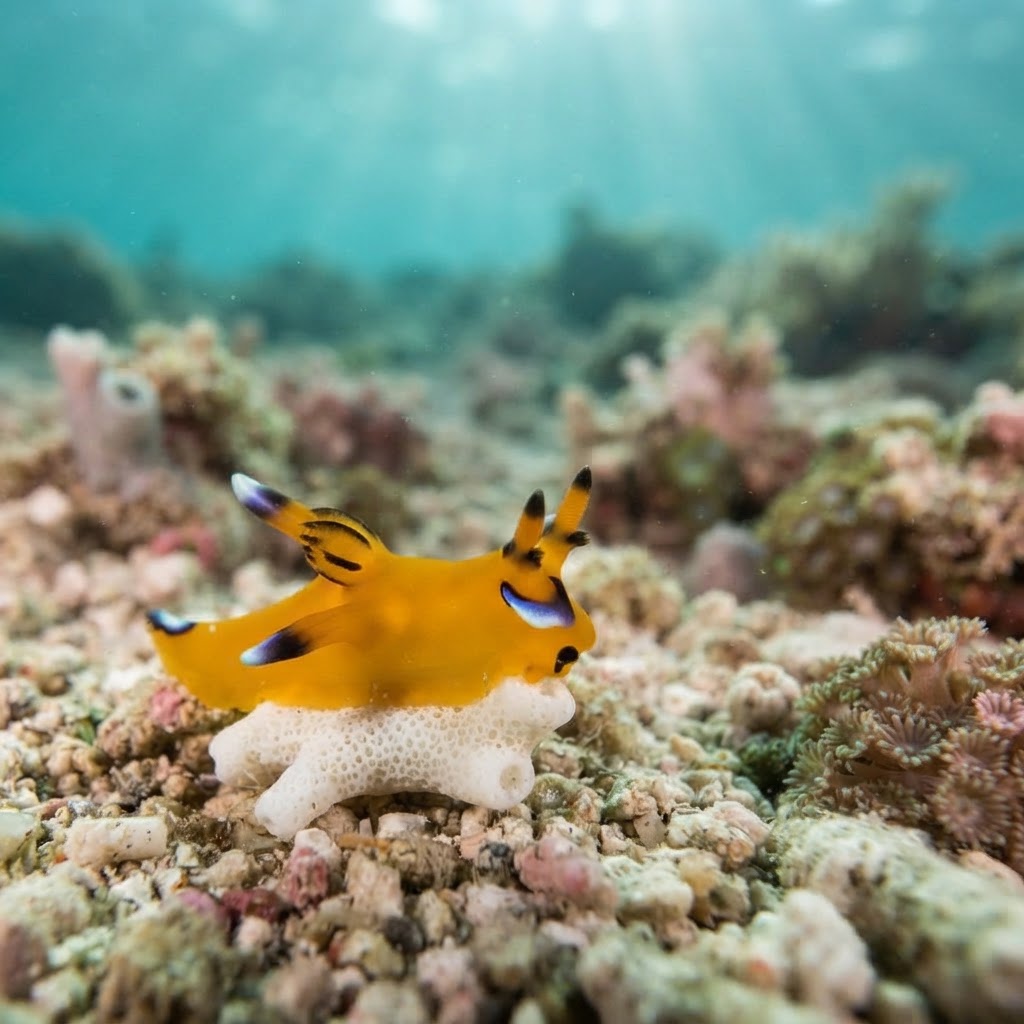
A small yellow nudibranch, rarely more than 3 cm long, with two tall orange rhinophores (sensory horns) tipped in black that give it its Pikachu nickname. A matching pair of orange, black-tipped gill-like projections sits toward the rear of the body, echoing the horns. The body is otherwise smooth and unmarked, which makes the four orange-and-black projections the easiest thing to key on against the plain yellow background.
Divers find it slow-moving over rubble, sand patches and low reef structure, grazing on the bryozoans it feeds on rather than swimming or fleeing. It shows little reaction to a hovering diver or a macro lens, which makes it a reliable subject once spotted, though its small size and matching background colour mean it is easy to swim past. Most sightings come from divers doing deliberate slow, close-focus searches rather than casual reef cruising.
The orange horn-like projections are not just decorative rhinophores; the matching pair at the rear are actually modified gills, so the animal effectively wears two look-alike sets of "antennae" front and back.
Sightings span a wide range from roughly 19 to 30 C, and there is no clear seasonal pattern in the data, so treat it as a year-round find at sites where it already occurs. It is logged as uncommon rather than rare, meaning patient reef scanning on any dive in season for that region is more useful than timing a specific month.
Most commonly logged in Japan, particularly Okinawa and the Ryukyu Islands and Central Japan, with a strong showing along the East Coast of the United Arab Emirates and in Western Australia. Smaller numbers turn up at Longdong in Taiwan and in the Visayas in the Philippines, so it is worth checking muck and rubble patches on Indo-Pacific reefs generally.
Mapping where Pikachu Longhorn Dorid is logged…
It is most reliably logged in Japan, especially Okinawa and the Ryukyu Islands and Central Japan, and along the East Coast of the United Arab Emirates. Western Australia also produces regular sightings, with occasional finds in Taiwan's Longdong and the Philippine Visayas.
There is no strong seasonal pattern in the sightings, so it is best treated as a year-round find at sites where it is already known to occur, given the wide temperature range it tolerates.
Look for a small yellow nudibranch under 3 cm with two tall orange, black-tipped rhinophores up front and a matching pair of orange gill projections at the rear. The plain yellow body makes those four horn-like marks the giveaway.
They are tiny, typically around 3 cm long, so spotting one usually takes a slow, close look at rubble and sand patches rather than a casual reef scan.
Its rear gill projections are shaped and coloured almost identically to its front rhinophores, giving it two matching sets of orange, black-tipped horns front and back, which is the origin of its Pikachu nickname.
Site and sighting data is aggregated from diver logs, iNaturalist and GBIF. For taxonomy and conservation status:
Light-spotted Aegires
3,168 sites