
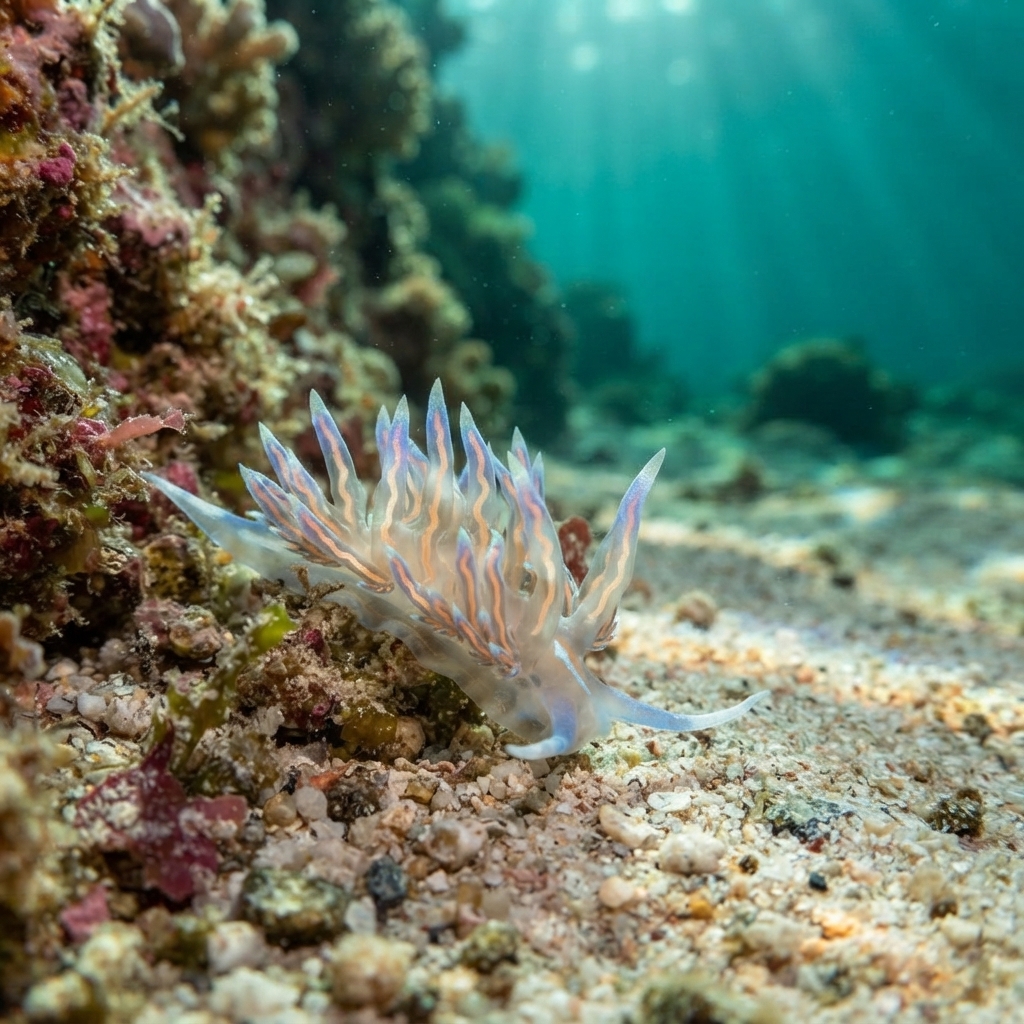
Phyllodesmium opalescens
A rare find on Queensland reefs and in Hong Kong's Sai Kung waters, this translucent nudibranch rewards divers who slow down and look close.
Look for a small, semi-translucent body with rows of finger-like projections (cerata) running down its back, often tinged with soft opal-like colours picked up from its diet. The body is soft and low-slung against the substrate, easy to miss unless you are scanning slowly. There is no strong size data logged, so treat it as a typical small nudibranch best found by checking rubble and soft coral patches closely rather than scanning open reef.
Divers find this nudibranch moving slowly over rubble, sponge patches and soft coral, grazing at its own pace with no reaction to a diver hovering nearby. It stays low and close to the substrate rather than out in open water, so most sightings come from divers doing a deliberate close search rather than a general reef swim. Given how rarely it turns up even at its known sites, patience and a slow macro-hunting pace matter more than dive timing.
Like many nudibranchs in its family, this species likely incorporates pigments or symbiotic algae from the soft corals it feeds on into its own tissue, which is part of why its colouring can look subtly opalescent rather than flat.
Sighting data shows no clear seasonal pattern, so treat it as a year-round possibility. Water temperatures where it has been observed range from 22.7 to 29.7 C, comfortably within tropical and subtropical reef conditions across all the countries where it is logged.
This one is most reliably logged in Queensland, Australia, with a strong scatter of sightings across Sai Kung in Hong Kong and Luzon and Mindanao in the Philippines. Queensland accounts for the bulk of records, making it the strongest bet if you are specifically hunting this species, though every logged site so far ranks it as rare to uncommon rather than a sure thing.
Mapping where Opalescent Phyllodesmium is logged…
Queensland in Australia has the strongest concentration of logged sightings, with additional records from Sai Kung in Hong Kong and Luzon and Mindanao in the Philippines. Even in these regions it is considered rare to uncommon, so it takes a dedicated macro search rather than a casual reef dive.
There is no detected seasonal pattern in the sighting data, so it is best treated as a year-round find. It has been observed across a wide temperature range from 22.7 to 29.7 C, which covers most of the diving calendar in its known regions.
Look for a small, soft-bodied nudibranch with translucent skin and rows of branching cerata along its back, sometimes carrying a subtle opal-like sheen. It stays low against rubble or soft coral rather than out in the open, so a slow close-up search is the best way to spot it.
No confirmed size range is available for this species in current sighting data. As with most members of its family, it is safe to expect a small, easily overlooked animal best searched for at close range rather than spotted from a distance.
It likely takes on colour and possibly nutritional benefit from the soft corals it feeds on, a trait shared across its family. This diet-linked appearance is part of why its colouring can look subtly translucent and iridescent rather than solid.
No, it poses no danger to divers. It is a small, slow-moving nudibranch with no venom or defence relevant to humans, so it can be observed and photographed at close range without any risk.
Site and sighting data is aggregated from diver logs, iNaturalist and GBIF. For taxonomy and conservation status:
Light-spotted Aegires
3,168 sites





