Phyllidiella pustulosa
Spot Pustular Phyllidia on warm Indo-Pacific reefs from the Philippines to Bali. Here's how to ID it and when to dive for the best chance of a sighting.
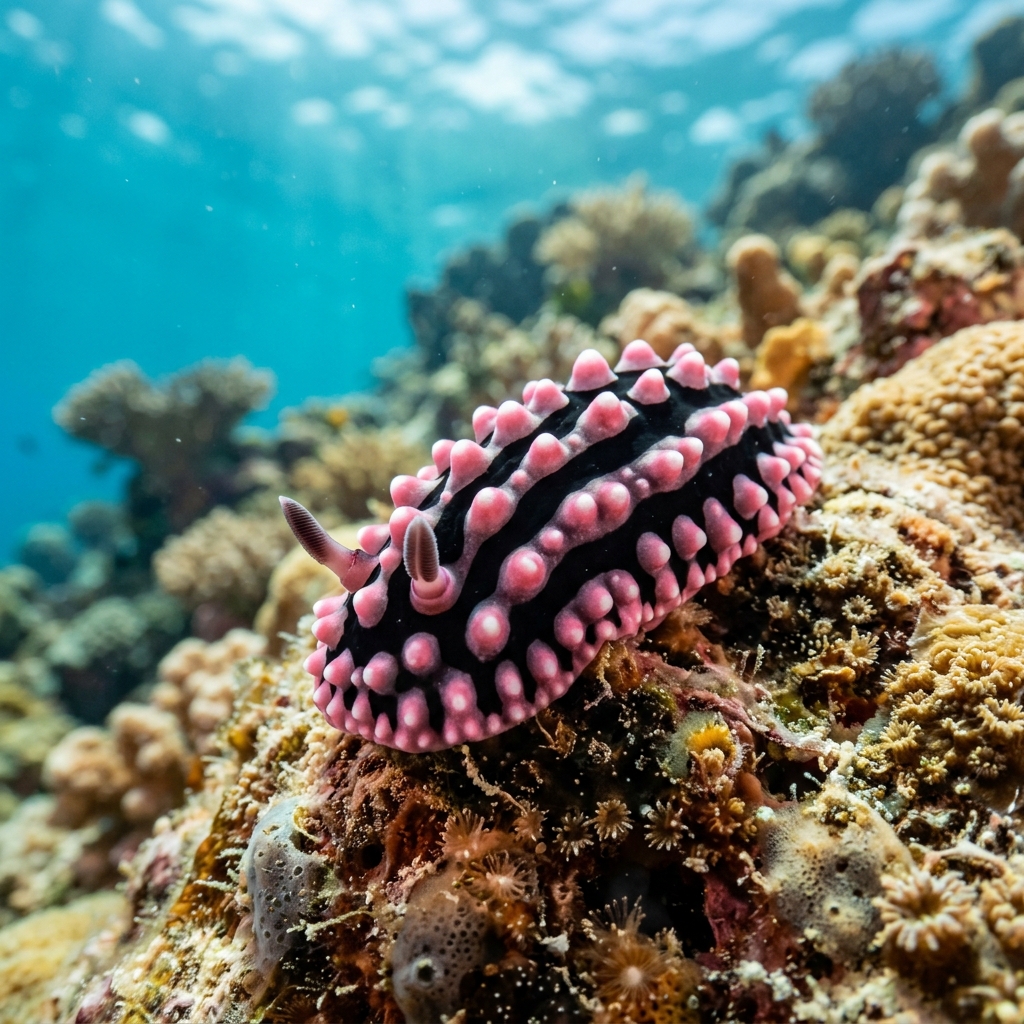
A compact, flattened nudibranch covered in raised, wart-like tubercles (bumps on the body surface) arranged in irregular clusters, typically cream or white against a black background. The tubercles are often tipped in yellow or orange, giving a speckled, almost alien appearance. It crawls slowly across hard substrate, staying low and close to the reef, which is usually how divers first spot it.
You will almost always find one crawling slowly over hard coral or rubble, grazing on the sponges and cyanobacteria that colonise reef surfaces. It shows little reaction to divers and will simply plod on regardless of how close you get, making it a relaxed macro photography subject. Look closely at the undersides of coral overhangs and on encrusting algae, especially during daylight dives.
Like other phyllidiid nudibranchs, Pustular Phyllidia stores toxic compounds from the sponges it eats and can secrete noxious chemicals through its skin as a defence against predators. This chemical arsenal is thought to be why the bright, contrasting colouration works as a warning signal rather than camouflage.
Sightings are recorded across nearly every month of the year in both hemispheres, which fits neatly with its preference for water temperatures between about 24 and 29 °C. If you are diving northern-hemisphere sites such as the Philippines or Japan, Dec through Sep shows the strongest concentration of records.
Most consistently logged across the Philippines, Indonesia, and Malaysia, with the Central Visayas in the Philippines and Bali, Lombok and Java in Indonesia standing out as the strongest regions. Pulau Tioman in Malaysia is also a reliable area, and divers in Hawaii and Okinawa report solid records too. The species turns up right across the Indo-Pacific wherever warm, shallow reef diving is available.
Mapping where Pustular Phyllidia is logged…
The Philippines and Indonesia lead the records, with Central Visayas and Bali among the most productive regions. Malaysia's Pulau Tioman, Hawaii, and Okinawa are also strong options. Broadly, any warm, shallow reef site across the Indo-Pacific is worth checking.
Sightings are spread across nearly every month of the year. For northern-hemisphere destinations like the Philippines, Japan, or Hawaii, records concentrate from December through September. The species is tied to warm tropical reef temperatures of roughly 24 to 29 °C, so there is rarely a hard off-season.
Look for a small, flattened nudibranch with a strongly contrasted black body covered in irregular clusters of raised white or cream tubercles, often tipped in yellow or orange. It moves slowly across reef substrate, which makes the warty texture and bold colouration easy to key on once you are searching at macro scale.
Typical individuals encountered on reef dives are small, generally in the range of 2 to 5 cm in length, though the species can reach around 6 cm. Their compact size means they are easy to overlook unless you are actively hunting the rubble and coral surfaces where they graze.
No. They pose no threat to divers whatsoever. The toxic skin secretions they use against predators are only relevant if the animal is handled or ingested, so simply observe and photograph without touching and there is nothing to worry about.
The high-contrast black and white pattern is aposematic colouration, a visual warning to predators that the animal is toxic or unpleasant to eat. Pustular Phyllidia accumulates defensive chemicals from the sponges it grazes on and can release them through the skin. The louder the pattern, the stronger the signal to anything that might consider taking a bite.
Site and sighting data is aggregated from diver logs, iNaturalist and GBIF. For taxonomy and conservation status:
Light-spotted Aegires
3,168 sites