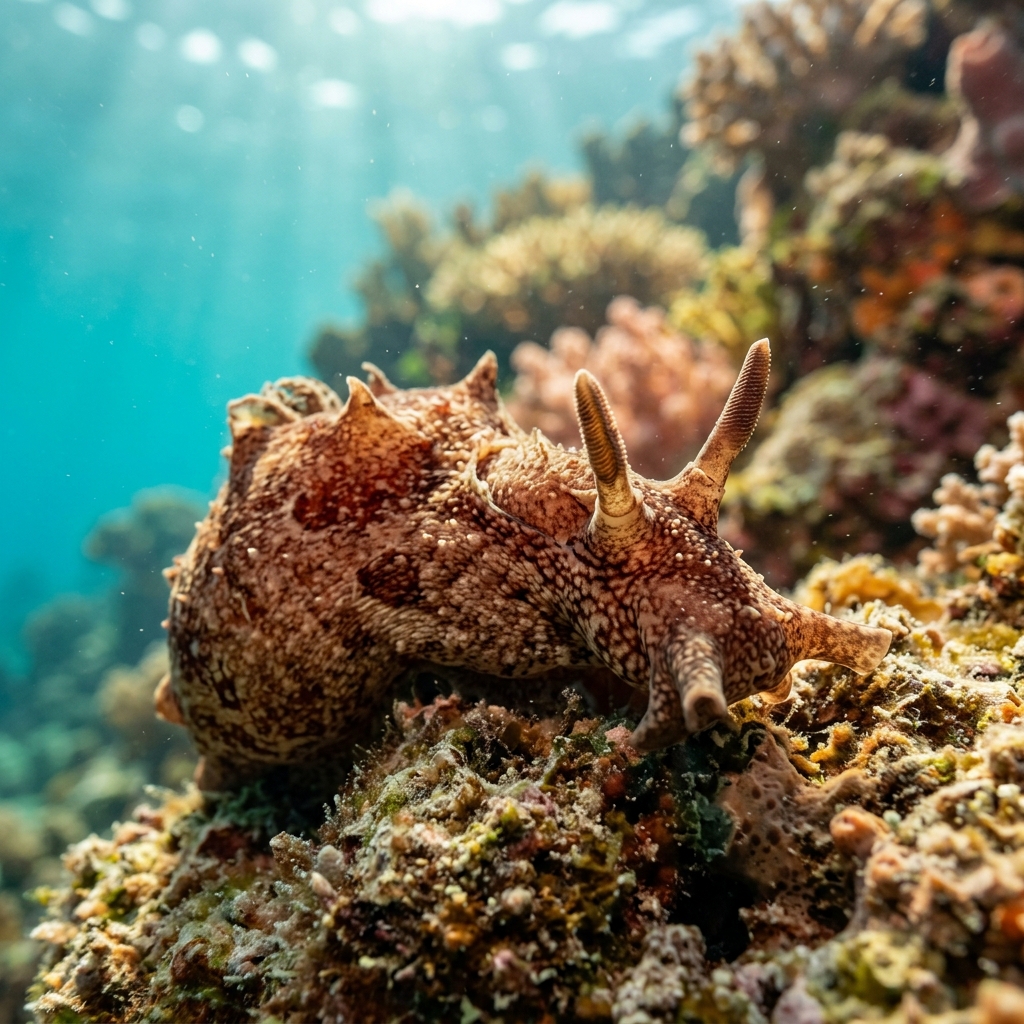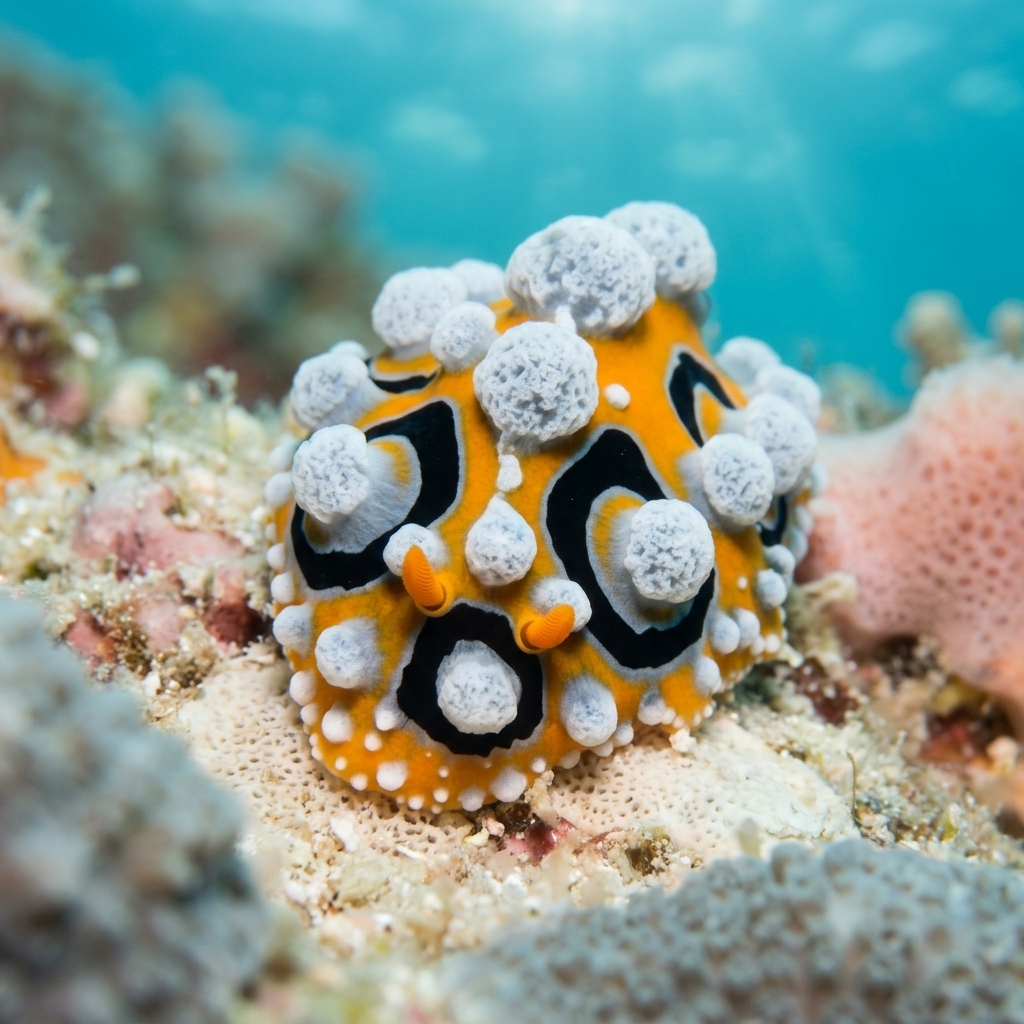
Phyllidia ocellata
Spot the Ocellated Wart Slug in the Philippines, Bali, or Sipadan. A warm-water nudibranch most logged year-round across Indo-Pacific reefs.
Chunky and flattened, this phyllidiid nudibranch carries rows of firm, wart-like bumps called tubercles arranged across a pale white or grey body. Each tubercle is tipped in yellow and ringed with black, giving the animal a distinctive spotted, almost beaded appearance. It lacks the exposed gills seen on most other nudibranchs, breathing instead through a groove around its body margin. On a coral reef it stands out against dark rock, but its slow pace and small footprint mean it is easy to miss unless you are actively searching.
When divers encounter it, the Ocellated Wart Slug is almost always on the move across hard substrate, rubble, or encrusting sponge, slowly grazing. It does not react strongly to diver presence and rarely stops, so you get a brief window to observe before it tucks into a crevice. Look low on the reef, especially on shaded walls and under ledges, where it tends to be most active.
Like other phyllidiids, this species is thought to sequester toxic compounds from the sponges it feeds on, making it unpalatable to most predators. Its conspicuous colouration is a direct advertisement of that chemical defence, a strategy known as aposematism.
In the Northern Hemisphere, sightings are spread across all months with no concentrated peak, reflecting the species' preference for consistently warm water in the 27 to 29 °C range found on year-round tropical reefs. In the Southern Hemisphere, sightings tend to concentrate between October and January, aligning with the austral summer warm season.
Most commonly logged in the Philippines, particularly across Luzon and the Visayas, and in Bali, Lombok, and Java in Indonesia. Strong populations are also recorded around Sipadan and East Sabah in Malaysia, making the Coral Triangle the core of its range. Outside that hotspot, divers regularly log it in Mauritius, Tanzania, the Seychelles, and Australia.
Mapping where Ocellated Wart Slug is logged…
The Philippines leads all records, with the Luzon and Visayas regions particularly productive. Bali and Sipadan are the next best bets, and Mauritius, Tanzania, and the Seychelles offer reliable sightings further west in the Indo-Pacific.
Across the Northern Hemisphere tropics, including the Philippines, Malaysia, and Indonesia, it can be found year-round with no standout season. In southern destinations such as Australia and Mauritius, sightings peak during the austral summer from October through January.
Look for a small, flat nudibranch covered in neat rows of yellow-tipped, black-ringed bumps on a pale body. Unlike most nudibranchs, it has no visible external gills. That warty, beaded texture combined with the ringed colouration is the key feature to key on.
No. They are entirely harmless to divers. Like many phyllidiids, they carry chemical defences derived from their sponge diet, but these only matter to potential predators, not to humans observing them underwater.
Exact size data for this species is not well documented in diver records. Most phyllidiid nudibranchs in this family reach roughly two to five centimetres in length, and underwater they tend to look compact and low-profile against the reef.
The bold yellow and black patterning is a classic example of aposematism, a warning signal to potential predators that the animal is toxic or unpalatable. Phyllidiids feed on sponges and concentrate the sponges' noxious chemicals in their own tissues, making the advertisement honest and effective.
Site and sighting data is aggregated from diver logs, iNaturalist and GBIF. For taxonomy and conservation status:
Light-spotted Aegires
3,168 sites