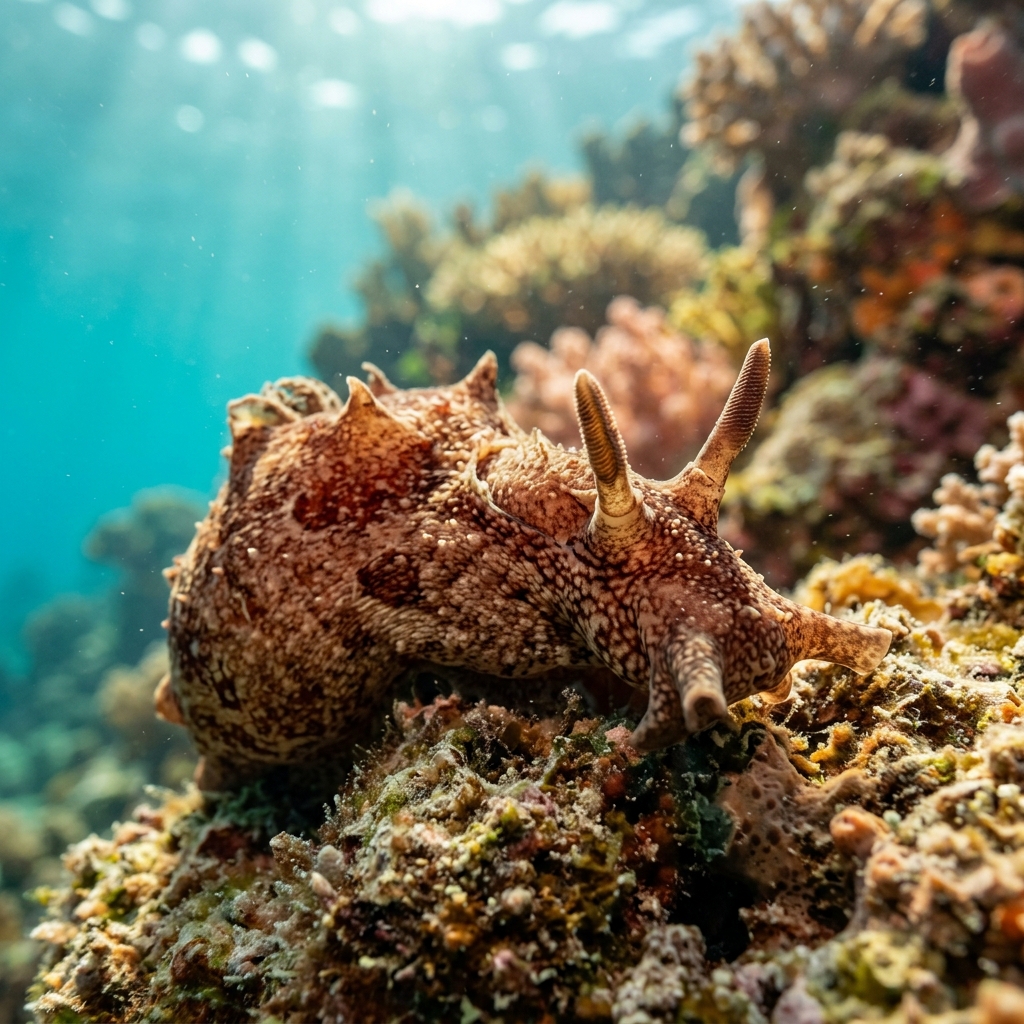
Phidiana spp.
Spotted stalked slugs turning up on reefs from Colombia's Caribbean coast to Rio de Janeiro, year-round, no set season needed.
Look for a slender slug body covered in finger-like projections called cerata, usually banded or tipped in orange, brown or white depending on the species in this genus. Two pairs of tentacles project from the head, the upper pair often ringed and the lower pair smooth, giving it a slightly spiky, bristled silhouette against bare rock or rubble. Most individuals logged by divers are small, a few centimetres at most, and easy to miss unless you are scanning close to the substrate.
Divers find these slugs slow-moving across rubble, sponge and hydroid-covered surfaces, usually during the day when doing a close macro-focused look at the substrate rather than mid-water scanning. They pay no attention to divers and simply keep grazing, making them an easy subject once spotted, though their small size and mottled colouring mean most people swim straight past without noticing.
Members of this genus feed on hydroids and can store stinging cells from their prey in the tips of their cerata, reusing them as a defence, the same trick used by several other aeolid nudibranch groups.
Sightings show no detectable seasonal pattern, and the observed temperature range of 12.3 to 28.3 C spans everything from cool New Zealand water to warm Caribbean reef, so it is worth looking for on any dive, any month, in the right habitat.
This genus turns up most reliably along the Caribbean Coast of Colombia and around Florida in the United States, with strong logging in Rio de Janeiro and Pernambuco in Brazil and across Jardines del Rey in Cuba. New Zealand's North Island is another dependable region, giving this genus an unusually wide geographic spread from tropical Caribbean sites to cooler Kiwi waters.
Mapping where Phidiana Nudibranch is logged…
Best logged along Colombia's Caribbean Coast, around Florida, in Rio de Janeiro and Pernambuco in Brazil, across Jardines del Rey in Cuba, and on New Zealand's North Island.
There is no clear season in the sighting data, and the genus has been logged from 12.3 to 28.3 C, so it is a reasonable find on any dive throughout the year.
Check for a slim body covered in finger-like cerata, often tipped orange or brown, with two pairs of head tentacles giving a slightly bristled look. Size is small, typically a few centimetres, and they are usually found crawling slowly over rubble or hydroid-covered surfaces.
Exact size data is not confirmed for this genus, but divers typically log individuals as small, macro-scale slugs a few centimetres long rather than large, easily spotted animals.
They graze on hydroids and can recycle the stinging cells from their prey, storing them in the tips of their cerata to use as their own defence against predators.
No, they pose no threat to divers. They are small, slow-moving grazers that ignore approaching divers entirely.
Site and sighting data is aggregated from diver logs, iNaturalist and GBIF. For taxonomy and conservation status:
Light-spotted Aegires
3,168 sites