
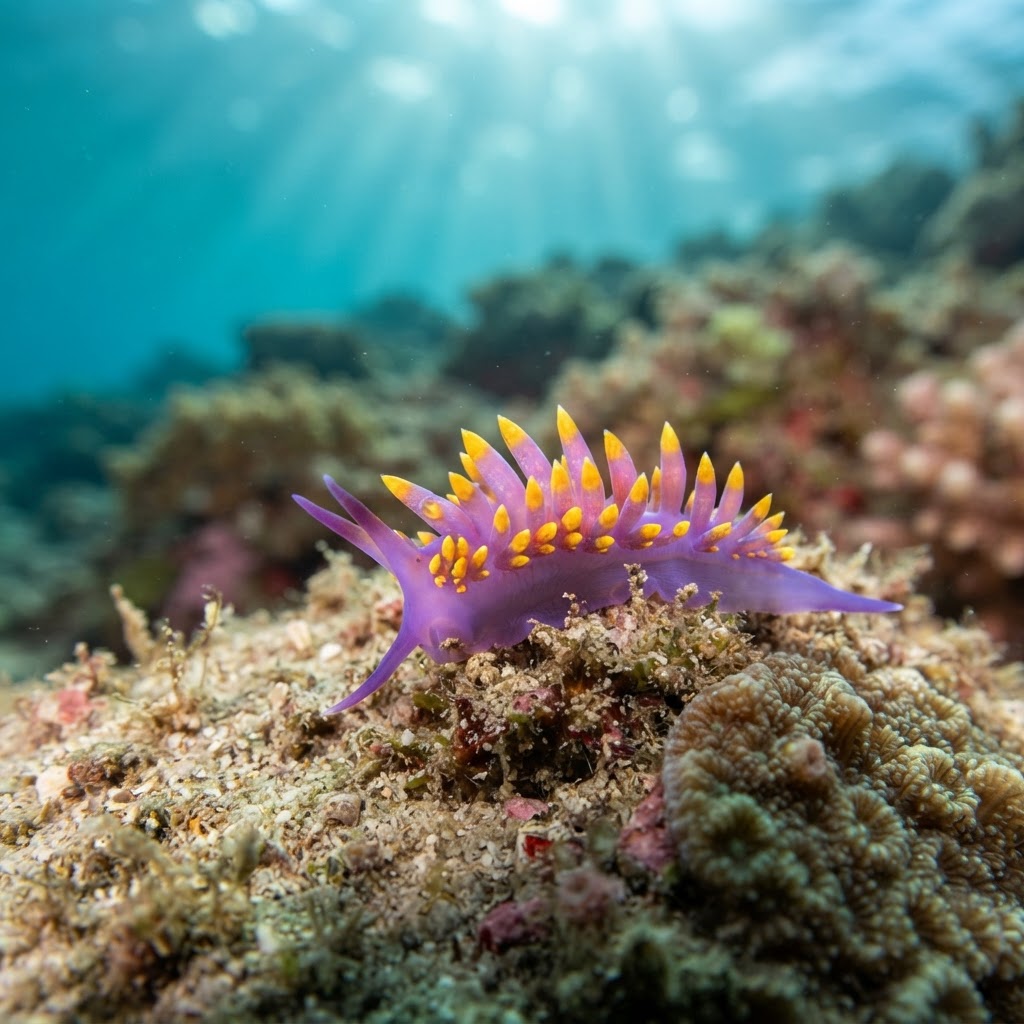
Phestilla sibogae
Uncommon but reliably found on coral reefs in Sihanoukville and KwaZulu-Natal, thriving year-round in warm 23-30C water.
A small, slender nudibranch (sea slug) whose back is covered in finger-like projections called cerata, usually pale cream to brown with orange or brown tips that pick up colour from the coral it has been eating. The body tapers to a narrow tail, and the two rhinophores (sensory tentacles) on the head are simple and unadorned compared with showier nudibranch families. Look closely at coral colonies rather than open rock, since this species blends into its host's tissue and only stands out once your eye adjusts to the texture.
Found slowly grazing across the surface of its coral host, often a Porites colony, where it feeds directly on the coral polyps rather than algae or sponges. It moves at the unhurried pace typical of nudibranchs and shows no reaction to divers beyond retracting slightly if touched. Most sightings happen during daylight reef dives when divers scan coral heads closely rather than swim past them.
This species feeds exclusively on stony coral polyps of the genus Porites, making it one of the relatively few nudibranchs that specialises in eating live coral tissue rather than sponges, hydroids, or algae.
Sightings are spread across the year with no clear seasonal peak in the data, which fits its comfort range of roughly 23 to 30C, warm enough on tropical and subtropical reefs for most of the year. Plan any dedicated search around calm, clear conditions rather than a specific month.
Most commonly logged on reefs in Australia and the Philippines, with strong numbers also reported from Cambodia's Sihanoukville coast and South Africa's KwaZulu-Natal region. It also turns up with some regularity around Ponta do Ouro in Mozambique, Alofi in Niue, and select sites in the Philippine Visayas and Luzon.
Mapping where Porites-eating Nudibranch is logged…
It is most reliably reported on reefs in Australia and the Philippines, with good numbers also logged around Sihanoukville in Cambodia and KwaZulu-Natal in South Africa. Smaller but consistent populations appear near Ponta do Ouro in Mozambique and Alofi in Niue.
There is no strong seasonal pattern in sightings, and its warm-water comfort range of about 23 to 30C means it can be found on tropical reefs throughout the year. Any calm-water reef dive session in its known regions gives a fair chance of spotting one.
Look for a small, slender nudibranch covered in cerata (finger-like projections) tipped in orange or brown, usually crawling directly on coral tissue rather than open substrate. Its plain rhinophores and coral-matching colouring make it easy to overlook unless you scan coral heads slowly.
Exact size data is not available, but like most members of its family it stays small, typically only a centimetre or two long, which is part of why it is easy to miss on a reef.
It feeds directly on the living polyps of Porites coral, one of the few nudibranchs specialised to eat coral tissue rather than sponges or hydroids. This tight relationship with its coral host also explains why its colouring often blends so closely with the coral surface.
No, it poses no risk to divers. It has no venomous sting or bite of concern to humans and simply grazes quietly on coral polyps.
Site and sighting data is aggregated from diver logs, iNaturalist and GBIF. For taxonomy and conservation status:
Light-spotted Aegires
3,168 sites





