Caloria elegans
Small orange-tufted nudibranch turning up in dive logs across the French Riviera, the Balearics and Gozo, mostly in cooler 15-21C water.
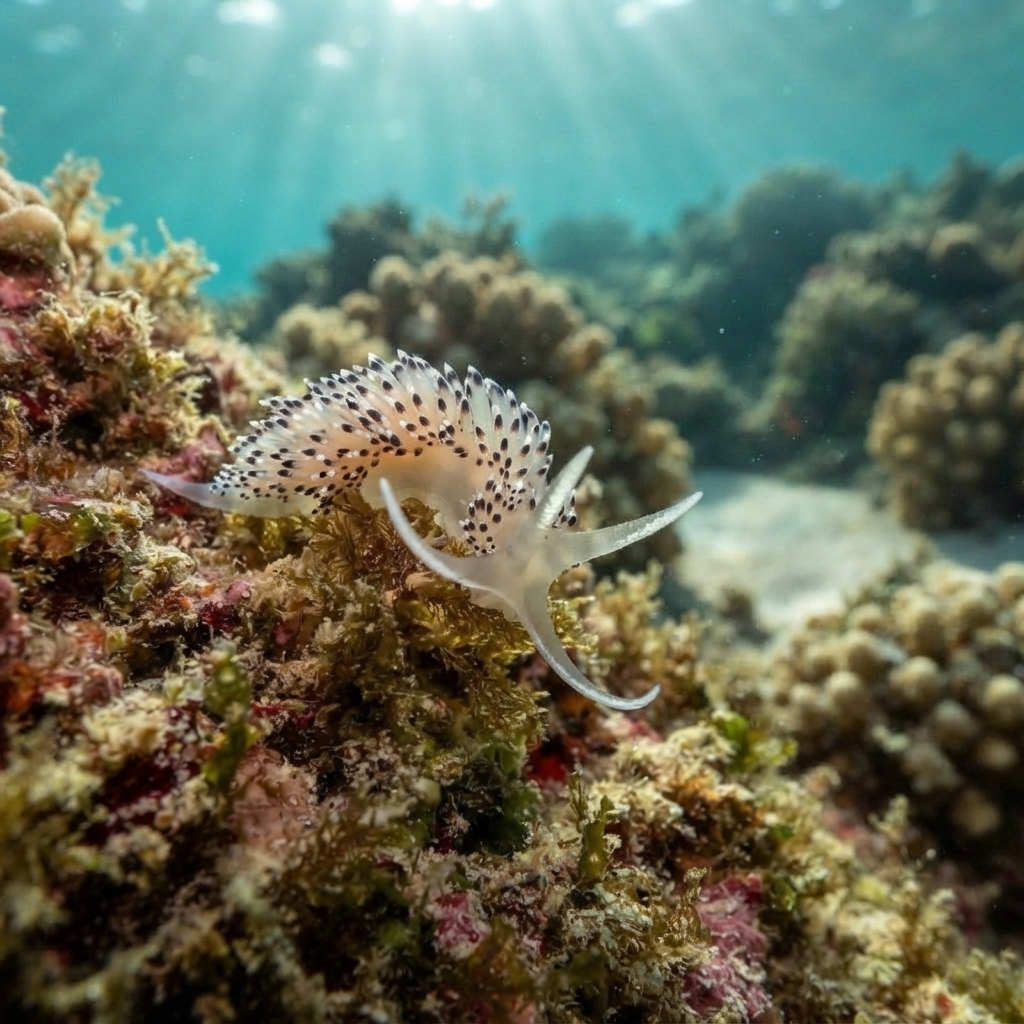
Look for a slender, translucent white to pale body covered in dense clusters of finger-like projections called cerata, each tipped in orange to reddish-brown, giving the speckled 'pepper and salt' look the common name refers to. The head carries a pair of long, tapering rhinophores (sensory tentacles) that usually match the cerata colouring. It sits low against rock and algae and rarely grows large enough to catch a passing diver's eye without a close look.
Divers find it grazing slowly over rock, rubble and algae-covered surfaces, feeding on the hydroids it shares its colour palette with. It shows no reaction to divers beyond the usual slow retraction if disturbed, and like most nudibranchs it's an easy subject for a macro lens rather than something that flees. Most logs describe it as uncommon rather than abundant, so a careful eye scanning rocky substrate is usually what turns one up.
Like other aeolid nudibranchs, it can store stinging cells from the hydroids it eats inside its own cerata, turning its food's defences into its own.
Sightings are spread across the year with no clear seasonal spike in the data, so treat it as a year-round find wherever it occurs. It's logged in water from about 15 to 21C, which fits the cooler-to-mild conditions typical of Mediterranean and Atlantic dive sites outside peak summer.
This is a reliable find across the Mediterranean and nearby Atlantic coast, most commonly logged in France, particularly the French Riviera and Provence and Corsica, and in Spain across the Balearic Islands and Andalusia. It also turns up consistently around Gozo and Malta, along Portugal's Lisbon Coast, and in smaller numbers in Greece, Italy and southern England.
Mapping where Pepper-and-salt Slug is logged…
It's most consistently reported in France along the French Riviera and Corsica, in Spain's Balearic Islands and Andalusia, and around Gozo and Malta. Portugal's Lisbon Coast and parts of southern England and Greece also produce regular sightings.
There's no strong seasonal pattern in the sightings, so it can be found year-round. It's typically logged in cooler water between about 15 and 21C, conditions common outside the height of summer in the Mediterranean and Atlantic.
Check for a slim, pale white body covered in dense orange-tipped cerata and a pair of matching rhinophores on the head, giving a speckled look against the rock it sits on. It's a small, unhurried nudibranch usually found grazing on hydroid-covered surfaces.
No, it poses no risk to divers. It's a small, slow-moving grazer that has no interest in and no real interaction with anyone passing by.
It feeds on stinging hydroids and can repurpose their stinging cells for its own defence, storing them in the tips of its cerata. This trick, called kleptocnidae, is shared across many aeolid nudibranchs.
Site and sighting data is aggregated from diver logs, iNaturalist and GBIF. For taxonomy and conservation status:
Light-spotted Aegires
3,168 sites