Peltodoris atromaculata
Spot the cow snail across the French Riviera, Costa Brava and Croatian coastlines. Present year-round in cooler Mediterranean waters from 13-22 °C.
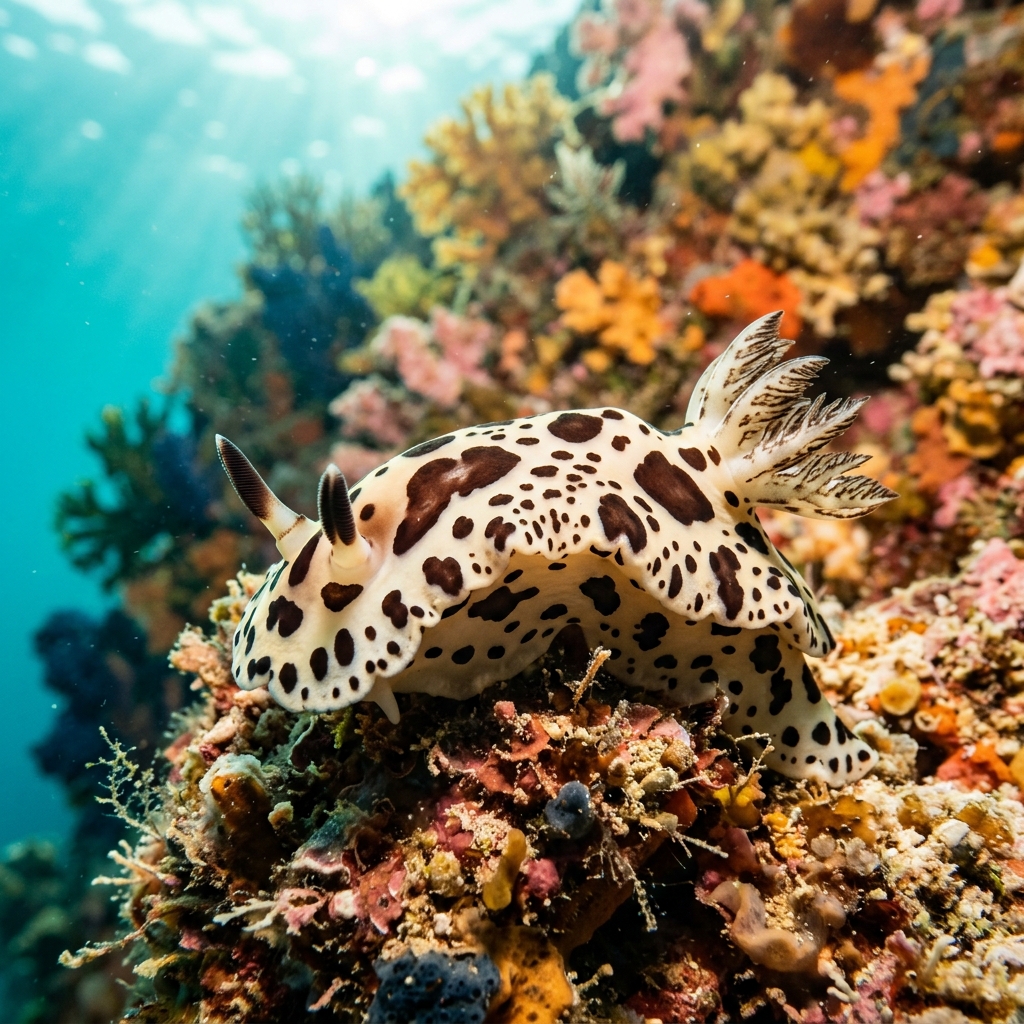
Pale cream or white body covered in bold, irregular dark brown to black blotches gives this nudibranch its bovine nickname and makes it one of the more distinctive dorids (disc-shaped sea slugs) in the Mediterranean. The mantle is noticeably broad and flat with a velvety texture, and the gills and rhinophores (sensory horns) are typically dark-tipped, contrasting sharply with the pale background. Most individuals encountered underwater sit in roughly the 3-8 cm range, though the body contracts when disturbed, making size a poor field guide on its own.
You will almost always find it moving slowly across rocky, encrusting-sponge reef, where it feeds on the dark-coloured sponge Petrosia ficiformis, if you see that sponge, scan it carefully. It shows little concern for divers and continues grazing steadily rather than curling up or fleeing, making close observation straightforward. Individuals are typically solitary, though encounters become easier as your eye learns to pick out the spotted pattern against the mottled reef background.
The cow snail is a specialist feeder: it eats almost exclusively the sponge Petrosia ficiformis, so its distribution tracks that of its prey. Knowing where that dark, smooth-surfaced encrusting sponge grows on a dive site is often the quickest way to find one.
Sighting data shows the cow snail present year-round with no concentrated season, which fits its cool-temperate niche, it thrives in water between roughly 13 and 22 °C, exactly the range the Mediterranean and nearby Atlantic coastlines deliver across most months.
Reef neighbours a diver could mistake it for. Use the identification notes above to tell them apart.
Most commonly logged across France, Spain, Croatia, and Italy, with the French Riviera and Provence standing out as the single richest area for sightings. The Costa Brava in Spain and the Kvarner Gulf in Croatia are also strong bets, and divers regularly encounter it around Sardinia and the Cyclades. Outside the Mediterranean heartland, populations have been recorded in the Canary Islands, the Azores, and mainland Portugal.
Mapping where Cow Snail is logged…
The best-represented areas are the French Riviera and Provence, the Costa Brava in Spain, and the Kvarner Gulf in Croatia. Italy's Sardinian and Tuscan coasts, the Greek Cyclades, and Atlantic outposts like the Canary Islands and the Azores also produce regular sightings.
Diver records show it present across all months with no obvious peak season. It favours cooler water, roughly 13 to 22 °C, so Mediterranean and northeast Atlantic dive sites stay within its comfort zone for much of the year.
Look for a broad, flat, velvety nudibranch with a cream-white base colour and large, irregular dark brown or black blotches, the pattern really does resemble dairy-cow markings. The dark-tipped gills and rhinophores add a second confirmation. It is usually found crawling on or near dark encrusting sponge.
Most individuals seen underwater measure roughly 3 to 8 cm in length. The body contracts noticeably when the animal is disturbed, so a stressed specimen can look considerably smaller than a relaxed, actively feeding one.
It feeds almost exclusively on the sponge Petrosia ficiformis, a dark, smooth encrusting sponge common on shaded Mediterranean rocky reef. This dietary specialisation means finding the sponge is often the most reliable strategy for finding the nudibranch.
Site and sighting data is aggregated from diver logs, iNaturalist and GBIF. For taxonomy and conservation status:
Light-spotted Aegires
3,168 sites